
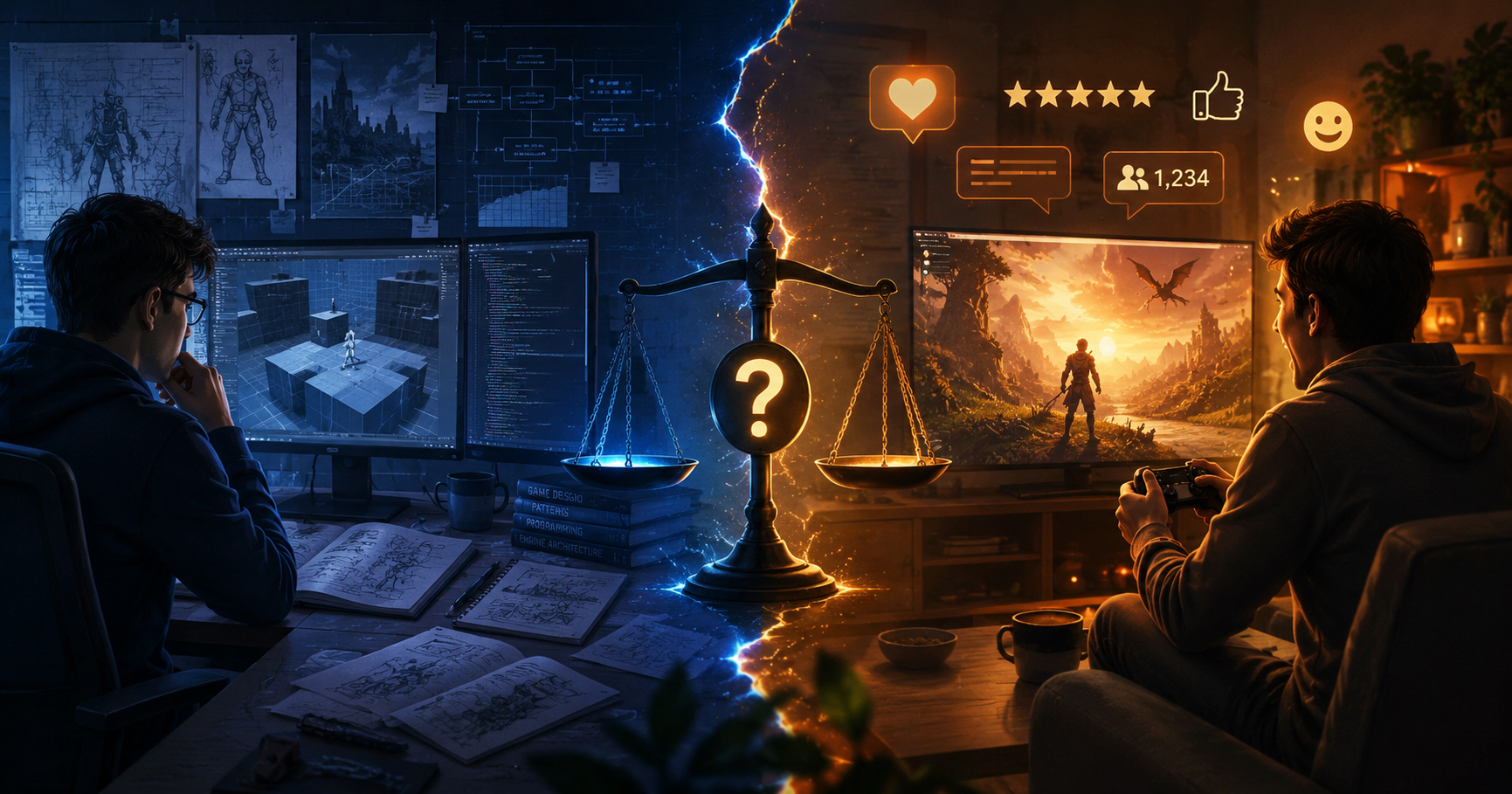
Making a Good Game vs. Making a Game Players Actually Want

When developing an indie game, one question comes up more often than people admit:
Should we focus on making a “good game,” or should we focus on making a game that actually speaks to players?
At first, these sound like the same thing. A good game should naturally attract players, right? In reality, it is not always that simple.
A game can be technically solid, visually polished, and well-designed on paper, but still fail to create a strong connection with its audience. On the other hand, a game with rough edges can sometimes reach players deeply because it understands exactly what kind of experience they are looking for.
This difference is especially important for indie developers.
A “Good Game” Is Not Always Enough
As developers, we often judge our own games from a production perspective.
We ask questions like:
Are the mechanics working?
Is the lighting good?
Are the animations acceptable?
Is the level design clear?
Are there enough features?
Does the game look professional?
These questions matter. A game still needs quality, structure, and technical stability. But players usually do not experience a game as a checklist.
Players remember feelings.
They remember tension, curiosity, frustration, surprise, comfort, fear, satisfaction, or emotional impact. They remember whether the game gave them a reason to continue.
A game can be “good” in a technical sense and still feel forgettable if it does not create a clear emotional or experiential hook.
Players Do Not Buy Features, They Buy Expectations
This is something I learned more clearly while working on indie horror projects and Steam publishing.
Players do not usually approach a game by saying, “I want a game with seven mechanics, high-resolution textures, and a three-hour runtime.”
Instead, they usually come with an expectation:
“I want to feel scared.”
“I want to explore something mysterious.”
“I want a tense experience.”
“I want to solve something.”
“I want a cozy world.”
“I want fast action.”
“I want to be surprised.”
If your game does not understand that expectation, even strong production quality may not be enough.
For example, in a horror game, the player is not only judging the monster model, the environment, or the number of jumpscares. They are judging whether the game makes them feel unsafe, curious, watched, or uncertain.
That feeling is the real product.
Making a Game for Players Does Not Mean Chasing Trends
There is also a dangerous misunderstanding here.
Making a game that appeals to players does not mean blindly following trends. It does not mean copying whatever is popular. It does not mean removing your creative identity.
Actually, I think the opposite is true.
A strong game needs both:
A clear creative identity
and
A clear understanding of the player experience
If a game only follows trends, it becomes generic.
If a game only follows the developer’s personal taste, it may become disconnected from its audience.
The balance is the hard part.
As developers, we need to ask:
Who is this game for?
What do they expect to feel?
What promise does the game make in its trailer, screenshots, store page, and first minutes?
Does the actual gameplay deliver that promise?
Steam Makes This Even More Important
On Steam, players make decisions quickly.
The capsule image, screenshots, trailer, short description, tags, and reviews all create expectations before the player even launches the game.
If the store page promises one experience but the game delivers another, players feel misled even if the game itself has good elements.
This is why “player fit” matters.
A game does not need to appeal to everyone. In fact, most indie games should not try to appeal to everyone. But it should strongly appeal to the right players.
For a horror game, that might mean focusing less on feature quantity and more on atmosphere, pacing, sound, uncertainty, and tension.
For a management game, it might mean focusing on satisfying loops, clear progression, readable systems, and player agency.
For a narrative game, it might mean emotional pacing, character motivation, and meaningful choices.
Different audiences value different things.
The Best Version Is Both
So, should we make a good game or a game that players want?
The honest answer is: both, but in the right order.
First, understand the player experience you are trying to create.
Then build the game quality around that experience.
A polished game without a clear audience can feel empty.
A marketable idea without quality can disappoint players.
But when a game has both a strong identity and a clear understanding of its audience, it has a much better chance to connect.
For indie developers, this can also help reduce wasted work. Instead of adding features just because they seem impressive, we can focus on the elements that strengthen the core experience.
In my opinion, the question should not be:
“Is this game good?”
It should be:
“Is this game good for the players it is trying to reach?”
That small difference changes many design decisions.
It affects the mechanics, pacing, visuals, trailer, store page, difficulty, feedback, and even the scope of the project.
Final Thought
A good game is not only a game that works well.
A good game is one that understands its promise, respects its audience, and delivers the experience players came for.
For indie developers, this may be one of the most important lessons: technical quality matters, but connection matters more.
Players may forgive small imperfections if the experience speaks to them.
But they rarely remember a game that is polished, correct, and emotionally empty.
-Huseyin Onur
Discussion