
The D7/D1 Retention Ratio for Mobile Games - A Complete Guide
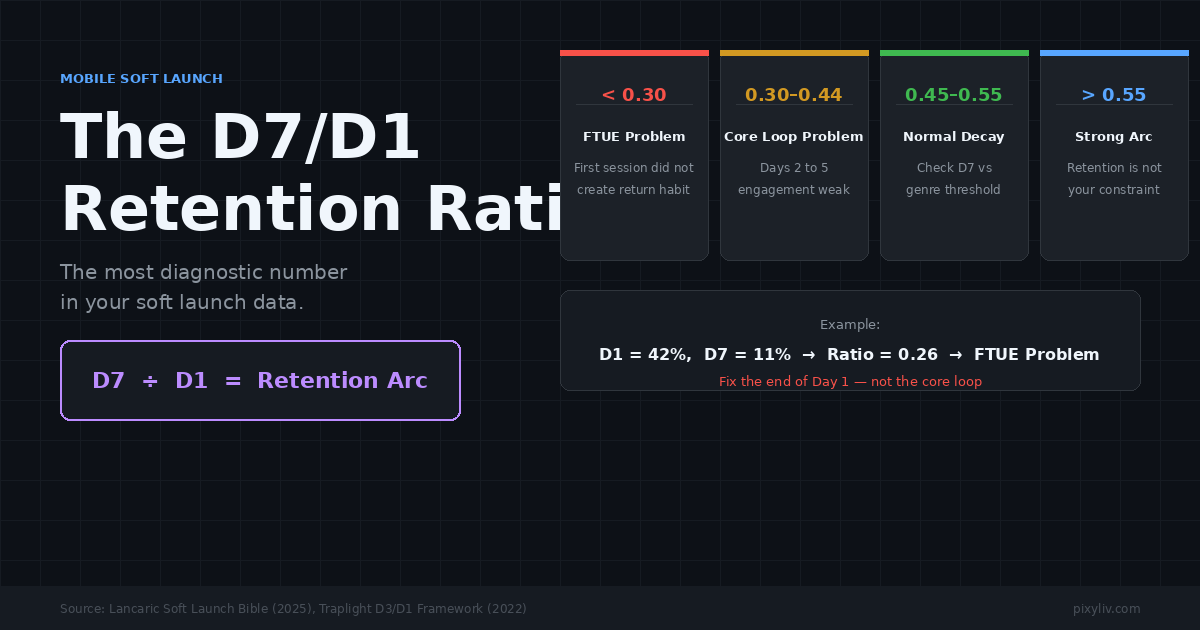
Most mobile game studios track D1 and D7 retention separately. But the ratio between them - D7 divided by D1 - is more diagnostic than either number alone. It tells you not just that retention is low, but where in the player journey it is breaking down.
This is the framework practitioners use to diagnose retention problems during soft launch before spending more on UA.
How to Calculate the D7/D1 Ratio
D7 ÷ D1 = Retention Arc
Example: D7 = 14%, D1 = 40% → Ratio = 0.35
The ratio describes the shape of your retention curve. A ratio of 0.35 means you are retaining 35% of your Day 1 players through to Day 7. The question is whether that is normal decay or a signal of a specific problem.
How to Interpret Each Ratio Band
Below 0.30
FTUE Problem: First Session did not create a return habit
Players opened Day 1 but did not come back by Day 7. The first session experience did not give them a reason to return. This is a Day 1 design problem, not a core loop problem.
Where to look: End of Day 1 session. Does the game leave an unresolved goal? Is there a clear return hook - a reward waiting, a challenge unfinished, a narrative thread open?
0.30 to 0.44
Core Loop Problem: Days 2 to 5 engagement is weak
Players came back after Day 1 but dropped off before Day 7. The first session worked but the game did not sustain engagement in the early days.
Where to look: Daily progression system, streak mechanics, content pacing in Days 2 to 5. Is there enough new content or challenge to pull players back each day?
0.45 to 0.55
Normal Decay: Healthy retention curve
This is the normal decay range for most mobile game genres. Your retention arc is healthy. Check your D7 absolute value against your genre benchmark to confirm it clears the threshold.
Where to look: D7 absolute value vs genre benchmark. If D7 absolute clears the threshold, retention is not your constraint.
Above 0.55
Strong Arc: Retention is not your constraint
Excellent retention curve. Players who engage on Day 1 have a high probability of returning by Day 7. Retention is not what is holding back your soft launch.
Where to look: CPI and hook CTR. If retention is strong but CPI is too high, the problem is in your UA creative or targeting, not the game itself.
Real Examples
D1 | D7 | Ratio | Diagnosis | Fix |
|---|---|---|---|---|
42% | 11% | 0.26 | FTUE problem | Fix end of Day 1 experience |
40% | 15% | 0.38 | Core loop problem | Strengthen Days 2 to 5 content |
38% | 19% | 0.50 | Normal decay | Check D7 vs genre threshold |
35% | 21% | 0.60 | Strong arc | Focus on CPI and creative |
Why D7/D1 Is More Useful Than D7 Alone
Two studios can both have D7 of 15% and face completely different problems. If Studio A has D1 of 30%, their ratio is 0.50 - normal decay, the core loop is working, D7 is just at the lower end of their genre threshold. If Studio B has D1 of 55%, their ratio is 0.27 - FTUE problem, players are engaging strongly on Day 1 but not coming back.
Studio A needs to work on UA. Studio B needs to fix their Day 1 experience. They have the same D7 but completely different diagnoses. The ratio is what separates them.
What the Research Says
The D7/D1 ratio framework comes from Lancaric's Soft Launch Bible (2025) and Traplight's D3/D1 analysis (2022). The bands described above are the practitioner consensus on how to interpret the ratio across mobile game genres.
Important: These are directional indicators, not guarantees. The ratio tells you where to look first, not what the fix is. A below-0.30 ratio suggests a first session problem but what specifically needs fixing depends on your game's design and target player.
Discussion