
When your characters come to life: Designing the Residents of Dark Coffee
How a cast of coffee-shop visitors became a network of friendships, rivalries, romance, and secrets.
About six months ago, both of us lost our jobs.
We are artists, and we have been working in game development and related fields for more than ten years. Between the two of us, we've worked on mobile games, PC games, animation, 3D modeling, and quite a few other things.
So when we suddenly found ourselves having to start over anyway, we decided to try something we had wanted to do for a long time:
make our own game.
That game became Dark Coffee, a cozy horror visual novel about a witch, a small coffee shop, and a fog-covered town called Mursvinch.
At first, the idea seemed relatively simple.
There would be a coffee shop.
People would come in.
They would talk to the protagonist.
The player would learn their stories.
Then we started writing the people who lived there.
And that made everything considerably less simple.
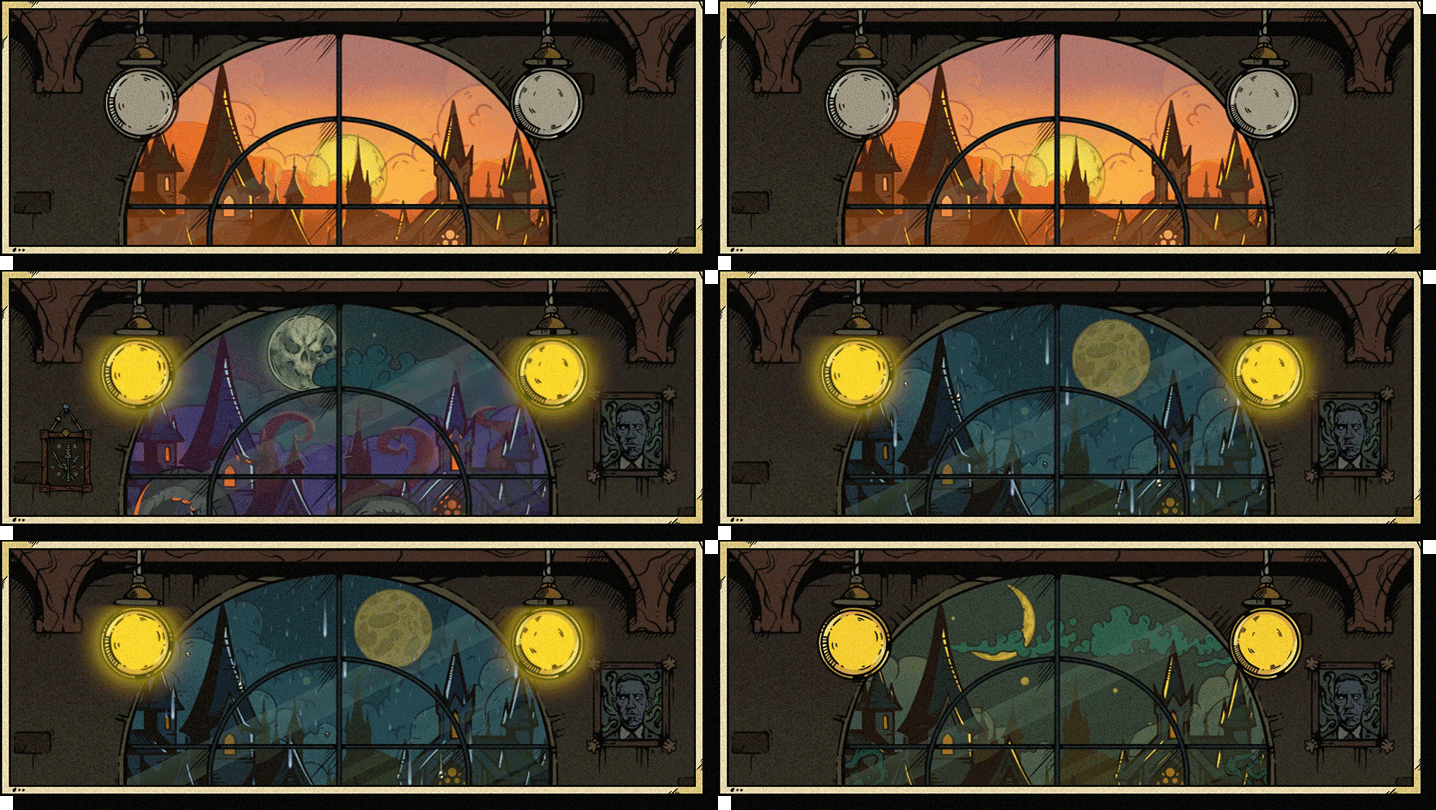
We wanted a town, not a collection of quest givers
Our protagonist is Carrozia, a witch who arrives in Mursvinch and becomes the owner of a small coffee shop.
Naturally, most of the game's characters meet her there.
But fairly early in development, we realized that if every resident existed only to enter the café, give Carrozia a problem, receive some help, and disappear again, Mursvinch would never feel like a real place.
It would feel like a collection of quests.
So instead of asking only:
"What does this character need from the player?"
we started asking:
"Who is this person when Carrozia isn't in the room?"
Who do they know?
Who do they avoid?
Who annoys them?
Who do they secretly care about?
What happened between them before the game even started?
That change in perspective affected much more than we expected.
Characters stopped existing as isolated dialogue branches and started becoming part of a scenario.
Someone might come into the café to talk to Carrozia, but the real reason they are upset could be something another resident did yesterday.
A seemingly unimportant conversation could affect a relationship that becomes important several days later.
And sometimes the player is not even at the center of the conflict.
That was exactly what we wanted.
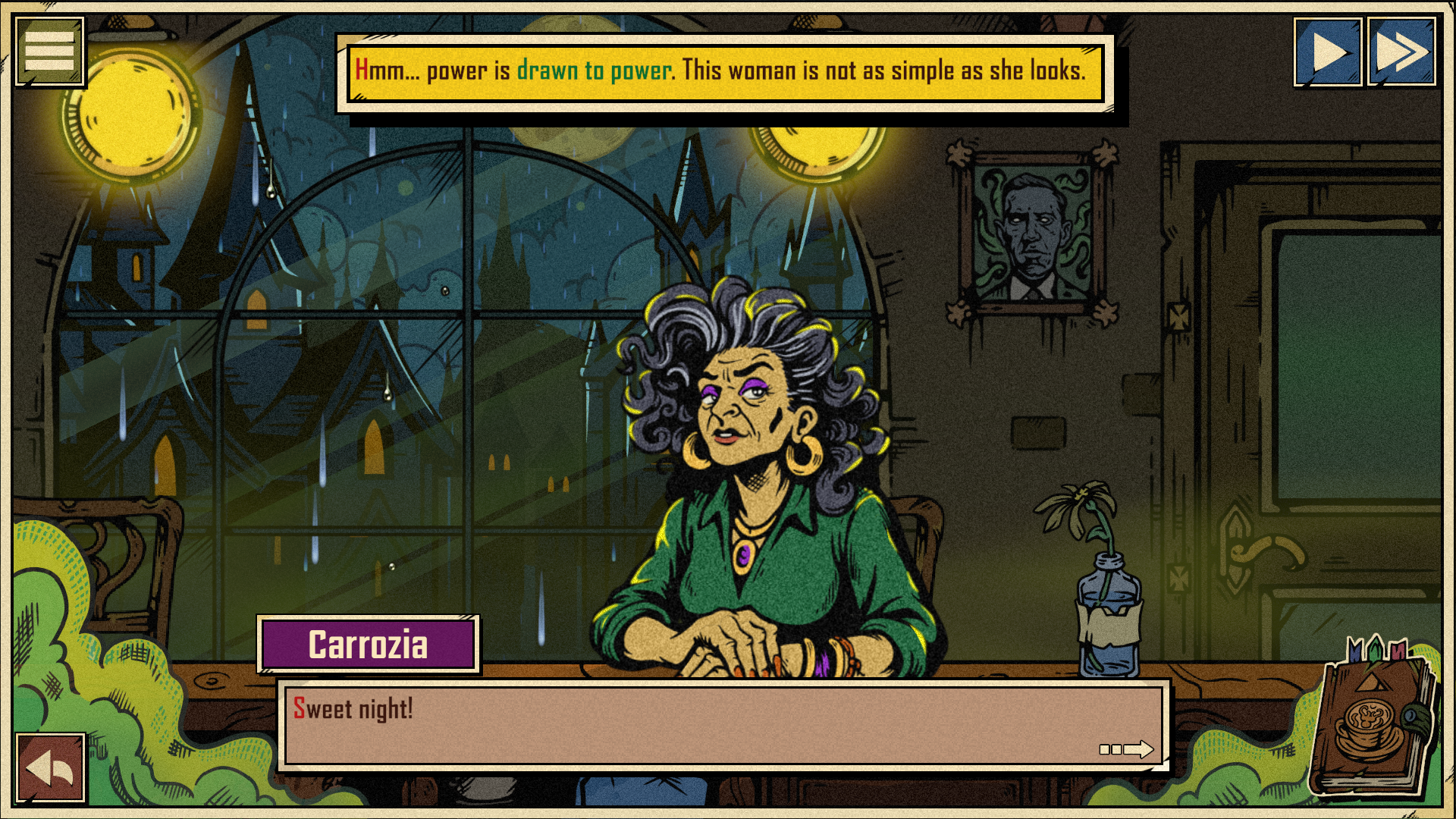
Madame knows more than she says
Madame is the first to realize where Carrozia has arrived.
People call her Madame, or "that woman," or simply don't address her at all.
Outwardly, she appears to be just an elderly woman who comes to the coffee shop to socialize.
Yet, it is she who begins to cautiously warn Carrozia about the town and its inhabitants.
At the same time, she has a past of her own-one she speaks of with great reluctance.
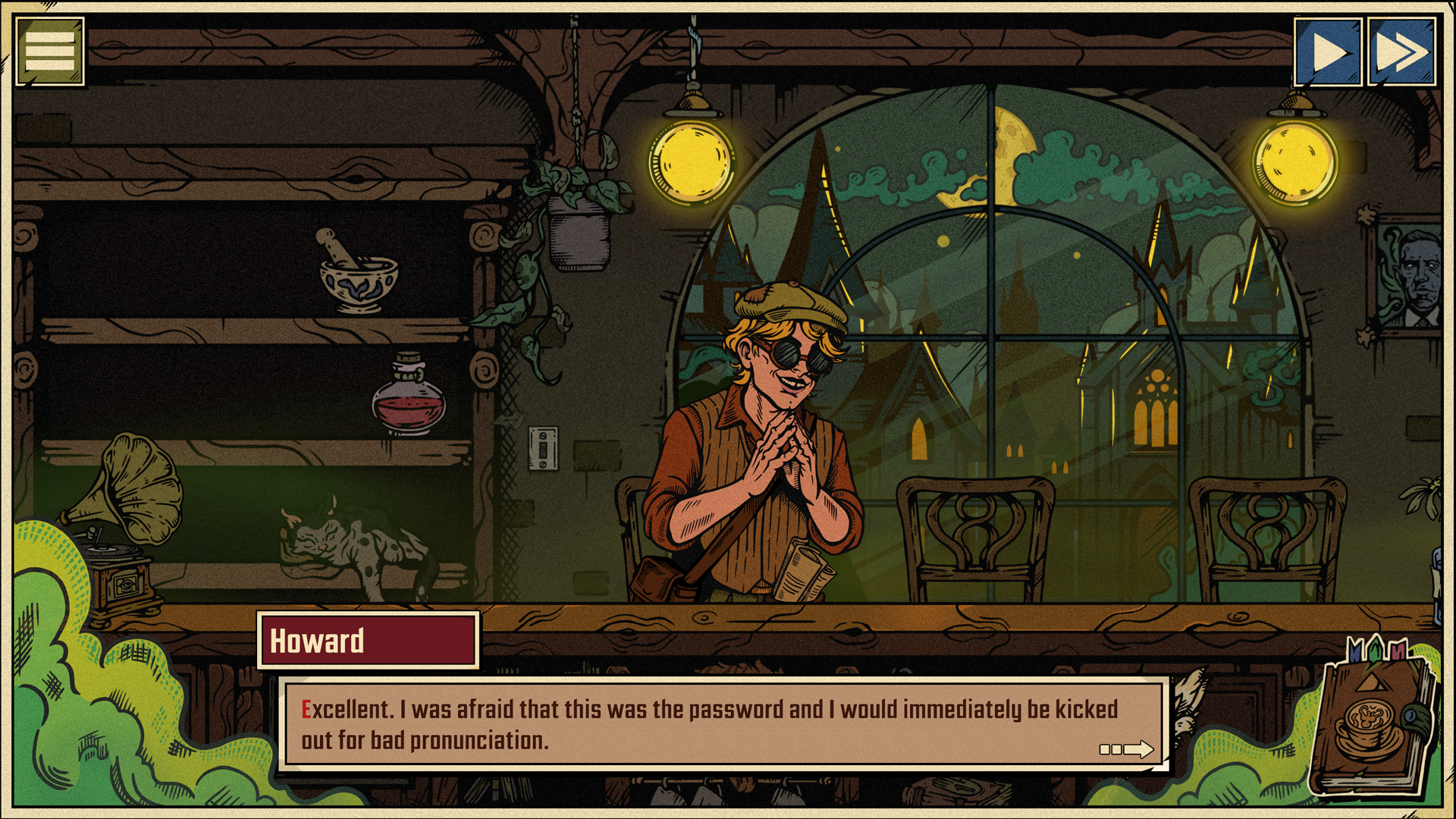
Howard is always where the gossip is
Howard is always where the gossip is.
Howard turned out to be one of those characters who took up just a few lines on paper but gradually began commanding more and more screen time.
He burst into the storyline almost on his own, stirring up a whirlwind of chaos, bustle, and charm.
When leaving the house, he puts on a smile before he even puts on his glasses.
He jokes, charms, and can be a bit of a nuisance, yet he remains a welcome guest nonetheless.
(If it suddenly seems to you that the author is a little in love with this character-you aren't imagining things.)
I could write a lot more about him, but that would make playing the game less interesting for you, so I’ll stop here.
Characters became more interesting when they stopped orbiting the protagonist
There are friendships in Dark Coffee.
Jealousy.
Romance.
Old disagreements.
People who care about each other but are terrible at showing it.
People who probably should stay away from each other but do not.
We did not want every emotional relationship to exist because Carrozia arrived in town.
Some relationships have been developing for years before the player ever enters the story.
Carrozia can influence them.
She can help.
She can interfere.
She can misunderstand what is happening.
Or sometimes she can simply stay out of it.
This became particularly important when we started working on romantic relationships.
One of us is a big fan of movies like 500 Days of Summer, so we knew fairly early that we did not want romance in Dark Coffee to behave like a separate reward system where the player simply accumulates enough invisible points and receives the "correct" relationship.
People are messy.
They can want contradictory things.
Sometimes helping one person makes things worse for somebody else.
Sometimes doing nothing is also a decision.
So rather than treating romance as something separate from the rest of the narrative, we try to treat it as another part of the same relationship network.
And this eventually caused a problem.
A very useful problem.
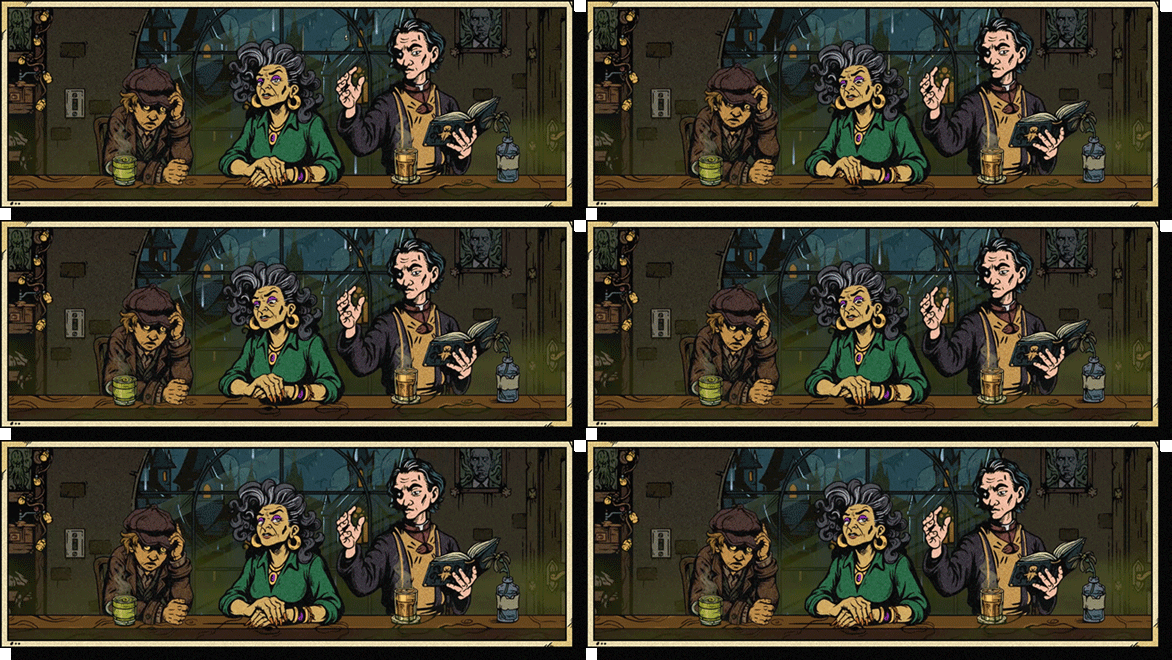
Our characters started breaking the script
The more detailed the characters became, the more often our original script stopped working.
We would write a scene.
The scene would technically do everything it needed to do.
It moved the plot forward.
It communicated the necessary information.
It connected correctly to the next event.
And then we would reread one line and realize:
No. This person would never say that.
Sometimes the problem was the wording.
Sometimes the entire motivation for a scene no longer made sense.
Sometimes a convenient piece of exposition required a character to behave in a way that contradicted everything we had already established about them.
And then we had to rewrite it.
This happens more often now than it did at the beginning.
Strangely, we see that as a good sign.
Once a character becomes defined enough that they can make a perfectly functional scene impossible, they have probably started becoming a person rather than a tool for moving the plot.
Of course, that also means more work.
A lot more work.
The easiest version of a scene is often not the version the characters allow us to write.
We have gradually learned that character consistency is more important than narrative convenience.
If we force someone to behave incorrectly simply because the plot needs them to, the player may not consciously identify what went wrong.
But they will probably feel it.
Relationships also gave us new ways to create consequences
Dark Coffee is structured around choices, although not all of them look like traditional dialogue choices.
One of the game's main systems involves preparing drinks for visitors.
Characters rarely walk into the café and simply tell you exactly what they want.
Instead, the player listens to them, interprets what they are feeling, and decides what kind of drink might help - or hurt - them.
Those decisions can affect what characters do later.
And once we had relationships between residents rather than isolated personal storylines, the consequences became much more interesting.
Helping one person can affect another.
A conversation can change the way somebody behaves several scenes later.
An apparently private decision can eventually become somebody else's problem.
That gave us another reason to build connections between characters.
Consequences feel more meaningful when they travel through the world rather than stopping at the person directly in front of the player.
The characters started shaping the rooms too
Because we are both artists, character design was one of the parts of development where we felt relatively comfortable.
There is no dramatic story here about making five hundred sketches and rejecting every single one.
Most of our characters found their basic appearance surprisingly quickly.
And something interesting happened while we were drawing them.
The rooms started changing too.
As characters became more specific, the world around them needed to become more specific.
Their environments needed the same personality.
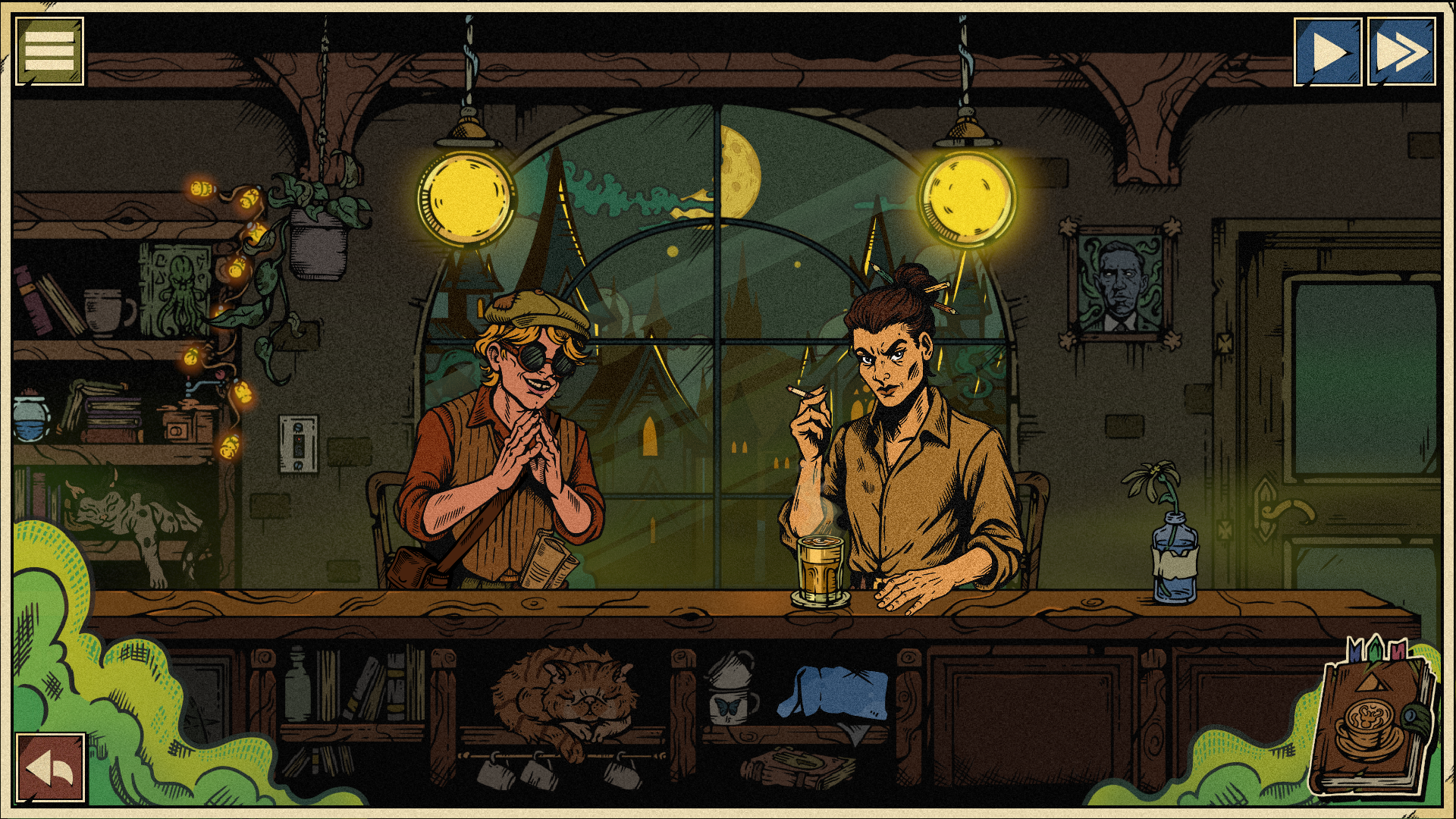
That is part of why the visual language of Dark Coffee settled quite early.
Heavy outlines.
Halftone textures.
Noise.
Limited colors.
Expressive faces.
Slightly rough printing effects.
Our main visual reference is old printed comic books.
We want the game to feel a little like someone found a strange comic in an attic, opened it, and discovered that it was interactive.
[IMAGE персонаж на фоне комнаты]
Not every visual idea survived production, however.
Sometimes you have to kill an effect you really like
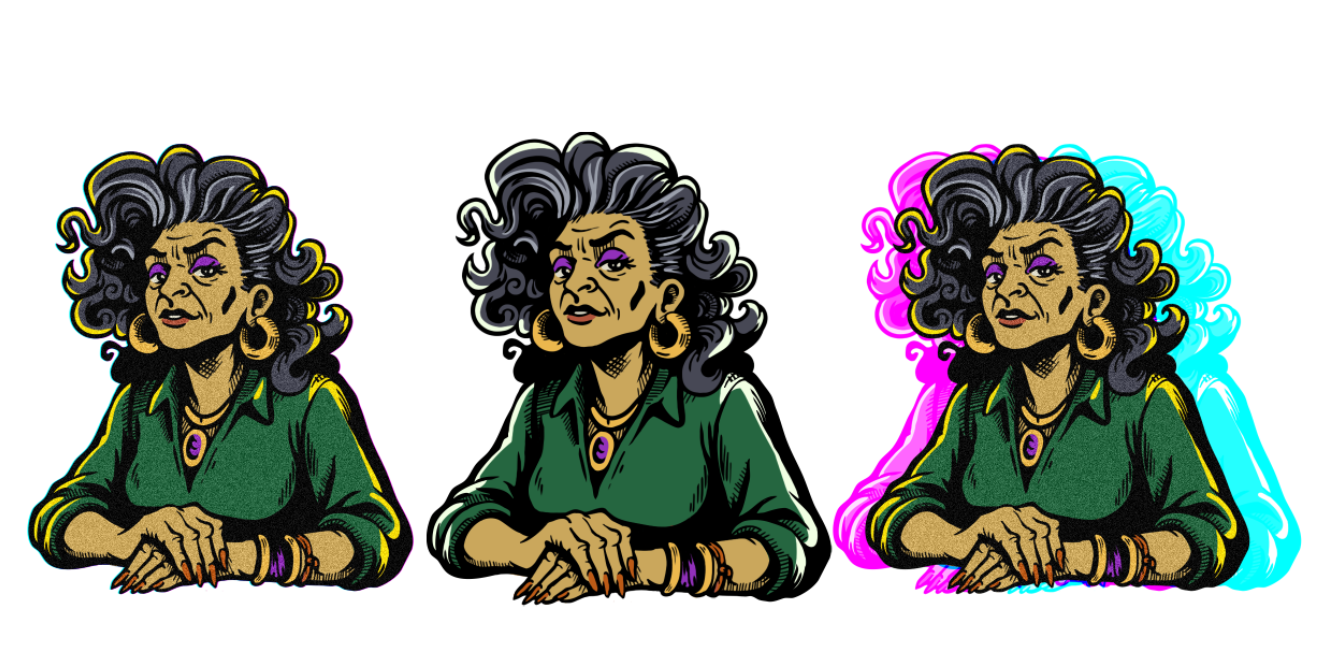
One effect we spent a surprisingly long time discussing was chromatic aberration.
Combined with the noise and print textures, we thought it could make the image feel slightly unstable and help reinforce the feeling of imperfect old printing.
Visually, we liked it.
Technically, it became a problem.
We could not get the effect working in Unity in a way that gave us the result we wanted across all of the game's artwork.
The alternative would have involved preparing parts of the artwork manually and accounting for the effect across animation.
For a two-person team producing a large amount of 2D art, that quickly became unreasonable.
So we removed it.
This sounds like a very small decision, but it was useful for us.
When you are an artist, it is very easy to become attached to an effect because it looks good in a single image.
But a game is not a single image.
Every visual decision has a production cost.
It has to work across characters, animations, interfaces, different scenes, and whatever content you decide to create six months later.
We liked the chromatic effect.
We did not like it enough to justify what it would cost us.
So the noise stayed.
The chromatic aberration did not.
And the game survived perfectly well without it.
What we're learning from all of this
We are still fairly early in development, so this is not a postmortem and we definitely do not have all the answers.
But after spending months with the residents of Mursvinch, one thing has become increasingly clear to us:
creating characters is not primarily about writing interesting biographies.
A biography can tell you that somebody is funny, lonely, jealous, kind, dishonest, or afraid.
But a character starts feeling alive when those traits begin affecting everything else.
The way they speak.
The people they like.
The people they dislike.
The decisions they make.
The information they hide.
The way other characters react to them.
And eventually, the scenes you are allowed to write.
For us, one of the strangest signs of progress has been having to delete or rewrite perfectly functional dialogue because we both look at it and say:
"No. They wouldn't do that."
It makes development slower.
But it also makes Mursvinch feel more like a town and less like a collection of NPCs waiting for the protagonist to arrive.
And that is probably one of the most important things we have learned so far:
A character starts feeling alive when they become inconvenient to the writer.
Dark Coffee is still in development, and we are still discovering who these people are.
Some of them keep surprising us.
You can find Dark Coffee on Steam here:
Dark Coffee on Steam
Dark Coffee Trailer
Thanks for reading.
And welcome to Mursvinch.
Just be careful who you trust.
Discussion