gamedev.net
🔒 Locked

Quantum Question

Started by Lode Feb 27, 2005 at 5:16 AM 24 replies 2.6k views
Original Post
Lode
Lode
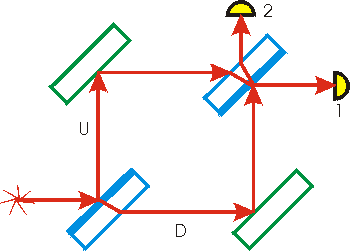
There's something I don't understand in the following article: http://www.cs.caltech.edu/~westside/quantum-intro.html They say, in the following experiment: the photons have 0 probability of reaching detector B and will always reach detector A. Out of this, they conclude: "The only conceivable conclusion is therefore that the photon somehow traveled both paths simultaneously, creating an interference at the point of intersection that destroyed the possibility of the signal reaching B.". I don't really understand the "interference" thing, and my own conclusion would be: "a photon that goes through a beamsplitter will always go through a beamsplitter and a photon that bounces off a beamsplitter will always bounce off a beamsplitter" since that also explains why all photons reach detector A (to reach detector B a photon has to go through the first beamsplitter and bounce off the second beamsplitter, or vica versa). Can anyone explain a bit more what's actually happening? EDIT: would it also be possible to try the experiment myself if I had such half silvered mirrors?
Yann L
Yann L
Ah, yes, the superposition phenomena. That's tricky to explain.

Quote:
Original post by Lode
I don't really understand the "interference" thing, and my own conclusion would be: "a photon that goes through a beamsplitter will always go through a beamsplitter and a photon that bounces off a beamsplitter will always bounce off a beamsplitter" since that also explains why all photons reach detector A (to reach detector B a photon has to go through the first beamsplitter and bounce off the second beamsplitter, or vica versa).

Not really. This would imply, that the photon had some form of 'memory', and that it could actually choose whether to be reflected or transmitted on its own. But this is not the case, the probabilities of reflectance vs. transmittance are both equal.

There is a quick way to show this, and it's mentioned in the article, just below the paragraph you quoted: put a piece of paper into one of the paths (either H or V), and suddendly, photons will reach both detectors with equal probability ! So in this case, say we block path V, it is equally probable for a photon to be transmitted + reflected than transmitted + transmitted.

The reason is coherent superposition. You have to see everything as probabilities. As soon as a photon reaches a mirror, it has 50% probability to be either transmitted or reflected. According to quantum mechanics, a state of a particle is undefined (ie. it could be any of these probabilities) until you observe it, where one of the possibilities become 'real'. This is visualized by the famous thought experiment of Schrödingers cat. Before observation, these superposition of propability waves can also interfere, and this is what this experiment is showing.


mikeman
mikeman
Quote:

Before observation, these superposition of propability waves can also interfere, and this is what this experiment is showing.


The article doesn't explain how that interference works, though. In that particular experiment, why the interference causes the propabilities of reaching B to be eliminated, and not A? Or in fact, why it causes the elimination of a propability in general?

Quote:

According to quantum mechanics, a state of a particle is undefined (ie. it could be any of these probabilities) until you observe it, where one of the possibilities become 'real'.


I always had a problem digesting that. Surely, the particles exist without me looking at them. I always thought it like all the propabilities are in fact real, and exist in parallel universes. Observation just gives us the ability to determine in which of those universes we exist.

[Edited by - mikeman on February 27, 2005 6:05:04 AM]
Alpha_ProgDes
Alpha_ProgDes
Quote:
Original post by mikeman
Quote:

Before observation, these superposition of propability waves can also interfere, and this is what this experiment is showing.


The article doesn't explain how that interference works, though. In that particular experiment, why the interference causes the propabilities of reaching B to be eliminated, and not A? Or in fact, why it causes the elimination of a propability in general?

Quote:

According to quantum mechanics, a state of a particle is undefined (ie. it could be any of these probabilities) until you observe it, where one of the possibilities become 'real'.


I always had a problem digesting that. Surely, the particles exist without me looking at them. I always thought it like all the propabilities are in fact real, and exist in parallel universes. Observation just gives us the ability to determine in which of those universes we exist.

I really don't understand why putting paper in either H or V would cause the proton to be detected in both A and B. It sounds like it should be the other way around.

Also, if the protons exist in parallel universes, as you put it, then us looking forces it to exist in this universe. ?. Hopefully, I didn't misunderstand your post.
Beginner in Game Development?  Read here. And read here.  
Dmytry
Dmytry
hmm, i don't sure interference in that scheme matters at all. Looks like that effect will happen due to polarisation alone, and even if you will block certain path it will be so (!). Also seems that interference of beams in that system should be affecting A and B equally well, assuming they somehow got non-polarising beamsplitters.

In any case even if they conclude to right thing, their "derivation"
Quote:

Figure b depicts an interesting experiment that demonstrates the phenomenon of single-particle interference. In this case, experiment shows that the photon always reaches detector A, never detector B! If a single photon travels vertically and strikes the mirror, then, by comparison to the experiment in figure a, there should be an equal probability that the photon will strike either detector A or detector B. The same goes for a photon traveling down the horizontal path. However, the actual result is drastically different. The only conceivable conclusion is therefore that the photon somehow traveled both paths simultaneously

is purely invalid; to make that be really "The only conceivable conclusion" they should compare results with results when one of paths is blocked ,that's how it was explained in good old books. In any such explanation, experiment with one path blocked, and full experiment was compared, and conclusion was made from it. Not the other way around, not "if for example" , lol, that "if for example" is the base of that conclusion.
Quote:

Not really. This would imply, that the photon had some form of 'memory', and that it could actually choose whether to be reflected or transmitted on its own. But this is not the case, the probabilities of reflectance vs. transmittance are both equal.

wrong. Let we have blocked path H and leaved path V open in this scheme. There's no interference if one of paths is blocked. Let beamsplitters is polarising (almost all beamsplitters is).
Note that photons that have bounced on beamsplitter have polarisation so electrical field is perpendicular to plane of drawing. They should bounce off second beamsplitter too, and in ideal case never reach B. Same if we will block path V and leave path H. See? This could happen without any interferece involved, if beamsplitters is polarising.


Example of thing that really works:
    _mirror    |  V  lambda/8 platter    |>---/---lambda/8 platter-|mirror    |                 H    |  detector

where lambda/8 platters is used to compensate polarisation, and where H is 1/4 wave longer than V
In that case, detector shouldn't receive any photons when both pathes is open, and should receive photons when one of pathes is blocked. And that does mean that it must travel both pathes, as finally we get information of state (blocked or open) of both pathes.

[Edited by - Dmytry on February 27, 2005 8:29:08 AM]
golopart
golopart
This probably seems like a silly question, but how are experimental quantum computers actually being built? I mean, they're not constructed with mirrors and particle beams are they...? Is work on quantum computers (hardware) only something that can be performed in a state-of-the-art lab at the moment?
mikeman
mikeman
Quote:

Let we have blocked path H and leaved path V open in this scheme. There's no interference if one of paths is blocked. Let beamsplitters is polarising (almost all beamsplitters is).
Note that photons that have bounced on beamsplitter have polarisation so electrical field is perpendicular to plane of drawing. They should bounce off second beamsplitter too, and in ideal case never reach B. Same if we will block path V and leave path H. See? This could happen without any interferece involved, if beamsplitters is polarising.


That's not what the article says. According to it, if we have both paths open, a photon will end up 100% in detector A. If we block one of the paths, then both A and B will get "hits". With your theory, if I understand correctly, whether we have both paths open, or one of them blocked, it doesn't matter, the photons will end up only in A.


Hamster
Hamster
Hmm,
Can't help but feel that the experiment shown doesn't really show off this phenomena nearly so well as Young's slits. Brief overview from memory:

Light is both a wave and a particle.
If waves are passed through a gap approximately equal in size to the wavelength, diffraction occurs and the waves spread out from that point. Waves interfere with each other.

Shine a single lightsource through one thin slit in an opaque material. Here the light will diffract and spread out from this point. Beyond that, place a barrier with two thin, parallel slits in an opaque material and project the resulting image on to a screen beyond. Diffraction occurs at each slit, and the light spreads out from each of these points. At the second barrier, the light from one slit interferes with the light from the other. You should see stripes of bright and dark areas on the screen.

The bright areas occur where the lightwaves from each second-layer slit have met at such a point that they are both at high amplitude, and therefore the resultant amplitude is about twice that of the lightsource (ignoring attenuation). Shiny bright fun.

The dark areas occur where the lightwaves from each second-layer slit have met at such a point that the resultant has no amplitude. Darkness.

If you know the wavelength of light you're dealing with and various other measurements you can stick all these in a formula to predict what brightness you will get at any given area on the screen.

This is all very well, as it all depends only on light behaving like a wave. The problem is, light is made up of particles: photons. If you send out a single photon, it seems that it should pass through only one of the second layer of slits. Therefore no interference can occur, therefore the brightness where it lands should not be predictable using the formula used when sending many photons.

The problem is, that doesn't happen. One photon DOES interfere with itself, and its brightness upon hitting the screen is governed by that formula. Weird as it sounds, this means that one photon travels through both of the secondary slits.

I have no explaination of why. Its a really weird result, but its cool that it happens.

This is all half-remembered from A-level physics. Hope I got everything right, but there are probably some mistakes and corrections are welcome.
Dmytry
Dmytry
Quote:
Original post by mikeman
Quote:

Let we have blocked path H and leaved path V open in this scheme. There's no interference if one of paths is blocked. Let beamsplitters is polarising (almost all beamsplitters is).
Note that photons that have bounced on beamsplitter have polarisation so electrical field is perpendicular to plane of drawing. They should bounce off second beamsplitter too, and in ideal case never reach B. Same if we will block path V and leave path H. See? This could happen without any interferece involved, if beamsplitters is polarising.


That's not what the article says. According to it, if we have both paths open, a photon will end up 100% in detector A. If we block one of the paths, then both A and B will get "hits". With your theory, if I understand correctly, whether we have both paths open, or one of them blocked, it doesn't matter, the photons will end up only in A.

now, tell me how they can make interference be constructive for A and destructive for B? To me, looks like phase difference must be exactly equal for A and B (even if sides is not equal). Maybe this thing is missing several parts, tho.

[Edited by - Dmytry on February 27, 2005 8:30:01 AM]
mikeman
mikeman
Quote:
Original post by Dmytry
Quote:
Original post by mikeman
Quote:

Let we have blocked path H and leaved path V open in this scheme. There's no interference if one of paths is blocked. Let beamsplitters is polarising (almost all beamsplitters is).
Note that photons that have bounced on beamsplitter have polarisation so electrical field is perpendicular to plane of drawing. They should bounce off second beamsplitter too, and in ideal case never reach B. Same if we will block path V and leave path H. See? This could happen without any interferece involved, if beamsplitters is polarising.


That's not what the article says. According to it, if we have both paths open, a photon will end up 100% in detector A. If we block one of the paths, then both A and B will get "hits". With your theory, if I understand correctly, whether we have both paths open, or one of them blocked, it doesn't matter, the photons will end up only in A.

now, tell me how they can make interference be constructive for A and destructive for B? To me, looks like phase difference must be exactly equal for A and B (even if sides is not equal). Maybe this thing is missing several parts, tho.


That's exactly what I'm wondering about, too. Of course, I assume that what the article says actually happen in reality.
Dmytry
Dmytry
i assume that these quantum things really happen in reality, but i also assume that
1: experiment setup requited to verify that is not so simple,(for example my interferometer example will surely work, but it is more complicated, or two-hole set-up also works, but it doesn't look too nice) and
2: in article, they are presenting some idealized experiment that a: most likely doesn't work, and b: heavily influenced by polarisation.


Usually , that is explained with very simple set-up like
                   platter with two holes        |                 |                   |source *         |                   |photofilm                 |                   |                                     |


where source emits photons one by one, yet you see interference patterns on film, and on film you have some completely dark places. And if you close one hole, you don't see these interference patterns, AND have light in places that was dark. Also, ideally, you can count all dots on photofilm and number of dots is equal to number of photons. Same happens if you fire electrons instead of photons.
Yann L
Yann L
Dmytry: your conclusions are almost correct, but you forgot about a little detail: that the beam splitters are not infinitely thin. A reflectance will cause a phase shift, but don't forget that a transmittance will be subject to refraction. The light speed will change as the light is transmitted, and will also induce a phase shift due to the delay.

This setup is perfectly working in reality, and is called a Mach Zehnder interferometer. It even works without the quantum superposition. I found this easy to understand explanation of it.

When used in the context of quantum super-position, it can be shown that even a single photon will create the interference with itself. This is called coherent super position.
Dmytry
Dmytry
Quote:
Original post by Yann L
Dmytry: your conclusions are almost correct, but you forgot about a little detail: that the beam splitters are not infinitely thin. A reflectance will cause a phase shift, but don't forget that a transmittance will be subject to refraction. The light speed will change as the light is transmitted, and will also induce a phase shift due to the delay.

This setup is perfectly working in reality, and is called a Mach Zehnder interferometer. It even works without the quantum superposition. I found this easy to understand explanation of it.

When used in the context of quantum super-position, it can be shown that even a single photon will create the interference with itself. This is called coherent super position.

hmm. okay, that works, but they 1: don't give explanations in OP's article, and 2: as i understand, thickness of coat on beamsplitter must have certain value.
Yann L
Yann L
Quote:
Original post by Dmytry
hmm. okay, that works, but they 1: don't give explanations in OP's article, and

Well, a Mach Zehnder interferometer is an absolutely common measure setup in particle physics, so I guess they implied the knowledge about it.

Quote:
Original post by Dmytry
2: as i understand, thickness of coat on beamsplitter must have certain value.

The phase shift of beam splitter transmittance is standarized per wavelength for common lab equipment. Otherwise, it would be totally impossible to do any kind of experimentation, if your beam splitters introduced random phase shifts ;)
Dmytry
Dmytry
ops, i was incorrect, it should work even with no coat at all, because of phase shift on reflection. I have assumed phase shift is the same for reflecting to other side as to first side.

Heck, readed article Yann posted, and have found what bugged me in that set-up:

Quote:


It turns out that, despite the figure, all of the light from the source ends up at detector 1; no light gets to detector 2. We will prove that this is so.

(note that there one plate is at one side, and other is at other)


and from OP:

Quote:


..However, experiment shows that in reality this arrangement causes detector A to register 100% of the time, and never at detector B! How can this be?...


of course it could be so if pathes is not equal, or platters are flipped.

I remembered that reflection creates phase shift of 0.5 wavelength, just note that if beamsplitter is symmetrical (thin gap of air between two prisms, that what i thinked about), at A we have one ray shifted by 0.5 to other, and on B we also have one ray shifted to other by 0.5 wavelength .


So, i stand corrected that with symmetrical beamsplitter, that would not work.
It works because of "Reflected by the inner surface of the second beam splitter, giving no phase change" versus "Reflected by the front of the second beam splitter, giving a phase change of one-half a wavelength. " , because that beamsplitter is non-symmetrical.
Yann L
Yann L
Quote:
Original post by Dmytry
or platters are flipped.

The detector beam splitter is inverted in those two setups.
Dmytry
Dmytry
in summary, as mathematician, i was thinking about symmetrical beamsplitter, as half-silvered mirror, i think, is symmetrical beamsplitter. With assymetrical beamsplitter such as air-glass surface, yes, it works, but i kinda doubt that glass-silver and air-silver surfaces are much different. And this thing works only with assymetrical beamsplitters... (note that glass thickness is irrelevant there)
Dmytry
Dmytry
Quote:
Original post by Yann L
Quote:
Original post by Dmytry
or platters are flipped.

The detector beam splitter is inverted in those two setups.

that would make result depend to wavelength of light very much, as one path of light passes two glasses, and other passes no glasses, and glass IOR depends to wavelength.(and also pathes don't have equal lengths) And if both is flipped, as i understand, it will not cnange anything
mikeman
mikeman
Sorry if I'm saying something that has already been told, but as I understand from the article YannL posted, there are 2 possibilities: either the photon will end up in detector A, or detector B. Each possibility can be fullfilled by 2 paths. If those 2 paths result in different amounts of phase change, then the possibility is destroyed. Correct?

In that case, in the OP's graph, the photon would always hit detector B, not A like the article says. Or am I wrong?
Dmytry
Dmytry
Quote:
Original post by mikeman
Sorry if I'm saying something that has already been told, but as I understand from the article YannL posted, there are 2 possibilities: either the photon will end up in detector A, or detector B. Each possibility can be fullfilled by 2 paths. If those 2 paths result in different amounts of phase change, then the possibility is destroyed. Correct?

In that case, in the OP's graph, the photon would always hit detector B, not A like the article says. Or am I wrong?

that's exactly what i noted too. Though, if lengths of sides is non-equal by odd amount of half-waves, that could be so it will always hit A.
As about thing - really, these explanation is supposed to be made for people without pre-knowledge. For people with pre-knowledge of interference, you can just say that any inteference observable with continuous beam is observable with firing photons one by one, and do not need to explain how half-silvered mirror can work as beamsplitter. (BTW, half-silvered mirror is poor beamsplitter, significant portion of light is simply absorbed)

Topic Locked

This topic has been locked by a moderator. New replies are not allowed.

Sign in to reply to this topic.