GameDev.net gamedev.net
🔒 Locked

Photos of my past experiments in airplane design

Started by grhodes_at_work Dec 9, 2005 at 12:08 AM 12 replies 10k views
Original Post
grhodes_at_work
grhodes_at_work
Folks, I have to admit this is somewhat off topic, but not 100% off topic. The subject of airplane flight simulation comes around often here at gamedev. Some of you know that in a past life I was an aerospace engineer doing some work in the design of airplanes. I was starting down that career path when 3D graphics and game got hold of me once again (having got hold of me once during high school and turned loose while I went to college and worked for a couple of years). And some of you may have enjoyed my long rambling posts about various aspects of aerodynamics and flight simulation. I have just posted several photos to my personal website that document some of my aerospace excursions, including my research at NASA Langley and undergraduate design and construction of a general aviation concept airplane in the form of a forward-swept-wing canard. I was the lead aerodynamicist for the latter project, and created 3D computational aerodynamic models of the BFX 29.5 design. You can view the photos here: Graham Rhodes' Aerospace Stuff Page Thank you for listening and no laughing at my super HTML skills! My hope, well, my justification for posting this hear is that hopefully these images and words might trigger an awesome game design game idea for someone here!

Graham Rhodes Moderator, Math & Physics forum @ gamedev.net
stormrunner
stormrunner
Wow, that's just awesome. The Over-The-Tail Turboprop design looks like a torpedo, that you'd fly around underwater o_O.
stormrunner
John Schultz
John Schultz
Pretty cool stuff. Building and flying R/C is a great way to learn about real-world aerodynamics and stability. The engine in the photo, is that an OS .40/.60? I had an OS .40 FSR with an unmuffled tuned-pipe on a "Smoothie" (low wing, symmetric airfoil), 5-channel Futaba (channel 5 controlled the bomb drop (plastic shell filled with flour or ash)). The setup had enough power to fly straight up (now common with "3D" aerobatics where the planes are flown on the prop just above the ground, like a helicoptor). Also built and flew sailplanes, .049 racers, electrics, etc.

As for game ideas, check this out (watch the video using IE: does not play in Firefox).

This too.
and this.
Combat.
I've got one of these (flies OK, nearly indestructible; conventional designs are more aerobatic).
Tower Hobbies.
Jet Turbine jets.
Jet Turbine helicopters (see the gallery for videos (download to disk before playing (includes inverted flight hover at ground-level demo))).
Flying Pterosaur.
grhodes_at_work
grhodes_at_work
Its an OS .60. These test models may be R/C, looking like hobby airplanes, but they are more than hobby planes. We went through rigorous, formal design processes that included flight performance and payload analysis, custom airfoil design using the Eppler and Drela airfoil design codes, 3D configuration aerodynamic analysis using Rockwell's APAS, Lockheed's QUADPAN, and NASA PMARC aero codes, stability and control analysis using stability derivatives that were computed using the 2D and 3D aero codes, finite element structural analysis using various codes, and creation of engineering drawings using CATIA on dedicated CAD machines (back when the fancier CAD packages weren't running on PC's). The airfoil codes supported boundary layer stability analysis to predict boundary layer transition and separation and stall, including the presence of laminar separation bubbles that can burst one one wing but not the other leading to roll divergence in a stall. We even put an engine in our wind tunnel to measure the thrust vs. advance ratio for our specific propulsion system (the aforementioned OS .60 with whichever propellor we were using). Far more than back-of-the-envelope quick-and-dirty calcs! The 6 month design cycle was an approximation of real-world commercial airplane design (which has since evolved heavily). Construction and flight testing and post review was part 2 of a year-long process.

I have a bunch of all the old calc results, as well as the computational grids used for the 3D aero analysis. I plan to add images/screen shots of this to the page. I actually have an aero grid for the ATP as well, which I used for some computational work while waiting (and waiting and waiting) for my wind tunnel time slot.

I love all your links. This stuff is so cool. I'd love to spook my cat, Ari, with the R/C Pterosaur! Actually, I'm also interested in high power amateur rocketry, though more as a spectator at this point.

How often do you fly these days? I know there are some extremely cool R/C flight simulators (airplanes and helicopters), but I'd love to see more of an arcade-style game that is more for fun than practice. Something along the lines of Re-Volt, but for airplanes:

Re-Volt

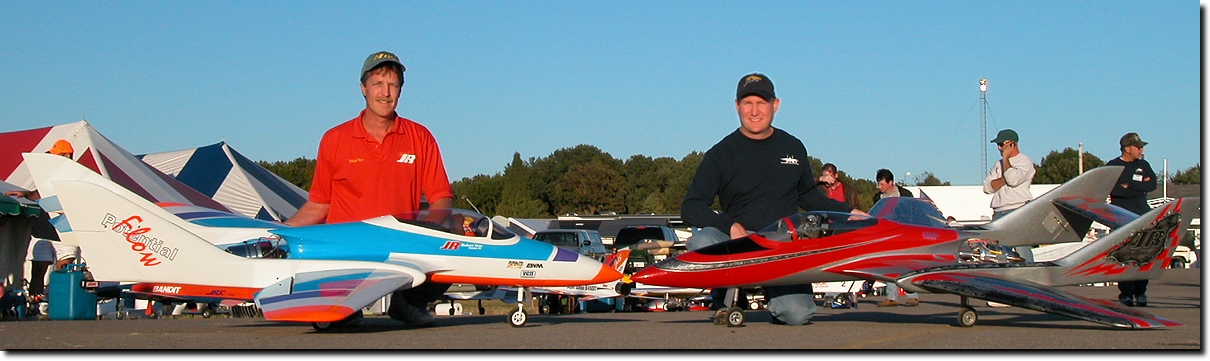
Its interesting that you posted the bvm jets page. My prior boss, Robert Vess, who was also NCSU's test pilot for many years, has worked with BVM on various projects, beginning (I believe) with the doomed F-18 project @ NCSU (link below). You can see Robert's photo, with his airplanes, on a few photos on the web, including the following one at the BVM website. He has also worked for a NASCAR team as an aerodynamicist trying to find ways to get the last ounce of performance by limited drag-reduction techniques.

Robert Vess on the Left, showing off one of his BVM-jet-powered R/C models

The NCSU F18 Project Page:

NCSU F18 Project Page

[Edited by - grhodes_at_work on December 9, 2005 2:10:29 PM]
Graham Rhodes Moderator, Math & Physics forum @ gamedev.net
John Schultz
John Schultz
Quote:
Original post by grhodes_at_work
Its an OS .60. These test models may be R/C, looking like hobby airplanes, but they are more than hobby planes. We went through rigorous, formal design processes that included flight performance and payload analysis, custom airfoil design using the Eppler and Drela airfoil design codes, 3D configuration aerodynamic analysis using Rockwell's APAS Lockheed's QUADPAN codes and NASA PMARC codes, finite element structural analysis using various codes, and creation of engineering drawings using CATIA on dedicated CAD machines (back when the fancier CAD packages weren't running on PC's). The design cycle was an approximation of real-world commercial airplane design (which has since evolved heavily).


Sounds like fun: going from design to a real, physical flying vehicle. I have a stack of aerodynamics books, including the impressive sounding, "Applied Computational Aerodynamics" and "Computational Nonlinear Mechanics in Aerospace Engineering" (AIAA series) that I used when writing VR Slingshot on the Amiga and then PC. I ended up using an extremely fast and simple method that was stable in fixed point (point sampling many simple airfoils).

Quote:

I'd love to spook my cat, Ari, with the R/C Pterosaur!


Yeah, they've got smaller birds on that site. The big one could probably carry your cat!

Quote:

How often do you fly these days? I know there are some extremely cool R/C flight simulators (airplanes and helicopters), but I'd love to see more of an arcade-style game that is more for fun than practice. Something along the lines of Re-Volt, but for airplanes:


In terms of real flight, just commercial these days (as a passenger ;-)). R/C: haven't had the free time. In simulation: just about every day (current game I'm working on).

Quote:

Its interesting that you posted the bvm jets page. My prior boss, Robert Vess, who was also NCSU's test pilot for many years, has worked with BVM on various projects, beginning (I believe) with the doomed F-18 project @ NCSU (link below). You can see Robert's photo, with his airplanes, on a few photos on the web, including the following one at the BVM website. He has also worked for a NASCAR team as an aerodynamicist trying to find ways to get the last ounce of performance by limited drag-reduction techniques.


BVM has been doing impressive jet work for some time: I was trying to find links to twin-turbine R/C jets, racing electric planes that hit ~200MPH (very thin/sharp carbon composite wings), etc. There's an electric flying field next to SeaWorld in San Diego: watching the electric 180+ MPH planes fly is impressive (your eyes "dart" while trying to track the planes).
Snaily
Snaily
First of all, that is a very interesting project (and profession). Just had to poke in with my favourite flying game - arcade-style R/C flying: Airfix Dogfighter.
¨@_
grhodes_at_work
grhodes_at_work
Quote:
Original post by Snaily
First of all, that is a very interesting project (and profession). Just had to poke in with my favourite flying game - arcade-style R/C flying: Airfix Dogfighter.


Cool, that's just what I was looking for! Now....anyone want to update it and port to one of the new consoles??!!!!
Graham Rhodes Moderator, Math & Physics forum @ gamedev.net
John Schultz
John Schultz
Quote:
Original post by grhodes_at_work
Quote:
Original post by Snaily
First of all, that is a very interesting project (and profession). Just had to poke in with my favourite flying game - arcade-style R/C flying: Airfix Dogfighter.


Cool, that's just what I was looking for! Now....anyone want to update it and port to one of the new consoles??!!!!


Toy Commander on Dreamcast.
T1Oracle
T1Oracle
That over the tail turboprop looks exactly like a design I saw for a high speed turboprop engine that would improve the aerodynamics of a turboprop and still provide a more efficient thrust than a turbo-fan. I read about that quite some time ago (almost 10 years) and haven't seen anything about it since.

I also remeber reading about something called CCV (I think that was the acronym) that included aerolons (sp? whatever you call small wings planes on the sides of an aircraft's nose or close to the nose), and a vertical stabilizer in front and in back. The idea of all of that was to all the plane to move side ways left and right, or up and down without pitch, yaw, or roll. Only ever saw information on that once as well.

Anyway, interesting post.
Programming since 1995.
grhodes_at_work
grhodes_at_work
Quote:
Original post by John Schultz
Quote:
Original post by grhodes_at_work
Quote:
Original post by Snaily
First of all, that is a very interesting project (and profession). Just had to poke in with my favourite flying game - arcade-style R/C flying: Airfix Dogfighter.


Cool, that's just what I was looking for! Now....anyone want to update it and port to one of the new consoles??!!!!


Toy Commander on Dreamcast.


Well I just haven't kept up, have I? My favorite game on N64 was Pilot Wings, a super-fun arcade "flight simulator" type game. SUPER fun. I had heard a rumor that a new Pilot Wings game might come out on GameCube, but I don't believe it did. Perhaps on Revolution...
Graham Rhodes Moderator, Math & Physics forum @ gamedev.net
grhodes_at_work
grhodes_at_work
Quote:
Original post by T1Oracle
That over the tail turboprop looks exactly like a design I saw for a high speed turboprop engine that would improve the aerodynamics of a turboprop and still provide a more efficient thrust than a turbo-fan. I read about that quite some time ago (almost 10 years) and haven't seen anything about it since.

I also remeber reading about something called CCV (I think that was the acronym) that included aerolons (sp? whatever you call small wings planes on the sides of an aircraft's nose or close to the nose), and a vertical stabilizer in front and in back. The idea of all of that was to all the plane to move side ways left and right, or up and down without pitch, yaw, or roll. Only ever saw information on that once as well.

Anyway, interesting post.


The OTT design was one of the last concepts in the Advanced TurboProp program, which indeed explored highly swept prop blades that could operate at the high Mach number cruise speeds of Turbojets (Mach 0.8'ish) but with improved fuel efficient. Without the swept blades, the propellors would exhibit supersonic flow, or would at least experience transonic drag rise and a corresponding huge drop in efficiency----the reason traditional turboprops wouldn't really operate above Mach 0.6-ish. The program began in the mid-1970's after the oil embargo of 1973. The program was essentially dead when I completed my Master's degree in 1990. One wonders if these designs will be resurrected. I've seen some commuter turboprops that have propulsion system designs that appear influenced by the ATP program, but as far as I know there is no operational high speed turboprop. Only remnants from the research program.

Some history of the ATP program
High speed ATP's a good idea now?

There are many control schemes designed to manipulate an airplane in flight. I'm not sure what CCV is. Ailerons, elevators, elevons, flaps, flaperons, rudder, stabilator are all variations of traditional control surfaces. There are various leading-edge extensions (LEX's) that effectively change the airfoil to be optimized for different speeds and angles-of-attack. Folks I know have studied things called strake fence flaps, which are vortex generators that pop up out of wing strakes to increase lift and drag to reduce landing speed----think of having an airplane that can fly super fast at cruise but that can land like a STOL (short take-off-and-landing) craft. For the very high angle-of-attack fighters (F-18 HARV---high alpha research vehicle), there's the concept of nose chines, which use vortex generators to provide directional control from the front when the main vertical stabilizer behind the center-of-gravity is drenched in the turbulent wake of the fuselage and is therefore ineffective. Then there are the researchy Active Aeroelastic Wing (AAW) ideas that have smooth, hingeless wings that deform/morph without all the mechanical bits that plague conventional control surfaces with turbulence, flow separation and drag...

My ex-boss, Robert Vess, once again appears, as he is one of the patent holders on the strake fence flap concept. (Patents for hardware are, to me, far more tolerable than patents on software algorithms.)

Strake Fence Flap patent
Graham Rhodes Moderator, Math & Physics forum @ gamedev.net
CombatWombat
CombatWombat
I've been flying R/C planes nearly every week for the past..too many (7-10) years.


So I am entertained.


owl
owl
[copyrighted photo removed by grhodes_at_work]

Very nice model!

On a serious note: Congratulations for all the good work you've done. Keep it up! :)

PS: I don't know about your HTML skills, but your writting is pretty cool and as entertaining as informative.

[Edited by - grhodes_at_work on December 10, 2005 12:25:35 PM]
[size="2"]I like the Walrus best.
grhodes_at_work
grhodes_at_work
Thanks for all the kind comments folks! Its fun to reminisce. I expect to add more stuff to that page. I want to look back in my box of stuff and locate the CD that has some of the computational models on it. Should be some interesting things there to post on the site, including some charts from the wind tunnel experiments that could be adopted to realistic flight simulator games.
Graham Rhodes Moderator, Math & Physics forum @ gamedev.net

Topic Locked

This topic has been locked by a moderator. New replies are not allowed.

Sign in to reply to this topic.