GameDev.net gamedev.net
🔒 Locked

Pose, proportion, anatomy

Started by Oluseyi Sep 26, 2006 at 11:20 PM 21 replies 6.5k views
Original Post
Oluseyi
Oluseyi
In my last thread, I was encouraged to beef up my figure drawing. Below are some sketches I did earlier today (the spine of my sketchbook makes scanned pages dark toward the middle), of a standing woman from different angles and of my own hand holding my sketchbook as I drew on the subway (standing; I'm kind of pleased with those). The woman was drawn from a reference, to, as I'm also working on drawing what I see and not what I "remember."
C & C, please. [smile]
Oluseyi
Oluseyi
One definite flaw I see in my approach is a tendency to draw in details before creating a balanced overall composition. This causes proportional inconsistencies, as I zero in on individual parts before the whole is completed. I'm going to try to first roughly sketch the whole with "construction lines" before going back in and fleshing out detailed areas of future sketches.
slowpid
slowpid
Good job man, those are marginally better than your stuff before. Your sketchy style seems more robust, and your basic anatomy is also pretty good. Like you wrote on the paper, you seem to have a tendency to make heads to small, but thats about all I saw, except for the fact that her hair could be more dynamic. Keep it up.
Professor420
Professor420
-The middle figure in the first drawing seems to be leaning too far forward... usually the center of gravity (either in the pelvis or the neck) is over the weight bearing leg(s). Her body is too far forward, and even with her hands behind her back, she'd very likely fall forward. But she does have a sense of dynamism that your last series seemed to lack, even in that very stationary pose.

Your proportional inaccuracies are, like you said, because improper 'planning' by first blocking out the form, but this is easy to get over with rigor and costantly learning how to cross-check your work compared to what you see. Your details, though, whether the woman's knee or your fingers or the man's jacket, are very good though.

Finally, hair. Ignore it (like you did for the sheet the woman's holding), or make it part of the composition. In the first figure, its good, in the second and especially third however, its poor. Same applies to faces... an ovoid shape will suffice until you are really ready to put in the very minor contours that a shape requires... because of the simplicity of a contour figure drawing, be careful about drawing in too many lines for the face, it will make it look unbalanced.
-------------www.robg3d.com
Oluseyi
Oluseyi
Thanks for the pointers. I'll do some more sketches after work and upload/paste them tonight. I'm trying to just keep drawing (and adding to this thread) until I start to show significant improvement.

Thanks again.
slowpid
slowpid
Yeah, the hard part of learning art is keeping at it, so good luck.

Also, as an exercise, draw something similar to what you did above, a whole human figure. Then go back and right next to it try drawing the figure again at 1/2 the detail. It will get you to think about what creates form, what is necessary and what is extra.
nsmadsen
nsmadsen
I'm an artist only in the hobby sense, so I hope you don't mind me commenting on your work. I thought it was very good. I saw the notes you were making to yourself (i.e. "head to small" and such) and agree with those but was also very impressed with your talent!!

Wish I could draw that well.
Nathan Madsen
Nate (AT) MadsenStudios (DOT) Com
Composer-Sound Designer
Madsen Studios

Austin, TX
Oluseyi
Oluseyi
Quote:
Original post by slowpid
Yeah, the hard part of learning art is keeping at it, so good luck.

Thanks.

Quote:
Also, as an exercise, draw something similar to what you did above, a whole human figure. Then go back and right next to it try drawing the figure again at 1/2 the detail. It will get you to think about what creates form, what is necessary and what is extra.

That's a pretty interesting exercise. I presume it will eventually help me identify the fundamental forms of a figure through successive reduction? (That is, if I went ahead and repeated the process on the 1/2 detail, and so on?)

Quote:
Original post by nsmadsen
I'm an artist only in the hobby sense, so I hope you don't mind me commenting on your work. I thought it was very good. I saw the notes you were making to yourself (i.e. "head to small" and such) and agree with those but was also very impressed with your talent!!

Thank you very much. I'm trying to get better. [smile]

Quote:
Wish I could draw that well.

I like to quote Kit Laybourne's comment in The Animation Book, where he opines that everyone can draw, but most people have been intimidated into thinking that if they can't draw lifelike figures with high versimilitude, they "can't draw." (Consider most cartoonists; they can often caricature fairly well, but they can't "draw" in the sense of portraiture or realistic renderings.)

Keep drawing. The keys are pose, proportion and anatomy. Even if your characters are cartoony, so long as they exhibit those fundamentals, they'll look pretty good. Good luck!
Oluseyi
Oluseyi
Quote:
Original post by Professor420
-The middle figure in the first drawing seems to be leaning too far forward... usually the center of gravity (either in the pelvis or the neck) is over the weight bearing leg(s). Her body is too far forward, and even with her hands behind her back, she'd very likely fall forward. But she does have a sense of dynamism that your last series seemed to lack, even in that very stationary pose.

Now that you mention it, I see that she does lean forward. I was reading about the stability of the S-curve, and how that helps to distribute our weight (and that of a stunning variety of natural/organic forms) for maximal stability. I think I'll try to identify the S-curve as part of my sketches in the future.

Quote:
Your proportional inaccuracies are, like you said, because improper 'planning' by first blocking out the form, but this is easy to get over with rigor and costantly learning how to cross-check your work compared to what you see. Your details, though, whether the woman's knee or your fingers or the man's jacket, are very good though.

Thanks. Yes, the proportional accuracies are due to failure to plan, which also leads to another problem: my lines are too deliberate, so if there's an error then I have to erase or the whole composition is shot. By focusing on loosely sketching the overall form and then adding detail later, I think I'll increase the fluidity and energy in my lines, which will add a subtle layer of dynamism to my drawings. (I hope.)

Quote:
Finally, hair. Ignore it (like you did for the sheet the woman's holding), or make it part of the composition. In the first figure, its good, in the second and especially third however, its poor. Same applies to faces... an ovoid shape will suffice until you are really ready to put in the very minor contours that a shape requires... because of the simplicity of a contour figure drawing, be careful about drawing in too many lines for the face, it will make it look unbalanced.

Interesting. I'll try that.
slowpid
slowpid
Yes, its supposed to help you learn to simplify and learn to simplify.

At the same time, I like the excercise because I have the same problem you do. I add to much detail to early. Doing this, going 1/2, then 1/2 that and so on, causes you to work backwards. Eventually, like it did for me, it might help you adjust your process so that you do things correctly from 1st step to last, without skipping steps or so on. Often times the problem with learning art is learning to think differently (theres a book on this called 'drawing with the right side of your brain'). The book addresses this issue, which it 'left brain thinking'. Maybe it will work for you, it did for me, maybe not. You could certaintly learn to draw the way you do it now and might not need an adjustment in process, but its worth looking into.
Oluseyi
Oluseyi
Quote:
Original post by slowpid
Yes, its supposed to help you learn to simplify and learn to simplify.

At the same time, I like the excercise because I have the same problem you do. I add to much detail to early. Doing this, going 1/2, then 1/2 that and so on, causes you to work backwards. Eventually, like it did for me, it might help you adjust your process so that you do things correctly from 1st step to last, without skipping steps or so on. Often times the problem with learning art is learning to think differently (theres a book on this called 'drawing with the right side of your brain'). The book addresses this issue, which it 'left brain thinking'. Maybe it will work for you, it did for me, maybe not. You could certaintly learn to draw the way you do it now and might not need an adjustment in process, but its worth looking into.

That actually sounds very interesting. I'm a firm believer in principles, and, due to my lack of formal art education, I'm short on principles of representation as well as the behavior/reaction of objects to different types of lighting, poses, etc. So that's something I'd like to acquire - how pigment responds, and how to use that to create a variety of visual effects.

(You can pretty much consider all my reading and studies as remedial acquisition of principles. I feel the same way about playing musical instruments.)
Oluseyi
Oluseyi
Just got back from doing some new sketches around Lincoln Center and Columbus Circle. Rather than using a photographic reference, I was drawing real, live people who were not posing models. Sometimes they moved, changed position or even left. In some cases the actions I tried to capture were particularly fleeting.

I only erased once. I read somewhere about not trying for perfection with initial sketches, which is often what you do when you are constantly erasing. Instead, I would simply draw another line over to get what I wanted (and missed) the first time. I'm pretty excited about the improvement that such an approach has engendered, from my perspective.

I also picked up Betty Edwards' The New Drawing on the Right Side of the Brain, as well as Drawing on the Artist Within, on slowpid's recommendation.

My scanner has a blue tint to its captures; I was actually drawing in a regular H pencil.


The Sketches


In this drawing I was just "warming up," trying to quickly capture passers-by by identifying certain essential traits or movements. I found it a very liberating exercise.


In the center is one more passer-by, which I abandoned after she was too far away for me to glean any useful details about her head (and I'm not sure she was carrying a bag/purse, anyway). On either side are pairs of people who were sitting and taking in the gorgeous afternoon, near ideal subjects. In both cases they got up and left just after I finished drawing them, for which I was inwardly very grateful.

There's a little error in the composition of the left sketch. They're supposed to be sitting a little further apart, so that error caused me to have to obscure some details and now, without color, the forms are not as clear as I would have liked.


On the left is a partial sketch of my drawing partner drawing. On the right is a bit of a composite, as the lady moved her legs - and later her chair and entire position, which yielded another sketch I couldn't finish and didn't scan - so I tried to extract details about her boots and mentally rotate them to fit the pose and perspective I was drawing.


I saw this kid fall over when trying a jump off the base of the statue, and I quickly tried to sketch essential characteristics. Then, using him as a reference, I worked backwards to yield the sequence of the jump. The skating stance pre-jump doesn't satisfy, though.


My scanner (or the scanning software) cropped out a lot around the sides of this picture. Perhaps my pencil lines were too faint.

Comments and crit, per usual. Thanks.
D Shankar
D Shankar
I apologize for entering this thread this late, but I suppose my two cents might help your drawings a bit.

Your structure & pose is developing well, but I'm not so sure about proportion. Sure no one is perfect, but in the last pic with the skater, the buttocks might be the problem. Also, angle of lower body, and of the left skate is a bit off. Then again, it depends on the pose of the skater; perhaps it was an awkward one?

Generally, I suggest you bring along a digital camera when you go out drawing the public. It helps capture the perfect pose, and you can compare your sketches to the actual picture. The public normally doesn't care if you took a picture of them, so no problems should arise.

Also, I'm curious if you practice abstract proportions of humans?
A quick [google] search on "drawing human proportions" resulted in the following site:
Human Figure Drawing Proportions

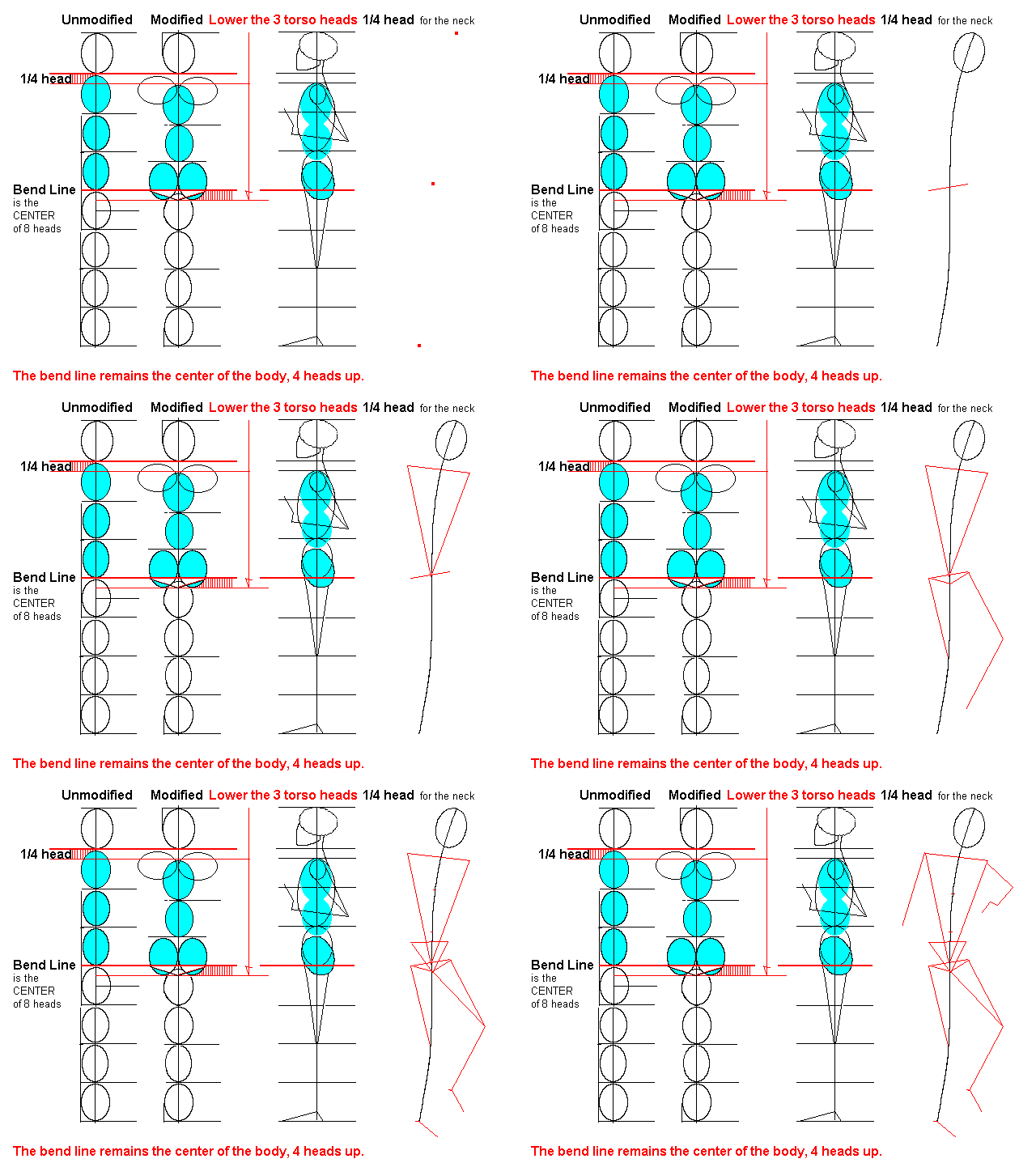
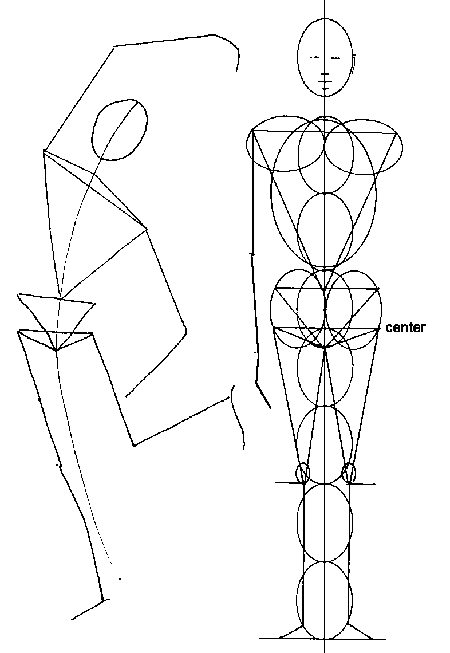
Take special note of the two pictures on the site, also shown below:


Good luck with your drawings, and I hope I helped.
Cheers,
D. "Nex" ShankarRed Winter Studios
Oluseyi
Oluseyi
Quote:
Original post by D Shankar
Your structure & pose is developing well, but I'm not so sure about proportion. Sure no one is perfect, but in the last pic with the skater, the buttocks might be the problem. Also, angle of lower body, and of the left skate is a bit off. Then again, it depends on the pose of the skater; perhaps it was an awkward one?

The pockets aren't at the buttocks. If you look closely, you will in fact see two pairs of rear pockets. The later, dominant ones were overdrawn when I realized that the kid had his pants sagging - you might also see a bit of his boxer shorts between the waist of his jeans and the bottom of his t-shirt.

Or did you see something else?


I considered taking my camera with, but concluded it wasn't worth the trouble. Thanks for the pointers, though.
D Shankar
D Shankar
Alright, and as I said, I wasn't sure because I didn't know the pose of the skater. I couldn't really tell that those were boxers protruding out, as the lines were too faint (at least on my monitor).

And I hope I didn't offend you by me asking if you do stick-figure proportion drawings. I was just curious because its recommended to draw stick-figures when drawing poses before adding detail; I never do it, and if you didn't erase it, it doesn't appear that you do either. Just wondering if perhaps drawing stick first creates a more accurate pose? I do that for 3d blueprints, but that's it...

Regards,
D. "Nex" ShankarRed Winter Studios
Oluseyi
Oluseyi
Quote:
Original post by D Shankar
Alright, and as I said, I wasn't sure because I didn't know the pose of the skater. I couldn't really tell that those were boxers protruding out, as the lines were too faint (at least on my monitor).

Yeah, I was drawing in an H pencil, which scans quite faintly. I might switch to a 4B to at least outline, but that's likely to smear when I scan. Maybe I'll photograph my sketchbook instead?

Quote:
And I hope I didn't offend you by me asking if you do stick-figure proportion drawings. I was just curious because its recommended to draw stick-figures when drawing poses before adding detail; I never do it, and if you didn't erase it, it doesn't appear that you do either. Just wondering if perhaps drawing stick first creates a more accurate pose? I do that for 3d blueprints, but that's it...

I'm not at all offended. I came here asking for critiques and suggestions on how to improve, so your comments are very much appreciated.

I don't do stick figures by virtue of habit. I've actually been drawing for a long time, without any formal instruction, but had been away from "serious" drawing for nearly ten years. I decided to get serious about it earlier this year. I may never do stick figures, but I will probably try using simple ovoid shapes for construction/posing and see how that affects my work.

Thanks!
slowpid
slowpid
Not being a fan of over-acclaim I'll keep my praise short. I like them, I like the men in the chair the most, very well done.

Your style is improving and/or we haven't seen this style from you yet. These drawing are a fine example of loose sketching, and I suggest you take it further. All this yet lacking in a certain foundational quality that I think will come with time (rather than formal study). Just work on your shape, make them slightly more dynamic, and keep your bearings when it comes to proportion. One of the hardest things for me to do personally is to keep from drawing proportionally smaller and smaller as I get down the page, so that by the time I am done my muscleman has feet that would fit a womens size 4.


D Shankar
D Shankar
Quote:
Original post by OluseyiMaybe I'll photograph my sketchbook instead?


I don't recommend that. I've tried it, and one must be careful, or one will get bad lighting and angles, and/or bad cameras result in yellow pictures, bright spots, and sometimes blur! You could try retouching it on a computer. Then again, you could also sketch over an H with a darker pencil after you’re done.
D. "Nex" ShankarRed Winter Studios
Oluseyi
Oluseyi
Quote:
Original post by slowpid
Not being a fan of over-acclaim I'll keep my praise short. I like them, I like the men in the chair the most, very well done.

Thanks!

Quote:
Your style is improving and/or we haven't seen this style from you yet. These drawing are a fine example of loose sketching, and I suggest you take it further. All this yet lacking in a certain foundational quality that I think will come with time (rather than formal study). Just work on your shape, make them slightly more dynamic, and keep your bearings when it comes to proportion. One of the hardest things for me to do personally is to keep from drawing proportionally smaller and smaller as I get down the page, so that by the time I am done my muscleman has feet that would fit a womens size 4.

I do remember you giving that advice earlier. I have a pretty interesting photograph that I want to sketch, so I'll take the opportunity to do both successive simplifications (each sketch in the progression at half detail) and size reductions.

Quote:
Original post by D Shankar
I don't recommend [photographing your sketchbook]. I've tried it, and one must be careful, or one will get bad lighting and angles, and/or bad cameras result in yellow pictures, bright spots, and sometimes blur! You could try retouching it on a computer. Then again, you could also sketch over an H with a darker pencil after you’re done.

I had tried it once, too, for the sketches at the top of this thread. The results were thoroughly mediocre. I'll try to darken my lines where appropriate, or even just switch to a heavier pencil.
Oluseyi
Oluseyi
New Drawings


Reference Image


For one thing, I worked over the outlines on these two drawings with my 2B pencil, and I think the results are much better scans. I'm hoping to be able to get away and do some sketching again this weekend. The first sketch below I did in the office, and while I found the results generally pleasing, I noticed some structural defects which I noted to the side. I feel that the structual problems may have arisen from the fact that I didn't build up the model from basic shapes; I just studied what I saw and tried to reproduce it to scale.


Image 1


I didn't originally set out to shade either of the drawings, but in the case of the former I was unsatisfied by the figure outline, and wanted to take my first stab at adding realistic volume to my drawings, before any formal reading/instruction. In the second picture, I used a lot of construction lines and basic shapes, and then simply rubbed them across the paper to smear, creating shade in the process. (I used my finger in Image 1, too, but the purpose was different, I think.)


Image 2


Image 2 is quite clearly still a work in progress. Comments, questions, critiques? Bring 'em on! For convenience, here are the thread drawings side by side (reduced size):

Topic Locked

This topic has been locked by a moderator. New replies are not allowed.

Sign in to reply to this topic.