🔒 Locked
🤖 Godot
Wall Street Implosion
Advertisement
Original Post
The Dow Jones Industrial Average has fallen 812 points this week for a loss in value of 7.11%. That works out to more than $1 trillion lost. Japanese and Australian markets are falling quickly as well. Goldman Sachs and Morgan Stanley are teetering. Washington Mutual is ready for the auction block. So far this year the United States government has spent $900 billion bailing out Wall Street. Last weekend Alan Greenspan described the situation as a "once-in-a century" financial crisis. That was before Lehman Brothers went bankrupt and the Federal Reserve bailed out AIG. So what do you think about all this? Will the Dow continue falling this week? Will the government suspend trading to halt the slide? Will the situation improve on it's own? And in this time of crisis where is President Bush? So far he seems content to send Paulson and Bernanke out to confront the matter. Is he worried that history will identify this meltdown with him, that is, is he worried about his legacy? How much worse will the crises have to get before he addresses the nation on it?
Quote:
Original post by Daaark
Isn't this to be expected? For the last decade, it has seemed like all the power was shifting to india, china, and other eastern countries. All the big companies are packing their bags and heading over there.
This is not so. If their is a crisis in America it will affect the whole world. No country is immune to it. The closure of Lehman Brothers made the lives of 25000 employees in India hung in balance. The business of Lehman Brothers in India is unsure of what to do now, mostly it includes the BPO. Even if companies may set up offices the power cannot be shifted to these countries. A lot of companies in India is now cutting jobs due to this crisis. So, this is not a crisis of America alone, the economy of a lot of developing countries depend on it.
The Man of Truth knows.
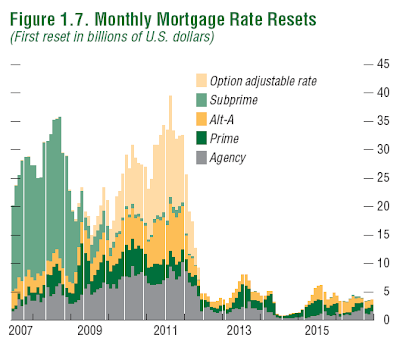
Take a look at the mortgage reset calendar and tell me that the worst is behind us.

Buying a house in 2009 is the trap of the decade. Take a look at the CSRX index or the shilling index.
Take a look at the mortgage reset calendar and tell me that the worst is behind us.

Buying a house in 2009 is the trap of the decade. Take a look at the CSRX index or the shilling index.
I've heard estimates that the crisis may take a couple of years to really play itself out and for the economy to begin recovering. It's not going to be a depression, and could be a recession. Growth and recession are perfectly normal. A meltdown like this is not. With proper regulation, the economic growth of the Bush years would have been slower, but at least there would not be such a sudden and surprising crisis.
Quote:
Original post by metalman666 Quote:
Original post by Daaark
Isn't this to be expected? For the last decade, it has seemed like all the power was shifting to india, china, and other eastern countries. All the big companies are packing their bags and heading over there.
This is not so.
This is so. Well... to an extent. The specific countries named arent necessarily the best examples, but its certainly true of Asia in general.
Earlier in the year I did some banquet waiting work and happened to work some business lunches for some of Autralia's larger banks, the Irish Chamber of Commerce, etc, a number of which included keynote speeches by highly respected economists which made exactly the same points: Detailing how major financial investment and insurance backing is increasingly coming out of Asia (alongside a few middle-eastern areas, such as the UAE), and moving away from western countries.
You're certainly correct that an American crisis is felt globally - business these days is too international to be able to completely avoid exposure to the American markets - but the point Daaark was making is correct: A lot of financial power is shifting away from America.
My guess is that a lot of smaller financial companies will go under. So far JPMorgan, Goldman Sachs and Morgan Stanley seem to the survivors since they don't have much subprime exposure. They're still taking a beating, but they'll probably recover. I'd be putting my money on smaller banks with no subprime connections.
I think that it'll take a couple of years to recover from this but since governments are a lot more likely to bail out the big companies there won't be any catastrophic bankruptcies. Unfortunately the taxpayer will be paying for it.
I see two good things come out of this:
- Stocks of good companies that will grow in the future have are now available at discount rates. If you've got money and you've got the guts for investing the time would be around now (maybe wait a few months to see if it goes down some more).
- Oil producing countries that were keen to show off their new found wealth and power (looking at you Russia, Iran and Venezuela too) will get a good bitch-slapping since demand for oil will be down ($95 a barrel right now compared to $140 in spring).
Quote:
Original post by XisZ
Meh, America and the world has been through worst.
It's not going to take 4 major banks/credit companies to shut down America.
(...)
Next, if my grandfather can live through the depression, then I think I can live through a recession.
You're right, this isn't a depression. This is the entire decade of 1930 to 40 * 10!
We're even feeling the shockwaves here in Norway... people aren't going to be able to loan money for new houses for the next year at least. Huge article in Norway's largest newspaper yesterday about a family that couldn't even loan money to build two new rooms for their kids.
Also, concerning the Gamedev business - what's happening to ID Software? Aren't they in Texas, where they were hit by a hurricane?
Quote:
Original post by Sirisian
Isn't that why bush has financial advisers? To deal with situations like these? He's not a jack of all trades.
No he's not a jack of all trades. He's a jack off. The United States government just bought the largest insurance company in the world. The government this year has spent $900 billion socializing the financial sector. Any other President would have addressed the nation regarding this financial crisis by now. Bear Sterns, Fannie Mae, Freddie Mac and now AIG. Instead of stepping up to fulfill the leadership role he was elected to perform he's hiding. He's letting Paulson and Perino front for him. It's a disgrace.
Quote:
Original post by XisZ
Also, the $80 Billion given to AIG is federal reserve, as in NON-TAXPAYER money. So no worries there...not only that the government will certainly not lose $80B, they took in 80% of the companies stock and will sell when the time is right.
non-taxpayer money...
roflcopter?
Technically he's right, it's not taxpayer money. Before it was used for this it didn't exist, the reserve just printed more money to do so.
He's wrong in thinking it doesn't have an effect on tax payers though as printing more money will raise inflation as it devalues the USD. So though it might not have been taken from tax payers wallets it did make what money tax payers have worth that much less.
Quote:
Original post by Yazilliclick
Technically he's right, it's not taxpayer money. Before it was used for this it didn't exist, the reserve just printed more money to do so.
He's wrong in thinking it doesn't have an effect on tax payers though as printing more money will raise inflation as it devalues the USD. So though it might not have been taken from tax payers wallets it did make what money tax payers have worth that much less.
Yes, exactly.
The value of a dollar is not in the paper: you dont have to transfer the paper to transfer the wealth. The transfer of wealth away from the taxpayer is every bit as real. It may not have been taxpayers money, it was taxpayers' wealth.
Quote:These things have added confidence to traders and stabilised things somewhat (stable being a relative term these days). I've not heard a single source say anything negative about these government interventions.
Original post by LessBread Quote:
Original post by Sirisian
Isn't that why bush has financial advisers? To deal with situations like these? He's not a jack of all trades.
No he's not a jack of all trades. He's a jack off. The United States government just bought the largest insurance company in the world. The government this year has spent $900 billion socializing the financial sector. Any other President would have addressed the nation regarding this financial crisis by now. Bear Sterns, Fannie Mae, Freddie Mac and now AIG. Instead of stepping up to fulfill the leadership role he was elected to perform he's hiding. He's letting Paulson and Perino front for him. It's a disgrace.
If nationalising these things stops banks collapsing, I think that's a good thing. I don't give a damn if that's considered socialist or communist, I think the world economy is more important.
Quote:
Original post by caffiene Quote:
Original post by metalman666 Quote:
Original post by Daaark
Isn't this to be expected? For the last decade, it has seemed like all the power was shifting to india, china, and other eastern countries. All the big companies are packing their bags and heading over there.
This is not so.
This is so. Well... to an extent. The specific countries named arent necessarily the best examples, but its certainly true of Asia in general.
Earlier in the year I did some banquet waiting work and happened to work some business lunches for some of Autralia's larger banks, the Irish Chamber of Commerce, etc, a number of which included keynote speeches by highly respected economists which made exactly the same points: Detailing how major financial investment and insurance backing is increasingly coming out of Asia (alongside a few middle-eastern areas, such as the UAE), and moving away from western countries.
You're certainly correct that an American crisis is felt globally - business these days is too international to be able to completely avoid exposure to the American markets - but the point Daaark was making is correct: A lot of financial power is shifting away from America.
You know, this whole financial crisis was caused by The American Dream(tm). Americans are mostly living on borrowed money, spending big time on things they cannot afford. When the economy goes well, this isn't usually a problem. But in the past decade a lot of banks gave out high-risk mortages to people who couldn't afford to pay of their mortgage. They were lured with mortgages with low rates, and after a few years the interest rate was doubled or tripled.
Because economically it was going bad(People lost their job, etc.), and the fact that the interest rates would go up, more and more couldn't afford their high risk mortgage. While these mortgages have an calculated number that wouldn't be paid off(a well calculated risk), with the declining economy the amounts of mortgages not being paid off increased and increased. And because these mortgages are cut up and traded between banks over and over again, noone knows who lost what amount of money or how much they're going to lose.
And that is the cause of the problem. Not outsourcing or whatever. The fact that financial power is shifting might be true, but if banks hadn't took such high risks, this crisis would have never happened. Perhaps an economical fall, but not a crisis as we see it now.
Toolmaker
Quote:
Original post by d000hg Quote:These things have added confidence to traders and stabilised things somewhat (stable being a relative term these days). I've not heard a single source say anything negative about these government interventions.
Original post by LessBread Quote:
Original post by Sirisian
Isn't that why bush has financial advisers? To deal with situations like these? He's not a jack of all trades.
No he's not a jack of all trades. He's a jack off. The United States government just bought the largest insurance company in the world. The government this year has spent $900 billion socializing the financial sector. Any other President would have addressed the nation regarding this financial crisis by now. Bear Sterns, Fannie Mae, Freddie Mac and now AIG. Instead of stepping up to fulfill the leadership role he was elected to perform he's hiding. He's letting Paulson and Perino front for him. It's a disgrace.
If nationalising these things stops banks collapsing, I think that's a good thing. I don't give a damn if that's considered socialist or communist, I think the world economy is more important.
Well, the thing is, the problem is caused by this 'solution'. Everybody knew the fed would bail out these institutions, so why not push the risk to the max? If you win, you win. If you lose, the fed/taxpayers bail you out. Id know what to do.
Whatever problems there were, they have just been magnified once again. But hey, by the time we see the effect of that, the people currently responsible will be long since gone.
The bottom line is: you dont want a central bank creating an illusion of security. You dont want politicians, or people without even a pretension of accountability such as central bankers, manipulating the economy from the top down. Not even if against all odds, such manipulations actually do serve some sort of greater good.
What you want is for people who gamble, to be able to lose.
Quote:
Original post by Toolmaker
You know, this whole financial crisis was caused by The American Dream(tm). Americans are mostly living on borrowed money, spending big time on things they cannot afford. When the economy goes well, this isn't usually a problem. But in the past decade a lot of banks gave out high-risk mortages to people who couldn't afford to pay of their mortgage. They were lured with mortgages with low rates, and after a few years the interest rate was doubled or tripled.
Because economically it was going bad(People lost their job, etc.), and the fact that the interest rates would go up, more and more couldn't afford their high risk mortgage.
Toolmaker
If this is me being naive, then so be it. Everybody is saying that these high risk loans were being made to people who couldn't afford it, a.k.a.: lower-income folks. But as Toolmaker mentioned, they were able to pay their mortgage until the interest rates went up. So the risk wasn't giving these people loans, the risk was giving them loans, hiking up their rates to the point they can't pay and then kicking them out with no way for the mortgagee to work out a deal to keep the house.
I find it hard to believe that these banks couldn't just freeze the interest rates or temporarily put the rate back at their original amount so people can continue to live in their houses and the banks could not crash and burn.
Topic Locked
This topic has been locked by a moderator. New replies are not allowed.
Sign in to reply to this topic.
Advertisement