Original Post

I'm in class now so I'll share mine when I get a chance. I just think it would be cool to be able to share the problems we solve. I think it would be motivating.
I just got a nice wrapper for GLSL shader programs working. Now, with just a single line of code, I can create a shader program.
I wrote a simple query language for my super tiny database engine.
I guess the only reason Im proud is because writing parsers is the one thing I detest more than anything.
Not sure if that counts as a problem or not.
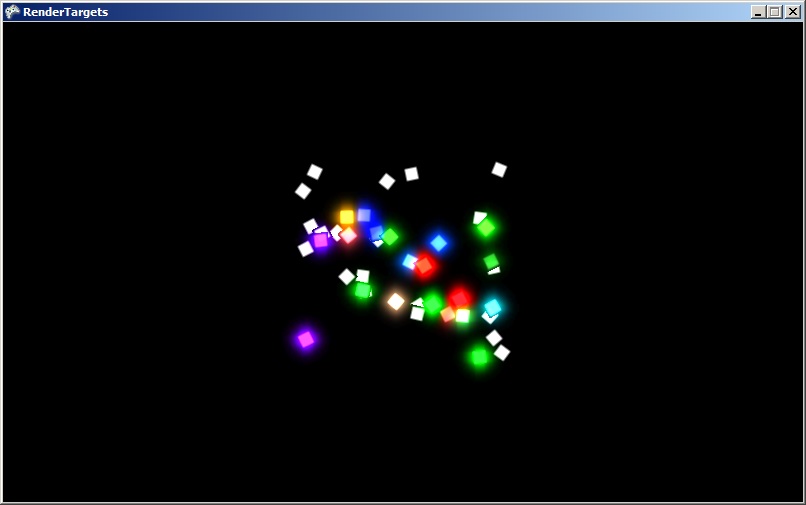
Hmmm, with the "recently" qualifier... I'm most proud of finally figuring out how to write and use shaders in XNA and selectively apply those to what I wanted. Downloading the bloom tutorial was easy-peasy. But understanding it along with the XNA SpriteBatch nuances took quite a bit longer. When it finally came together I was quite excited. :)
https://db4sgowjqfwig.cloudfront.net/assets/301809/GlowEffect2.jpg
I'm also pretty proud of my "Effects queue" for a turn-based combat system I'm working on. You piece-meal different effects together like a visual laser effect with a sound effect and random particles at the destination. The laser effect is drawn until the sound effect finishes playing while random particle effects are emited at the target end of the beam. When I first ran into the issue of "hey now there's sound in my game" the duration I was showing the laser blast, was completely off. :) I had to take a step back and think about the problem to come up with a decent design. Then it came together pretty quickly.
- Eck
template <typename Real>
Real compound_interest(Real x, Real y, int n_periods) {
  for (int i = 0; i < n_periods; ++i)
    x *= y;
  return x;
}
  Variable x{30000.0};
  Variable y{1.06};

  Variable z = compound_interest(x, y, 20);
  std::cout << "The value of the function is: " << z.get_value() << '\n';

  z.set_derivative(1.0);
  compute_gradient(); // This actually re-runs the computation in reverse, using a generalized form of backpropagation

  std::cout << x.get_derivative() << ' ' << y.get_derivative() << '\n';
Figured out how to give my enemies random movement and pattern movement "AI".
Self rolled animation controller. Though the harder part wasn't the controller but to get the data import right. And still is 
@Álvaro: Interesting: Is that paper available online ?
Implementing a 3D character controller entirely from scratch without a physics engine has been fun and certainly challenging. And also probably stupid. 
(What a nice, cheerful and positive thread by the way)
My recent achievement is getting asset hot swapping to work. Stuff like scripts, textures, data definitions, anything within a specific folder, are monitored and any modifications to these files are detected, and the file in question is reloaded. Since most of my code works with handles to these assets, the handles stay the same while the asset itself is reloaded, and everything works.
This has allowed me to do is create an ingame output console with a command prompt mode which executes any valid Lua code. This has been done completely in scripts (from logic to rendering), which means i developed the entire feature from the ground up in the matter of 2-3 hours without terminating the game at all :D
I switched most of my AI code (~80%) from single core to multi-core. Most challenging was to get the logic, which is written in lua (which does not support multithreading), distributed on several cores. All without using any additional lock-synchronsation like critical sections or semaphores etc., thought most of the sync is done in the 20% left for a single core.
Nevertheless, it works and make me proud 
I wrote a class that acts as a double for most purposes, but it almost magically computes the gradient of any function you define, with an CPU cost that is a fixed multiple of the cost of computing the function, no matter how many partial derivatives you are computing.
*Woosh* Right over my head...
My recent achievement is getting asset hot swapping to work. Stuff like scripts, textures, data definitions, anything within a specific folder, are monitored and any modifications to these files are detected, and the file in question is reloaded. Since most of my code works with handles to these assets, the handles stay the same while the asset itself is reloaded, and everything works.
This has allowed me to do is create an ingame output console with a command prompt mode which executes any valid Lua code. This has been done completely in scripts (from logic to rendering), which means i developed the entire feature from the ground up in the matter of 2-3 hours without terminating the game at all
I actually had to do something similar just recently too.
I just got a nice wrapper for GLSL shader programs working. Now, with just a single line of code, I can create a shader program.
I literally just got done doing this yesterday!
I had an idea for a voxel polygonization technique (isosurface, etc..) about three years ago, and proceeded to get distracted by life up until just recently. My goal was to produce something similar to marching cubes but without fine displacement of vertices to approximate isosurface. The goal was to come up with an algorithm that isn't marching cubes.
The ultimate goal was breaking the problem down into simple steps. I finally figured it out, and it was ultra gratifying. I haven't felt accomplished like that in years!
I started a blog about my project, with a better explanation if anybody is interested. http://deftware.blogspot.com/
I had an idea for a voxel polygonization technique (isosurface, etc..) about three years ago, and proceeded to get distracted by life up until just recently. My goal was to produce something similar to marching cubes but without fine displacement of vertices to approximate isosurface. The goal was to come up with an algorithm that isn't marching cubes.
The ultimate goal was breaking the problem down into simple steps. I finally figured it out, and it was ultra gratifying. I haven't felt accomplished like that in years!
I started a blog about my project, with a better explanation if anybody is interested. http://deftware.blogspot.com/
@radioteeth this blog is pretty cool, I favourited it so after tmrs testhopefully I'll be able to take a closer read through!
@Everyone I'm glad this has got so many responses and I see you guys are communicating with each other and learning new things here, as I guess happens in manye other places on these forums lol, but still, Awesome! And keep up the good work in general!
Got a deferred renderer working. G-buffer pass writing albedo + encoded normals. Then light pass decoding normals and applying diffuse lighting (single directional light for now). I need to get position reconstruction working so I can do specular lighting.
EDIT: Oh, and "published" my Artemis fork (journal link in my signature).
My latest most challenging problem: Not going mad while trying to release two of our games ported to Android...
So far, almost 100% success.
Still not completely released yet though...
Also a bit proud of my xml/C++11 UI framework that runs on our in-house engine that made the ports possible :P
This topic has been locked by a moderator. New replies are not allowed.
GameDev.net uses cookies to ensure you have the best experience on our platform. Learn more