Original Post

Hi,
Torque = Distance * Force
Torque = Distance * Mass * Linear Acceleration
These equations are for particles.
If I'm using a wrench, is the Mass the total of the particles in my hand?
Hi,
Torque = Distance * Force
Torque = Distance * Mass * Linear Acceleration
These equations are for particles.
If I'm using a wrench, is the Mass the total of the particles in my hand?
Nope, because your muscles and skeleton will deflect the force your arm applies to the end of the wrench into the ground.
You use Torque = Force * Length of the lever * sin(angle at which the force is applied to the lever).
The force it self must be known in this equation, e.g. a weight force or some such.
what u say doesn't make sense.
The mass in these equations stays the same. It's not the mass of the person that matters.
I deleted one part that really didn't make sense ?
If i understand you correctly you want to calculate a torque but do not know the force that's applied to the lever, is that right ?
You need to know the force your hand excerts. The force is the outcome of the work of the muscles and the skeleton of the person standing on the ground. It is not the number of particles in the person's hand. In the above case, the force must be known to solve the equation.
Torque = Distance * Mass * Linear Acceleration (for a particle)
If I use a 3D wrench, What constitutes the Mass?
10 minutes ago, Cacks said:Torque = Distance * Mass * Linear Acceleration (for a particle)
If I use a 3D wrench, What constitutes the Mass?
Almost correct. For the lever, you need the angle at which the force is applied as well, that is the sin term, or you assume that the force is always applied at 90° to the wrench all the way round.
For a child on a seesaw for example you know the mass (lets say 30kg) and the acceleration (9.81m/s² at sea level) and the angle is ~90° for the whole way it travels, for a hand pulling a wrench this is not the case. You must know the force and the angle at which it pulls to solve the equation (edit: for torque, or know the torque to solve for mass).
Mass is not applicable here, one must know or estimate the force at which the human pulls the wrench.
yeah 90 degree angle always to simplify
I disagree, the mass is applicable since it's in the equation
Any1 else like to add?
Vector from screw position to hand centered position (where you hold the wrench) x force applied (vector)
Is your torque
If i understand it right, the force is unknown. In this case, the formula for a force being mass * acceleration can't be applied like it could with a weight dangling from a lever (Harold Lloyd comes to my mind :-)) or a child on a seesaw.
Instead, the concept of work being done by the muscles should be used. That'll be Force = work/(displacement*angle) or so. But calculating the work isn't trivial and would differ from person to person. Perhaps it would just suffice to use a statistic figure from ergonomics, like 30kg or so ...
But i don't pretend to be right, just a suggestion.
Hi,
If that can help with the question when considering rotational motions the equivalent of the mass in linear dynamics is the moment of inertia (around the rotation axis here, it's more complicated with more degrees of freedom)
Torque [N*m] = moment of inertia [kg*m²] * angular acceleration [rad/s²]
There are some examples about how to compute moments of inertia here.
to calculate the Torque for a 3D object I could sum the Torques for each particle.
Which particles are we talking about?
A. All the particles within the hand
B. The particles which the fingers push on
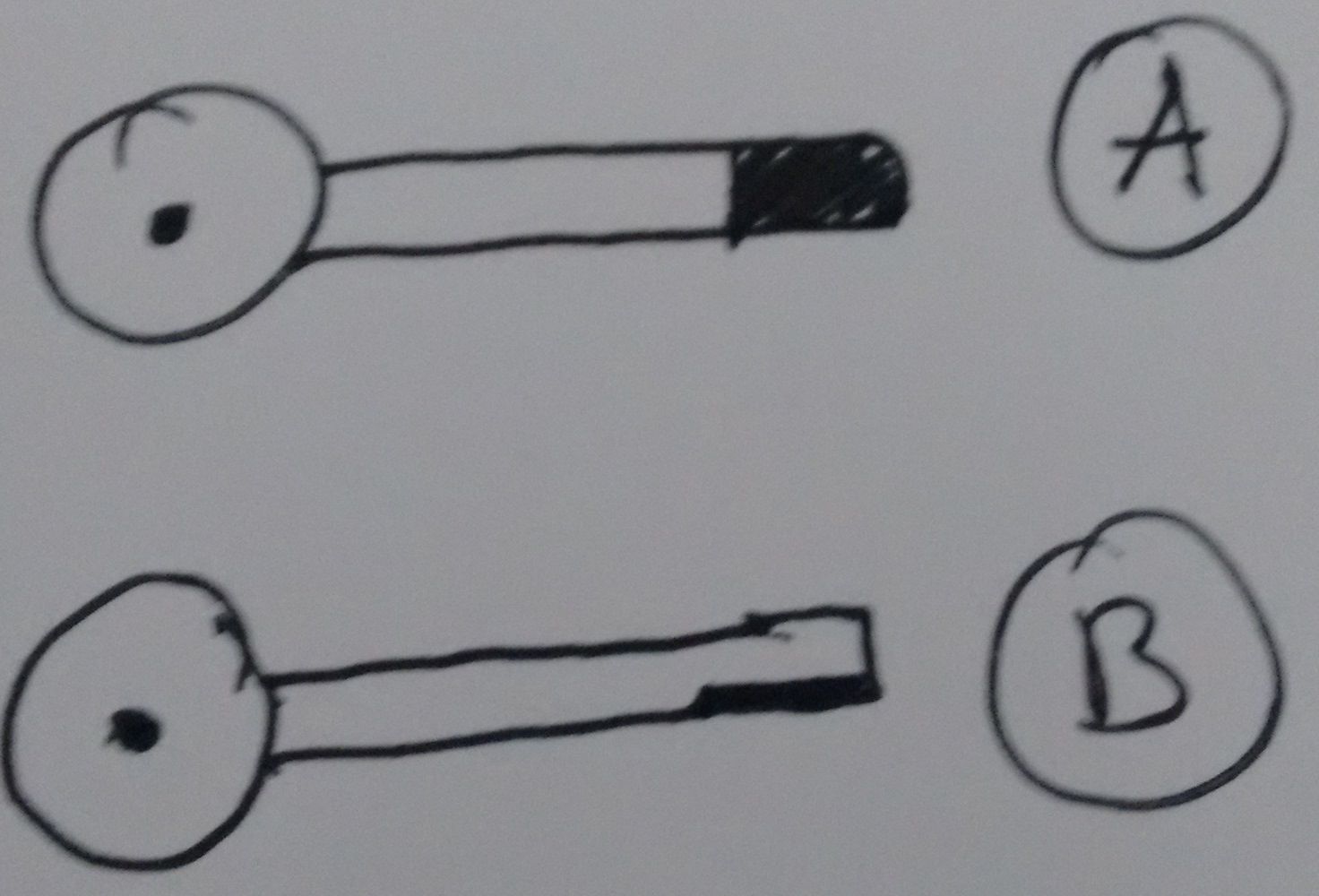
@Cacks
You need to integrate over the whole surface onto which a pressure is applied, which would lead to solution "A".
A net non-zero sum will emerge when one side applies more torque than the other in average. At least that's for a real hand for which the palm would apply more pressure than the gripping fingers on the other side for instance.
Also I don't know exactly what your inputs are but supposing that you get sets of particles onto which a given "force" is applied I would try to make sure the said "force" is scaled "per particle" = equivalent to a discrete pressure. Otherwise for each set it would be necessary to divide by the related number of particles to avoid artificially multiply the action.
Lots of guessing on my part here, never encountered such an issue TBH!
thanks. I never considered pressure before
The particles pushed by the fingers push on the particles above accelerating them too
So I could say the mass in Torque = Distance * Mass * Linear Acceleration is the mass of the particles in the hand 
I'm investigating angular movement in more depth atm
You should have a look about physics, and mainly the fundamental principle of dynamics, not the one from Newtons with vectors, but the one with torsors (extensions of Newton's laws which deal about moments). You will apply a force where the hand is, and will transport this resulting torsor at the center of rotation. This will give you the torsor of forces at this center, which should have a resultant null and a non null moment.
Q. When calculating Inertia; is 'r' in I=mr^2
a. The displacement from the centre of rotation
or
b. The displacement from the axis of rotation through the centre of rotation?
'r' is the distance from the mass element to the axis of rotation, and the r segment is therefore perpendicular to the axis of rotation (top figure at: https://en.wikipedia.org/wiki/List_of_moments_of_inertia)
In 3D the centre of rotation is actually undefined, and only an axis is to be considered. Also the point where the r segment meets the axis is purely geometrical and does not need to be part of the rotating object if that can help?
thanks that makes sense
But if I want to calculate the Inertia Tensor I will need a point the axis of rotation goes through?
Yes the axis itself is a line and as such must be fully defined by either a point and a direction or 2 distinct points indeed.
With 1 degree of freedom (= the axis is mechanically constrained) these points can be anywhere provided they geometrically belong to the line.
(with more degrees of freedom, typically 3 for a free solid, then there can be an infinity of different axes. However they all pass through the object's center of mass, which makes it a particular point for rotations too.)
If I want to add joints & composite objects I'll need to be able to calculate the Inertia Tensor at points which are not the Centre of Mass?
This topic has been locked by a moderator. New replies are not allowed.
GameDev.net uses cookies to ensure you have the best experience on our platform. Learn more