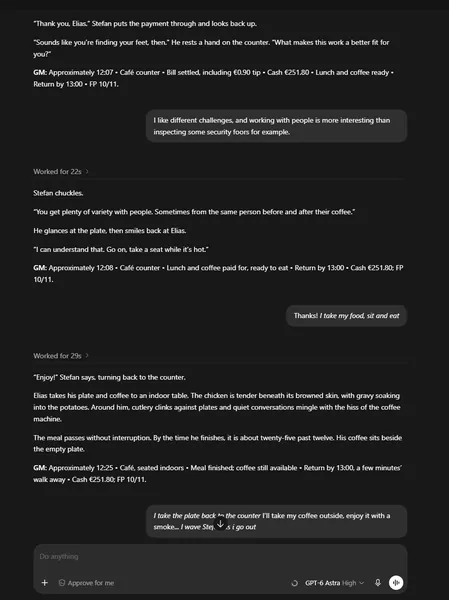
I’ve been working on an open-source project called RPG OS, and I’m looking for people willing to try it as a game and tell me where it succeeds or falls apart.
The easiest way to describe it is:
RPG OS turns a capable AI into a persistent text-based game engine.
You create or describe a world, become someone inside it, and play through normal conversation.
There is no fixed command list.
No dialogue wheel.
No predefined quest tree.
You simply describe what you try to do.
For example:
I don’t trust the front entrance. I climb onto the roof and look for another way inside.
The system has to determine what exists, whether that action makes sense in the established world, what happens, and what consequences should persist.
What I’m trying to build
The goal is not just “AI tells you a story.”
I wanted something closer to an open-ended game where:
the player can attempt actions that were never specifically scripted,
characters remember what has actually happened,
possessions and resources persist,
relationships can change,
injuries and unfinished problems remain relevant,
NPCs do not automatically know everything the player knows,
and failure is allowed to remain failure.
The world is stored in ordinary readable files so the campaign does not depend entirely on one long AI conversation.
You can save, come back later, and continue.
No tabletop RPG experience required
Despite the name, you do not need to know D&D or any tabletop RPG system.
If you can play a text adventure, you can understand the basic interaction.
The intended experience is closer to:
“What if an open-world game was made almost entirely from language?”
You could play:
a survivor on a damaged colony ship,
a merchant in ancient Rome,
a detective,
a smuggler,
a fantasy adventurer,
a ruler,
an animal,
or something completely custom.
The interesting part is that the game does not need the designer to predict every action in advance.
I tested one campaign for 30 sessions
I recently ran one continuous synthetic stress test for:
30 condensed sessions and 260 recorded player/GM exchanges.
The campaign intentionally included things that are difficult for an AI game to keep consistent:
debts with conditions,
different pools of money,
injuries,
unfinished work,
NPC knowledge,
changing agreements,
ownership disputes,
and consequences that only mattered many sessions later.
Some of it held up surprisingly well.
Some of it broke.
We found stale state, incorrect summaries, checkpoint timing problems, and other cases where the game files looked perfectly valid but did not accurately match what had actually happened.
I also deliberately corrupted copies of the saves to see whether the original play history could be used to expose the errors.
That process directly changed the current version.
This is still experimental
I’m not claiming that AI suddenly becomes a perfect game designer or game master.
It doesn’t.
The system can still misunderstand things, create weak scenes, or make continuity mistakes.
The current test was also AI-authored and non-blind, not a human usability study.
That is why I’m looking for actual outside players now.
I’m much more interested in discovering where real people break the system than in adding more features based only on my own assumptions.
Free and open source
RPG OS is free and open source:
https://github.com/croatianrdy2defend-create/RPG-OS
There is now a separate game-only download, so you do not need the development files, architecture documentation, or playtest material just to try it.
The repository also contains the full 30-session published test if you want to inspect what worked and what failed.
What I’d like feedback on
If anyone here tries it, I’d especially like to know:
Was it obvious how to start?
Did it feel like a game, or just like chatting with an AI?
Did you feel free to try unusual actions?
Did the world behave consistently?
Did anything important get forgotten or rewritten?
Was saving/resuming understandable?
At what point did the experience stop being fun?
What would make you choose this over a conventional game or ordinary AI chat?
And one broader game-design question:
Do you think “the player can attempt almost anything” is actually a meaningful game mechanic, or does it need much stronger structure around it to stay interesting?
If you try it and manage to break it, please tell me exactly how.