
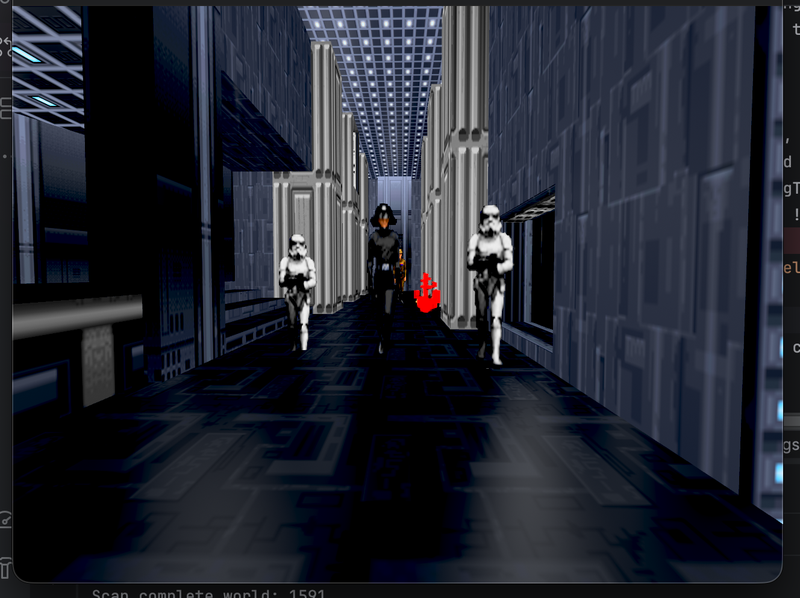
mr_tech Engine
Treat a game as source code, not as its runtime
About This Project
Can a 3D game be reverse-engineered, without infringing copyright, understood as a source representation, and transformed into a sufficiently general Intermediate Representation (IR) that allows it to execute on a runtime for which it was never designed?
mr_tech is an experimental attempt to answer this question.
The central idea is to treat a 3D game not as a runtime to be emulated, but as a source program to be understood, translated, and executed by a different runtime.
A bare-metal, highly decoupled 3D rendering and physics engine written in Go. Designed with a strict system-level architecture, it exposes the raw mechanics of spatial partitioning, portal-based visibility, rigid-body kinematics, and hardware graphics pipelines without relying on high-level commercial abstractions.
Architecture
The engine operates on a compiler-like pipeline, strictly decoupling geometry ingestion (frontends), logical entities, and the rendering/physics backends via an Intermediate Representation (IR).
Physics & Spatial Partitioning
The engine discards static blockmaps in favor of a universal, dynamic physical world.
Dynamic AABB Tree: Provides O(log n) spatial queries and collision detection. Every entity (player, NPCs, projectiles) is a first-class node within the tree.
Newtonian Kinematics: Implements real-time rigid-body dynamics featuring momentum conservation, friction, and elastic/inelastic responses.
Baumgarte Stabilization: Resolves inter-frame positional penetration (Positional Projection) ensuring jitter-free collision response.
Bidirectional Sync-Back: The physical solver and logical spatial topology are strictly synchronized. Passive physical deltas (bounces, impacts) are automatically translated back into sector transitions and portal resolution.
Entity System (Composition over Inheritance)
Entities are designed using idiomatic Go composition, entirely decoupling game logic from the physics and rendering cores.
Polymorphic Design: A central
IThinginterface drives the game loop.Core Encapsulation: A
ThingBasestruct centralizes the complex math for kinematic vectors and spatial sector synchronization.Behavioral Specialization: Entities (
ThingEnemy,ThingItem,ThingProjectile) embedThingBaseto inherit physics and topology natively, overriding only specific routines (like AI tracking or linear projectile motion) without polluting the core engine.
Frontends (Geometry Ingestion)
Geometry is parsed and translated into a unified planar topology (IR).
WAD Parser: Decodes classic WAD formats to extract raw geometry, completely ignoring legacy BSP trees.
Custom DSL: A text-based parser for rapid, textual planar topology prototyping.
Procedural Generator: An automated dungeon generator (Drunkard's walk) featuring dynamic portal resolution on shared grid edges and continuous elevation handling.
Rendering Backends
Portal Rendering Core: Dynamic visibility resolution and spatial culling utilizing a custom ring queue and visibility caching.
OpenGL Rasterizer: Hardware-accelerated pipeline featuring geometry batching and custom shader implementations (including SSAO for depth enhancement on planar geometry).
Software Rasterizer: A dependency-free implementation for direct vertex buffer manipulation and raw primitive rasterization.
Design Philosophy
This project acts as an explicit study of graphics internals, applied mathematics, and system programming. It avoids the "black-box" nature of modern 3D frameworks, offering granular, driver-level control over memory, spatial structures, and the rendering pipeline.
Discussion