
Crafting a 2D RPG
In this article we are going to go over a Game Design outline for a turn-based 2D RPG.
The RPG
So I'm not going to go in-depth here on all of the features. They will be discussed further down the article. However, I am going to make an overview of what we are going to design. To start things off, I want to say that we will be taking a look at a simple example of a 2D-Style RPG. We are going to keep it on a beginner level in nearly all terms. So, the 2D-style RPG will feature an old school King's Quest kind of camera. And yes, I know it's not particularly famous in the role playing genre, however I'm a believer that people should experiment when designing their own games, especially in the indies. So long story short - that's how I felt the viewpoint should be for the purpose of this game.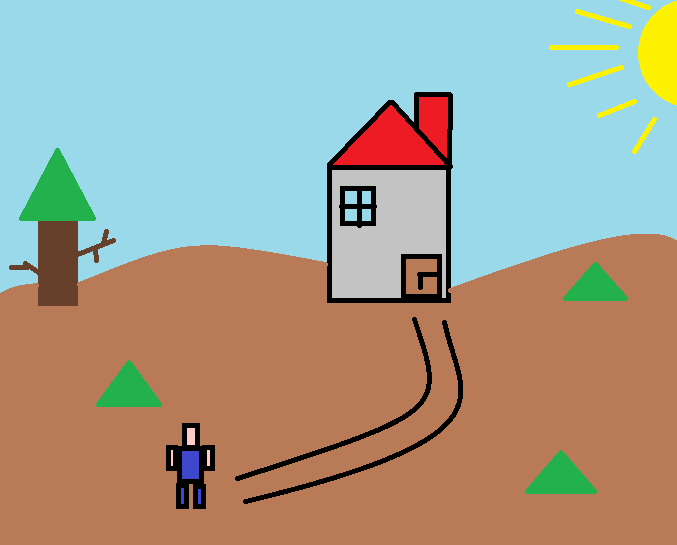
The Player
The Player will enter this game in the shoes of an unnamed main protagonist. The player has to be able to engage in all of the core mechanics of the game and thus - make the experience full. This would imply that the player needs to be able to do the following things:- Navigate freely throughout the game world.
- Interact with certain objects.
- Initiate in the game's story by engaging in dialogues and mainly quests.
- Evolve accordingly with the game's story and progress.
- Have the option to do certain things before others - that is, have options in front of him.
- Has to be as much a part of the story as any other component of the game.
The Game World
The Game World is one of the most important things to develop here. The fictional world that gives life to our fantasy has to be thought out in such a way, that it makes the player dive into it. Now, firstly, let's take a look at what we have as a design for the current game.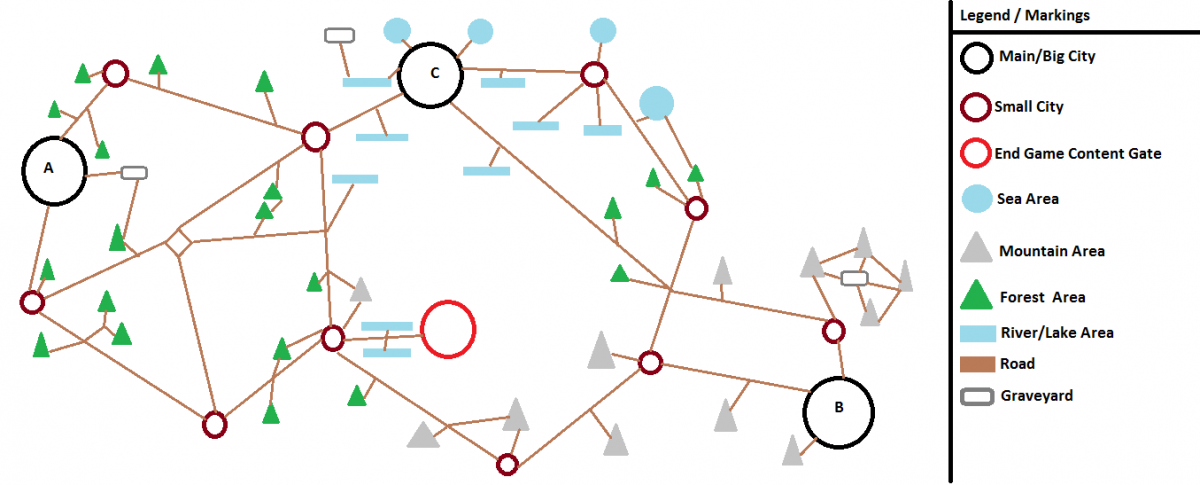
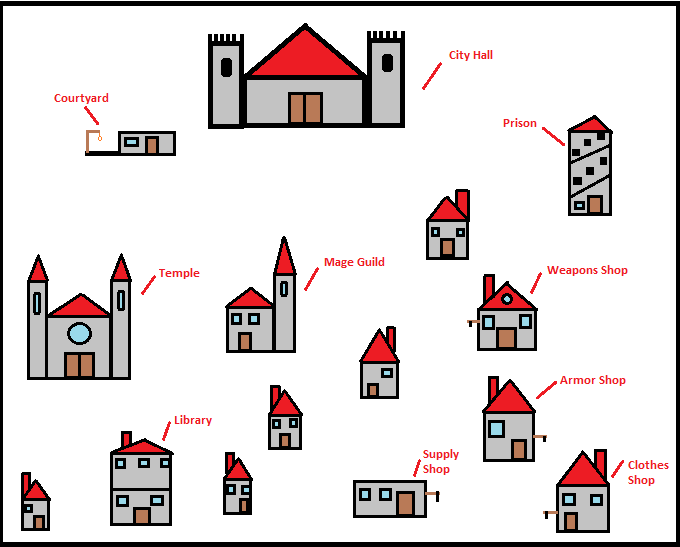
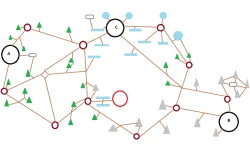
- City Hall - This is an important building for a lot of reasons. Most of your NPCs with high authority are going to be nested here. The story line intersects with these authorities, whether it's the Mayor, the city guard's Captain or whatever. A lot of the quests will lead you up to this building.
- Temple - This is the religious center of the city. As you will later on see, in the fictional religion of the game world, this would be the place to go and seek spiritual advice. The Temple is also going to serve the purpose of a healing center, a hospital if you will. Not in a literal way though.
- The Weapons Shop - Here you will be able to buy/sell items. Mainly weapons. This shop is a useful point for the Warlord, the Forest Hunter and the Tempest.
- The Armor Shop - Here you will be able to buy/sell items. Mainly armor. This shop is a useful point for the Warlord and the Tempest.
- The Clothes Shop - Here you will be able to buy/sell items. Mainly leather armor and robes. This shop is a useful point for the Elementalist and the Forest Hunter.
- The Mage Guild - This place is pretty much the biggest interest point for the Elementalist. From here you are going to be able to buy staffs, wands, books etc. (the items we will cover later on).
- The Supply Shop - Here you will be able to buy/sell items. Supplies like food, bandages, potions and others.
- The Prison - In this place you are going to be able to take up "bounty hunter" quests. These are going to be discussed later on.
- The Library - This is going to be a point of interest only for the players that want to dive deep into the story of the game. As this design promotes exploration, the library is going to do just that - give you the ability to explore facts and myths about the game world. You are going to be able to read books on enemies you might encounter, on the origin of the player classes and many others.
- Every other building on the picture, the Courtyard included, is there to be able to meet you with quest givers. People from the population of the city. That's not to say that you can't design the vendor at a certain shop to give you a quest, however the approach with having ordinary citizens reveal their not so ordinary stories through quests, is something that can be really enjoyable. The other buildings can vary. I've depicted them as houses, however the artist can choose for them to be something else.
Basic Story
Now in order for our world to have some logic into it, we need to mark out at least the overall story. No details, just the most fundamental things. They influence the gameplay, so basically we need to have them. So without going into names, details and other things along these lines, here is what it's all about. The game world was crafted by three godlike entities - one for each of the themes. A forest god, a mountain god and a water god. These three entities were tyrants and despots. They saw creation as a means to have something to destroy. As years pass and their torment over the beings of this world progresses and this pointed out to a defining moment in history. One of their own creations - a demigod hero, created for the purpose of forcefully spreading their will, is now too attached to the earthly creatures and opposes the entities. After an excruciating battle, the hero manages to seal them in an alternate isolated realm. He would have to offer himself as a sacrifice for three seals - one for each of the entities. By giving his own life, he manages to lock up the evils away from the realm of humans. The three seals were scattered throughout the world into the strangest of places and thus - the tyrants were no more. After the three entities were locked away, humanity progressed like never before. The people managed to find left over artifacts, scrolls and many other things that belonged to the tyrants and their minions. And even though the minions were still in this realm and not with their masters, they were no match for the humans. They became outcasts - terrorizing and attacking from a distance and not engaging in open warfare. This state allowed the humans to evolve beyond anything they've imagined possible - they tamed magic, they became exceptional warriors, they started to bend their own world to their will. In the wake of these events, a new religion came to be - one that would worship the hero that locked away the evils so long ago. And in the way of that religion, an order would be formed - The Order of the Tempests. They settled near the gateway to the other realm that was sealed so long ago and protect its entirety with their lives. Even more years pass. The hero, the evil entities and their cosmic battle now looks to be more of a religious story then an actual event. The only ones that still see and treat it as something real are the Tempests, however with time, they started becoming more and more of an outcast heretic order. However, some disturbing events are starting to unravel. The minions of the godlike entities, treated like insane heretics by the current population, are growing in numbers. They are starting to go through with more and more open attacks. It is at this point that our main protagonist receives a dark vision. The likeness of the ancient hero appears to him/her and tells a story of an upcoming storm that you have to stop. A story in which the evil entities have to be killed once for all or humanity will be devoured by them. And thus - after deepening the visions, our player is convinced that this is something that's real and has to to, so he/she sets on a quest to find the three seals, enter the tyrants' realm and put an end to them once and for all. So, now that we've looked at the story, let's go to something else in that regard - the questing and the narrative.Storytelling, Questing and Narrative
Now, in order to get a better grasp of how we are going to handle things with the storytelling, we will start off with the quests. Questing is going to be the essence of the game. We don't want a grindfest, mostly due to the core mechanics of the game. What we want is for the player to get the goods and rewards he deserves by doing something significant, at least to some extent. So, now we will have two lines of quests - main and optional. The main quests are going to serve as your progress meter - the more of these you complete, the further you will go. However, doing main quests only should not make your experience the best one out there. Yes, sure, you should be able to play through the game but not easily. The main quests should play the role of the mechanism that moves the story forward while optional quests should be there to grant the player experience and thus - levels, to enforce the story and last but not least - to help the player gear up with good items. That way, you will make the player experience more full and in turn - promote exploration. This is at the core of the current mechanics so this is something that we should strive for. Now onwards at how we are going to tell the story. This is something that we have to be very careful about. There are players that love story and dialogue and there are those that want to get straight to the point. Both types of players are right in their wishes and it is not impossible to attract both in one game. So to start off, one of the most important things in this regard are the dialogue interactions. On initiation, the dialogue should be short, concise, make a good but short summary of what's it all about and if it's information regarding a quest - you should be able to receive it in as few sentences as possible. However, with this being said, this should not be the dialogue in it's entirety. This is the feature that's meant for the players that want to go out and do things instead of talking. But let's extend on the dialogue - after everything is said and done, you should have more dialogue options. One is to stop the dialogue by saying "Thanks, bye now." but the others should have the function of extracting more and more information on your current topic. These other options should not contain data that is mandatory to complete the quest - that should be in the first, short version of the dialogue. The dialogue should enforce additional story, not mission objectives. So, the dialogue structure is out of the way. However our storytelling should not be restricted in just the narrative of dialogue. The gameplay and environment should be able to help out. How? Well, let's give a couple of examples. Let's say that you have a quest in a town and the objective is to hunt down a dangerous criminal. You have not taken the quest yet. As you go through the town, there should be one or two "WANTED" posters. On "use" action, you should be able to read more information on the wanted person. Also, this can be enforced by having the local people talk about the criminal. That way when you go and take the quest, you know what you are dealing with and that's done with no cut scenes and no additional dialogue. Another example of this would be the ability to read parts of the story in a big city's library. Let's say you want more information on an enemy type that you've encountered in the region. By going to the library you can read something on that enemy's origin and other helpful stuff along these lines. Another thing to note are the cut scenes. Even though we are talking about a 2D game, this can still be an issue. Cut scenes are awesome when implemented correctly and a real joy killer in other cases. So for our design we should have as few cut scenes as possible. They should be reserved only for the most important parts of the game and should not be too long. In them, we should just get the main point across. Nothing more and nothing less.Player Classes, Leveling and Skill trees
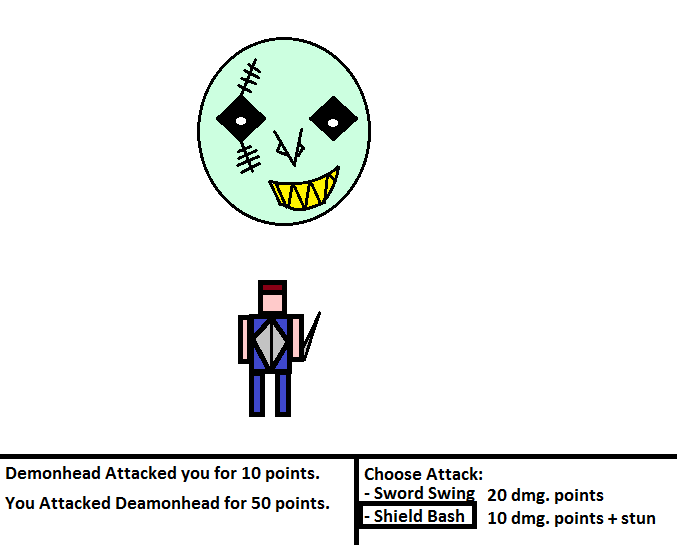
Now, in the beginning we've talked about the four classes that we are going to have - the Warlord, the Tempest, the Forest Hunter and the Elementalist. Now we are going to go more into detail of how they work, what their skills are going to look like and what the skill tree system is going to be. Just to clarify though - we are not going to go into details in terms of skills. Just outline them. Otherwise this article is going to get way too big. So now on to the classes. Warlord - this is the warrior class in the game. Brutal and ruthless, the Warlord craves combat and glory in an open battle. Can equip heavy armor and leather armor. Can use swords, maces, axes, spears, daggers and knives, hammers, shields. The skills of this class should be orientated to melee combat and close-quarter fighting. The skillsets that the Warlord can implement are those of a two-arm weapon specialist, dual wield weapon specialist and sword and shield specialist. This would mean that the first type is a slower, more damage dealing kind of build, the second is a faster fighter that deals less pure damage but more critical hits and lastly the last build is that of a character that places defense and attack on the same level. That is - he does not have the biggest damage output, however he can survive. Now, some of you might ask - what does faster and slower mean in a turn-based RPG? Well, it means that if you play a slow character, there is a bigger chance that your opponent can attack you twice before you can attack back. A faster is the opposite - you get a bigger chance of attacking twice. In case you level up correctly, you can get that attack number to three before the opponent can lash back. The normal pace is the norm - turn per turn. Tempest - the tempest is part warrior part caster. Can equip heavy armor and leather armor. Can use one handed swords, maces, hammers and shields. The skills are orientated to melee combat and close quarter fighting. The Tempest in his essence is not a real caster. The skills at his disposal are primarily buffs that increase either the attack, defense, speed or other attribute. Aside from that, the combat abilities are paced to an offensive warrior with a weapon and shield. This class should really be diverse and the way of play should be felt the strongest at your combat strategies. Elementalist - this is the caster class in the game. The Elementalist uses magic to bend the elements to his will. Can equip robes and clothes. Can use staffs, wands, daggers and books. In the gameplay of the Elementalist, the book is the off-hand weapon, like the shield in the examples above. Aside from that, the staffs can be two-handed and one-handed. The wands and daggers are naturally one handed. As a skill set, here we have three main builds - a fire mage that uses the power of the flames, a lightning wielder that bends the lightning to his will and a water mage that uses immense water attacks to drown his enemies. Forest Hunter - this is the archer in the game. The Forest Hunter's purpose is to keep the balance of nature intact. That some times, and that's quite often, requires a lot of killing. Being more of a cleanser to those who would threaten the forest, this range fighter has no problems in doing whatever is needed. Can equip leather armor. Can use bows, crossbows, daggers, knives, claws. As a build, the Forest Hunter can go on and kill opponents from a distance, thus giving two attacks to the player one after the other, he can also attack up close with increased critical hits and last but not least, he can use stealth as an increased defense mechanism, thus making him hard to hit. Each class has their own starting region. For the Warlord that would be the cold and brutal reality of the mountain terrain of City B; for the Forest Hunter, the woods of City A are the perfect place to fulfill their desire to balance out nature; for the Elementalist the perfect home are the shores of City C where they would gather knowledge from many known and unknown wizards and mages that travel from coast to coast; and the Tempest would find refuge in the town that's positioned right next to the sealed gate (the big red circle on the world map), leading to the exiled ancient evils. Now onto the leveling system. Naturally as with all games of this genre, we will level up through gaining experience. The attributes of a character (strength, agility, magic, health, mana, stamina) are going to be automatically incremented on a pre-defined basis. Per say the Warlord is going to gain more strength per level then the Elementalist. Now, as far as the level cap goes, in my estimation a total of 30 levels is going to be more then enough for this small setup. Now, on the topic of the attributes, we should take a look at just these simple schematics - strength increases damage; agility increases the chance that the enemy misses an attack; magic increases magic damage; health, mana and stamina are pretty clear. The one thing that needs to be noted here is this - the resource that the Elementalist and Tempest use for their skills is mana, and the resource for the Warlord and Forest Hunrer is stamina. So now that we've got the leveling and attributes covered, let's take a look at how we are going to spend skills. You will gain one point to spend per level. You will have a skill tree split into three branches, each of them being a character specialization as shown above. Now, the first skill of each branch is going to be unlocked at the beginning, the others are going to have a requirement of points invested into the branch. So, with the first skill being unlocked, you would need 3 points allocated into the branch and more specifically into the first skill in order to unlock the second skill and be able to allocate points into it. The third skill will need 8 points allocated into the branch, the fourth will need 16 and the final and fifth - 25. As the point number allocated per skill grows, so does the skill's efficiency. Now, let's take a look at how a skill can be used in a combat scenario - remember the combat picture from above? Well, the Shield Bash could be considered a skill in that instance. From the UI menu you would pick a possible "Skill" option and use the one that you would want.Items
Now to take a brief overview of the items. I've pretty much explained the items' grades and quality up to here, so I'm not going to repeat myself mostly because this article is starting to grow a lot. So, let's see how the rare items and the artifacts are going to affect our character. To start off, let's look at the rare items - they will have higher damage then your normal ones. Aside from that, they will grant you attribute bonuses. For example, a rare sword could give +3 to your strength. There could be all sorts of combinations in terms of upgrading your attributes. However, we need to add a bit of balance to this, so here is a rule for the current design - a rare item should not be able to add bonus points to more then two attributes. The artifacts are a different thing all together. Remember how in terms of the story they are left behind by the three godlike entities and their most powerful minions? Well, we have to reinforce that logic. These items have to really give the player the feeling that they have something special in their possession. So, straight to the point - the artifacts are going to be able to give bonus points up to four attributes. They are also going to be able to give up to 3 points to a specific skill. If the player has not allocated points to that skill, he will still be able to use it but as if just one point was allocated. In some special cases where the item has close correlation to the story, it can possess a special skill on its own and allow the player to use it. Aside from these item statistics, I'm not going to venture more into this, since again, this article is going to become too big. However, I want to note that the key to developing good items and good item systems is to test, test and test again. Do this until you have a good balance and a good experience.Enemies and Random Encounters
The enemies are a key feature in a game where exploration is in the center stage. If you want to have a good exploration feeling, you must have diversity in your opponents. As we've talked about earlier, the enemies are going to be theme-based. In order to make a good roster of enemies per theme, we should do a little grouping that looks something like this:- Recurring enemies - these are the lowest in power terms in the hierarchy. Only their attire changes on a regional basis.
- Region specific - these are enemies you will see in the entire region but are exclusive for it.
- Area specific - these enemies appear only in specific areas in the region. For example in the cemetery or in a specific forest.
- Bosses - they are unique. We will only have several of these throughout the game.
The Final Encounter
This is a very interesting point. However, I'm not going to discuss it in the current article since we are going into overload mode. I'm going to write a separate article on the encounter where we are going to talk about boss fights in a more broad spectrum and then I'll link the two materials together.Conclusion
Crafting a game experience is something that has to come from your own vision of what you want to see. In this design, I wanted to see a revert to the old school turn-based gameplay, quest-like atmosphere and broad exploration. I may have missed out on something but I hope I've encompassed enough in the current article.Article Update Log
2 Jun 2013: Initial releaseRelated Tutorials

Lesson 1 — What C# Actually Is
Why is C# the language driving the production of thousands of indie games using Unity and custom engines all around the…

Steps to Make a Simple Game in Unity
if you’re diving into game development, Flappy Bird is basically the ‘hello world‘ of the gaming universe. It is the ul…
.webp)
Automatic Tutorial Creation for Unity | No AI | No more time waste
Automatic Tutorial Maker (ATM) for Unity is a tool that automates in-game tutorial creation by recording developer acti…
Save and Load System for Godot 4 – Tutorial
Saving and loading game data is a crucial feature for any game, as it allows players to continue their progress even af…
 FreeTimeDev

Unity Finite State Machine Tutorial
Comprehensive tutorial on utilizing finite state machines (FSMs) in Unity game development. It explains the concept of …

Project Structure - Guide to Cocos Cyberpunk Source Code
In my previous post, I mentioned that I would be write a series of articles on Cocos Cyberpunk. So let's kick off with …
 Mr. Kylin
Discussion
More from Ivan Spasov
RPG Character Design: Technical Blueprints 101
In this article we will take a look at how you can design and develop from a technical standpoint your character classe…
Ivan Spasov
Crafting a Platformer Game
In this article we will take a closer look on how to create the Game Design for a simple Platformer Game.
Ivan Spasov
Documentation for Indie Studios: Why do you need it?
This article features the importance of writing down good documentation for the entire development process. This is app…
Ivan Spasov
Discussion