
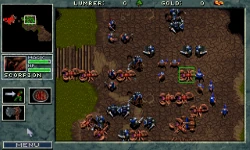
Retro Mortis: RTS (Part 2) - Then a Blizzard came...
In this article, I take a look at what Blizzard's Warcraft: Orcs and Humans brought to the table and how it differed from Dune II.

Context
During my last article, I've entertained that Dune II was the original precursor of the RTS genre, and have argued that it had led to a "conflict" that opposed Westwood Studios (Now defunct, formerly under EA leadership) and Blizzard Entertainment (now part of Activision Blizzard) from 1992 to 1998. The fierce competition during these years helped shape what would become of the modern RTS. I thought it only fitting to take a look at Blizzard's response to Westood and see where things went from there. Please note that without Patrick Wyatt's invaluable recollection, this article would not have been made possible.Warcraft: Orcs and Humans

Multiplayer
Warcraft's primary innovation is the concept of multi-player. In Blizzard's original vision of the RTS, it was a game that was meant to be played competitively. Limited by the technology of its time, it still managed to boast a modem-bound multiplayer system. It even allowed crossover multiplayer on different platforms (PC vs MAC). Since this was the first foray into the RTS multiplayer experience, it was provided "as is" with limited support. There were no specific gameplay features attached (ladders would only come with future installments). To make room for its multiplayer, Blizzard also helped define the core differences between the Single and Multi player experiences. Single Player... ...has an engaging storyline (much more characterization and context than Dune II). ...has a variety of threats and encounters (mirror matches (human vs human), npcs (scorpions, ogres), etc.) ...has a variety of objectives (rebuild a town, survive for a given duration, limited forces (no base), etc.) Multi Player... ...is a head-to-head match-up where both forces have an equal chance of winning. ...places the burden of "fun" on how players seek to defeat one another and assumes balanced opponents are facing off. A heated multiplayer match...
 Economy
Resources changed a lot with Warcraft. From mere "spice laying on the ground" they've evolved into two distinct sources: Trees (Forest) and Gold (Mine). Yet, the biggest change in the economy is the introduction of the complex economic units: Peasants (Peons). Peasants are "complex" because they provide the player with meaningful decision-making (and cost of option). They're both able to build structures (using resources) and harvest resources (acquiring resources). They affect the resource flow positively AND negatively. Choosing to order a peasant to build a structure has several implications:- It removes the peasant from the task it was performing: this is a cost of option as the player is accepting that the ongoing labor will no longer result in resources being acquired. Since the unit is immobilized for a certain duration, the effect can be quite dire.
- It consumes resources based on the structure cost. This is another cost of option as these resources cannot be used elsewhere from here on.
- It provides the player with a new structure (when construction is completed). Depending on what that structure is, it can help the player economically or militarily, but generally will require further investments. The building generally provides further cost of option (building a footman? at what cost?).
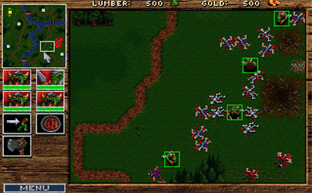 That's what happens when you fail to defend your supply lines...
 Logistics: Roads
An often forgotten mechanic from Warcraft: Orcs and Humans that was not present in either sequels was the inclusion of "roads". These were mandatory to construct buildings and expand the base. In a way, they played the same role as energy, minus its vulnerability. One would have to pay good money to have roads established. This emphasized the need to keep a closed base (use as few roads a possible given the cost). In a way, roads are the children of the concrete slab in Dune II. The slabs were initially established to insure buildings would be sturdy, but ultimately, it was a means to build proxy bases cheaply (without the use of a MCV). Unfortunately, the roads pale in comparison to the slabs, and did not add much in terms of gameplay. What it did however is provide a sense of community and strong lore: the players are building encampments, not just buildings here and there. Though the implementation was relatively poor, it was found to be lacking in later installments. Roads, building communities since 1994!
 Food
While Dune II sported a flamboyant limit on building construction, Warcraft: Orcs and Humans decided to put emphasis on units. Dune II had a loose text message to determine that the max unit count for the entire game had been reached which basically pooled all in-game units into a zero-sum game: you would have to kill units if you were to build more of them. This archaic form of handling unit capacity in games was around for a fair bit of time. For example, the turn-based strategy VGA Planets originally had the same approach: there is a maximum of 500 units in the game, no matter what. There comes a point where the max is reached, and the game handles it in a different way (in VGA Planets, it uses a system of points, which is mostly influenced by the amount of units you destroy, to determine who gets to build units when a "slot" frees up). Dune II was simplistic: whenever a unit would get destroyed, any unit currently "ready to deploy" could fill that slot, but the algorithm that determined which was arbitrary. Warcraft fixed this design issue by implementing a "by faction" cap. Assuming the maximum amount of units any game could have was, say, 100, this was split across both factions (50 for orcs, 50 for humans). In Warcraft: Orcs and Humans, each "farm" building provides a few units of food (4 if I remember correctly) which means you can create 4 units for each farm. Likewise, your army can never be larger than 4 times the amount of farms you have, or larger than your ultimate faction capacity (half of the game's units). You can, technically, construct more farms than your actual cap, but they will only serve as redundancy in case other farms get destroyed. What Warcraft recognized is a flaw in Dune II's (and many other games of its time) design: because base construction was limited, but not unit construction, it could lead to very aggressive build-ups. Since Warcraft insisted on competitive play, they couldn't allow it, and farms were a means to favor the defender: Assuming both factions always have the same amount of farms, the faction with the fastest reinforcements will be the one closest to the fight, de facto: the defender. This ensured that no amount of early aggressiveness could fully annihilate an opponent in the early game (unlike the "4pool" in Starcraft for example). Also, since all units consumed exactly one "food", players were encouraged to build their tech tree and get the "best units" to fill these slots as quickly as possible. Having a fully capped army of footmen was not desirable when facing off against several raiders (orc knights). The food system, however, left base growth rampant. Though limited by the construction of roads, a base could freely expand limitlessly. Food was also very abstract when compared to energy. It was "just a number" and a very static resource. It worked well in its own right, but did not provide much depth. In many ways, food was not necessarily the best solution, but it was certainly the simplest. It allowed to handle several of the design flaws of the original Dune which simply had no means to handle unit capacity properly, and prevented early rush tactics from being too efficient. A quick aside here on the feature that "almost was" (as was recently revealed through Patrick Wyatt's blog): farms were originally meant to be part of a drastically more complex approach to unit development which would've resulted in peasants being "spawned" from farms over time, and then trained at the barracks into military units or used as is as economic units. In what he calls a "design coup", the concept was drastically simplified into this abstract concept. One can't help but wonder what might have happened should the original system had been implemented. This barebone "Food System" has been used extensively by the Warcraft and Starcraft franchises, but also in other games such as the Warhammer series. It represents a very abstract means to achieve growth limitation and regulate army sizes. Though somewhat mainstream nowadays, it is important to note that it was found accidentally as a means to simplify an existing design that was deemed too complex at the time. It feels it has become the defacto common denominator of the RTS genre, though that may be a questionable status.Asymmetry
Warcraft: Orcs and Humans' assymetrical design is much more smoke and mirrors than gameplay. All orc units look drastically different than their human counterparts, but they serve mechanically the same roles. Though some units vary slightly (archers have a slightly longer range but lower damage output than spearmen, and magic units have a slightly varying range) they are fundamentally the same. With Blizzard, there's no cheap color swaps...
 - Both sides have a spell that allows them to reveal portions of the map (Dark Vision vs Far Fight)
- Both sides have a minor summon spells which summons creatures that are fairly similar (the spiders' damage is a bit more random)
- Both of them have a spell that can deal damage to a 1X1 area (over time dmg of 10) (Poison Cloud vs Rain of Fire)
- Both of them have a major summon spell which summons a powerful mob (The Demon is strong in melee and random, whereas the Water Elemental is ranged and has flat dmg)
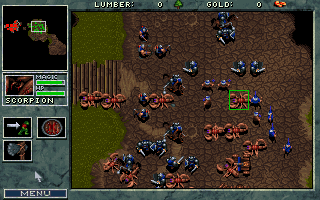 Spawning scorpions
 - The Orcs can raise the dead (temporarily) to add a few skeletons to their army and increase their damage output when there are fresh corpses nearby
- The Orcs can sacrifice half the life of a unit to make them temporarily invincible (tanks).
- The Humans can use "healing" which is particularly helpful economically as it allows to maximize the use of "surviving units" and give an extra boost to forwards in the fray.
- The Humans can use "invisibility" which allows them to hide units so long as they don't attack and allow them deep into enemy lines.
Unit Upgrades
Dune II had a system for upgrades which allowed players to unlock further units in the tech tree, but it never really capitalized on this system. Warcraft: Orcs and Humans built upon it by adding upgrades that would affect units directly. They went so far as to having buildings that would only be used to improve units as a whole (loosely based on the House of IX building in Dune II). From upgrades that would improve units' defenses and attacks up to outright new spells unlocked for spellcasters, these upgrades could easily lead to victory and defeat when misunderstood. They added an economic layer to the game where knowing when to make units more powerful vs creating a new unit was necessary. Because an upgrade's value could be measured by the amount of units it would be applied to, it was possible to min/max this strategy when weighting the upgrade's cost, and a number of players started to understand that it was fertile grounds for very advanced strategies.Random Map Generator
Borrowing from the Civilization series, the "Skirmish" mode had a random map generator which could potentially result in unlimited replayability. As time would prove however, the value of this random map generator was limited in that it did not necessarily generate "fair and balanced" scenarios. Later installments would use "ladder maps" instead which had undergone serious level design efforts.UX
Patrick Wyatt himself, lead programmer and producer of the game, would say that the feature he's ever been the most proud of was the multi-unit selection created for Warcraft: Orcs and Humans. He could very well be coined with the invention of that feature altogether, which no RTS has shunned ever since. Dune II was simply cumbersome to control, and it called for grouping. Though initially the feature was developed without limitations, some design constraints eventually led to multi-selection affecting only 4 units, thus making the feature much less useful, but nonetheless stellar. Suffice to say this one achievement was to become a staple of the genre.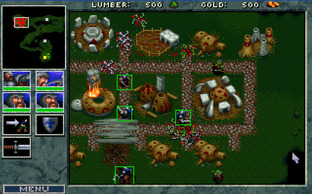 Multi-selection at work.
 Streamlining
Warcraft: Orcs and Humans started a process that several other RTS would refine which I like to call "streamlining". The good about streamlining is that it makes things easier to use and understand, it lowers the barrier to entry and minimizes the amount of fore-knowledge one has to have in order to learn and play the game. In most cases, this is desirable as it effectively allows to do more with less. The con with streamlining is that it sometimes eliminate depth. This often occurs when features were not implemented properly. With new installments, designers look at what worked and what didn't work and they axe features that didn't work without stopping at "why" they did not work. While this undeniably improves the quality of each subsequent installment it can also kill under-developed ideas that might have truly improved the game significantly.- *Warcraft: Orcs and Humans removed the concept of mercenary units which was present in Dune II's starport (and would later be re-discovered by Ground Control).
- *It removed the sandworm.
- It removed energy (though that's one system Westwood would not let rot).
- *It gave up on a lot of the subtleties of landscaping.
- *It simplified (and almost removed) faction assymetry.
- *It greatly simplified the campaign map.
- It made the minimap visible de-facto (without the need of a specific building).
- It reduced the amount of units per faction from 13 to 7-8.
- It reduced the amount of buildings from 18 to 8.
Assessment
I postulate that Warcraft: Orcs and Humans was instrumental to the evolution of the RTS genre. Its legacy is twofold:- On the one hand, it brought the RTS genre to the then rising multiplayer scene, forever associating RTS with PvP competition, and implementing the user interface tools to support that experience (multi-selection, control groups).
- On the other hand, it streamlined the original RTS design, focusing on very specific elements of the core gameplay to lower the barrier of entry to the genre, democratizing its use. However, it may have inadvertantly crystallized the core gameplay mechanics for titles to come along the way (sometimes relegating fresh ideas to the oubliette as a result)
Related Tutorials

Lesson 1 — What C# Actually Is
Why is C# the language driving the production of thousands of indie games using Unity and custom engines all around the…

Steps to Make a Simple Game in Unity
if you’re diving into game development, Flappy Bird is basically the ‘hello world‘ of the gaming universe. It is the ul…
.webp)
Automatic Tutorial Creation for Unity | No AI | No more time waste
Automatic Tutorial Maker (ATM) for Unity is a tool that automates in-game tutorial creation by recording developer acti…
Save and Load System for Godot 4 – Tutorial
Saving and loading game data is a crucial feature for any game, as it allows players to continue their progress even af…
 FreeTimeDev

Unity Finite State Machine Tutorial
Comprehensive tutorial on utilizing finite state machines (FSMs) in Unity game development. It explains the concept of …

Project Structure - Guide to Cocos Cyberpunk Source Code
In my previous post, I mentioned that I would be write a series of articles on Cocos Cyberpunk. So let's kick off with …
 Mr. Kylin
Discussion
More from Michel Mony
Elegant Design: An Applied Example
When I started in game design I read a lot of theory and really lacked tangible examples to ground my knowledge into. T…
Michel Mony
Retro Mortis: RTS (Part 4) - A New Hope?
We conclude a 4-parter on the history of RTS by covering the exceptions.
Michel Mony
The Art of Enemy Design in Zelda: A Link to the Past
Dissecting a game as an applied example of Functional Enemy Design.
Michel Mony
Discussion