

Light Introduction to Genetic Programming
GP is easy to conceptually understand and reasonably simple to implement at a basic level, which is what this article is about. It also covers the included example project
Introduction to GP
GP starts with 'genetic' because it is inspired from a process in nature called evolution. It is a subclass of Genetic Algorithms (GA) that deals with "programs" represented by tree graphs. By running a genetic program, you can perform a computation, make a decision, or generally execute some sequence of events. An example is shown below of a genetic program that calculates A + B * 7.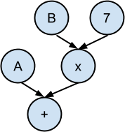
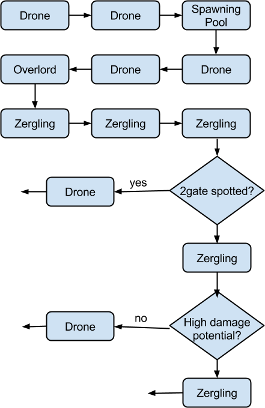
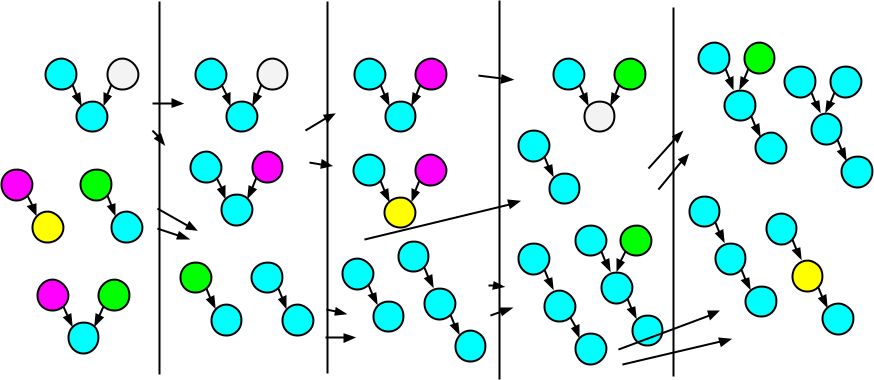
Some examples of what a GP tree can represent
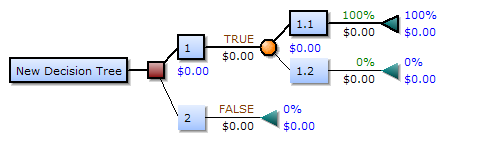
Arithmetic tree The easiest and I suspect most common use of GP is to let programs represent arithmetic expressions, most commonly expressions on "real" numbers (OK, computer floating precision aside). We have already looked at this earlier, but suffice to say that the ability to evolve a mathematical function for some purpose is a powerful one. Below shows an evaluation function in Lua evolved for a "medium" level AI in my game: (((((env.rounds)+((env.suit)*(env.rank)))+(env.safe))+((env.block)*(env.block)))*(((-4.0745883)+(0.025403308))+((((env.selfblock)*(env.dist))+((env.selfblock)*(env.safe)))+(math.random())))) Note how there are terminals (leaves) such as env.rounds, math.random() and constants, and the binary nonterminals + and *. Note that nonterminals in arithmetic trees don't in general need any extra parameters - just receive them as input branches. The whole thing is very confusing when read with parentheses in a linear text file, so let's draw the tree: 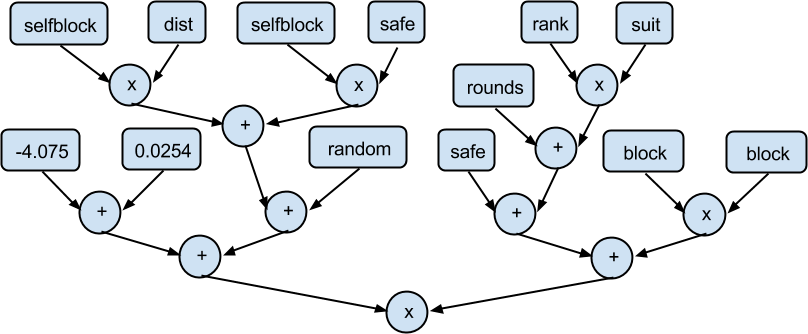
Genetic operations
Although only cloning and mutation were mentioned so far, there are in fact several fundamental genetic operations that can be applied on a GP tree. Cloning The easiest operation to understand is cloning, in which an identical copy of the parent/source tree is returned. I will avoid the term "parent" because it conflicts with tree graph terminology, and instead call parents source trees further on in this text. Similarly, I will avoid the term child (even though these terms are present in the source code). Anyway, here is an example of a cloning operation on a source tree:



Fitness and limiting overgrowth
Throughout this article we have assumed that there is a driving force behind evolution, guiding the evolution of genetic programs towards solving a particular task. That force is the fitness for the task. How you define fitness is domain specific, but for GP a good start is as a function that can be used to order the population. The fitness function of an individual should be based on how efficient it is at the task (whether it is to win, to survive, etc). For instance, in a game with win/lose outcomes you might base fitness on N_wins / (N_wins + N_losses). There is another important aspect of the fitness function; it can be used to protect against overgrowth. Overgrowth was briefly mentioned earlier, and it is a huge danger to the efficiency of evolution in some GP setups. Consider how efficient the expression 0 * (abs(sin(x)) ^ 5.88 + 72.21 - 28.01 * min(-827.17, x)) really is. In practice, rather than exactly 0, you might see constants evolving to some very small values when evolution tries to get rid of useless subtrees. The full effect of this can be unlimited growth of useless subtrees throughout the population, slowing down evolution to snail's pace, or worse. The problem, of course, is that there's no penalty for useless arithmetic in the AI code included in the game simulation. But rather than trying to add that to the simulation (which would break the game rules), we can add the penalty to the fitness function. A good start (if rough) is basing the penalty on the size of the GP tree. For instance, here's the fitness function I use in Sevens: float getFitness() { int size = play.getTreeSize() + send.getTreeSize(); int factor = Math.max(0, size - 20); return getWinRatio() - factor * 0.0004f; } Overgrowth might be less of a problem with execution trees than arithmetic trees since fitness will be influenced directly by the simulation cost of executing instructions; building a worker does not take zero resources in reference to Starcraft 2. On the other hand, decision nodes might consistently leave a branch unvisited in which case the subtree on that branch will be dead weight memory-wise. Evolution
There's another important detail yet to discuss, and it is how we select what genetic operations to apply to the individuals in each generation. First, here's how my rather crude implementation works (approximately) for each generation: New population := {}, population = (already initialized) Run simulation on population Sort population according to fitness in descending order For each genetic operation O: N := split_O * N_population For i = 1, N: Source := population Emit individual in new population using O(Source) Population := new population The split_O values should add up to 1 to keep the population at the same size between generations. These values let you assign how large of a percentage of each population should be submitted to each type of genetic operation. In practice, I use 10% cloning, 45% constant mutation, 22.5% tree mutation and 22.5% crossover. You'll have to experiment with what works for you. Why not do GP
GP is great since it (for example) can really learn entire functions independently, right? Yes, but only under certain conditions. To use arithmetic trees for AI agent evaluation functions as an example: First, you need to specify what the outputs of your functions mean, and in what context they will apply. Secondly, you need to describe the state of the environment with terminal nodes accurately for agents to be able to make informed decisions. Thirdly, you need to think about the set of nonterminal nodes. Including all possible binary functions on real numbers in mathematics you can think of is not necessarily useful and evolution will likely be much faster and stable with a limited set of nonterminal operators. Genetic programs share the same weakness with GA in general; a large number of generations with a large number of individuals must be computed for any learning/optimization to happen. This pretty much means GP is too slow for any online adjustment to the genomes. You need to be able to do batch-processing to execute a huge number of trials in advance (offline), and that entails having a simulation of the world. Consequently, GP is more suitable for games (on the condition they have batch processable simulation cores) than e.g. robotics, for which it is harder to produce simulations of the environment the agents operate in. GP and GA are random searches that will be outclassed by search algorithms that are better suited to the problem space, and should be seen as a last resort or "I don't care if it takes longer"-option. There are no silver bullets in AI; always investigate a lot before picking your approach or you end up wasting your time.Example project
The code attached with this article is the command line simulation and evolution tool in Java/Eclipse I developed in tandem with my app. The Lua source of my original app is not something anyone would like to view anyhow.The game
In the game of Sevens, the decisions that need to be made by an agent are of a very basic nature: Select the best card in two different contexts, when playing or "sending" a card to a player lacking a playable card. So, we can calculate a (utility) value for a certain action (a playable card), and we can pick the action with the best value. This is a reasonable way of modelling the decision structure of the game, and its simplicity means we can evolve basic arithmetic functions with GP for calculating the values from the state of the game for a particular action and context.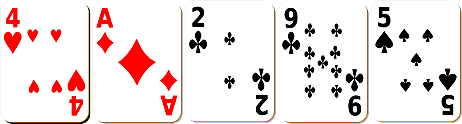 Which one???
 Running the tool
The tool simply executes from SevenGP.main() without taking any parameters or input. Thus, it's preferable to work from within Eclipse so you can modify the main function as needed. If you feel an urge to rant about this, consider that you will not be executing this kind of tool with changed input parameters very many times. You can download Eclipse for free here. The tool generates a file called computer.txt in the project directory, containing the Lua exported evaluation functions. I've left a default generated file there for your interest. Notice how at both easy and medium, many of the functions are downright trivial consisting of a single terminal - this is due to the stochastic nature of the game and the fact 0 versus 1 generations were executed for these skill levels. Only at hard with 11 generations you start seeing more interesting evaluation functions. I commented out the expert level as it's not necessary for demo purposes and it takes a while with 111 generations.How to adapt for own needs
I would recommend you rewrite the code in your favorite language and for your own game (while making improvements), in order to understand it. Try to avoid language mismatches like the Java/Lua mismatch in this implementation, since it is certainly preferable to be able to share game simulation code rather than rewriting it in two languages. Nothing prevents you from generating e.g. C# code from C# (heck, in .NET even at runtime if desirable) if you're concerned about the efficiency of the intermediate tree representation. You might find it possible to directly reuse this code in JVM projects - feel free to do so, although refactoring is still recommended. I did not intend this to be used as a library and I have no desire to start reworking it into one myself. Speaking of libraries, there probably are a couple to be found on the Internet in case you want to use a ready-made solution rather than do-it-yourself. If you feel confident you understand GP sufficiently or need a solution for a production level game, it's likely the better option.Structure of code
.sevengp package: Contains the main class SevenGP which you'll probably want to get reading/playing around with right away. .sevengp.game package: Contains the game simulation. Read up on this if you want to understand the game rules clearly, but you don't really need to. .gp package: Some base classes and interfaces for GP development, not particularly likely to be of generic use nonetheless. The Individual class is quite interesting, since it contains implementations of the genetic operations in its constructors. .sevengp.gp package: Extensions to the base GP package and player class for Sevens. .sevengp.gp.alphabet package: Terminals and nonterminals for Sevens. Many operations reside here in object oriented fashion (aspect oriented programming might have been more appropriate). Reading these are quite recommended. There's some confusion in the code regarding the term "individual". The Individual class only represents a single tree, whereas the Specimen class is a true individual, specifically tailored for the game of Sevens with two different trees for play and send contexts. There are more terms that might be confused, as a disclaimer.Final words
Hopefully this helps beginners to understand GP a bit better, and possibly giving them that final nudge that causes all pieces of the puzzle to fall in the right places and give sufficient understanding to implement GP. In my (subjective) opinion, GP isn't a difficult concept at all, and can be a very useful tool in the gameplay programmer's arsenal. Just make sure it's the best option before you spend time applying it to a problem. Top image credit: GECCORelated Tutorials
What To do If Your Game Received a Copyright Complaint
This tutorial explains how to respond to copyright complaints and why you shouldn't be scared of Apple's emails. It inc…
 IvanFedyanin

Video Game PR Basics
A brief guide to the very basics of video game public relations.
 Felicia McEntire
Building a Discord
Mega Cat Studios walk us through the journey the followed in setting up their Discord server.
Mega Cat Studios

Publishing 103 - What Publishers Look For in Games
A detailed look at what publishers want from a game, and the materials that you as a developer should have prepared.

Publishing 102 - How To Find The Best Publisher For You
In this article, I will be detailing the tactics you should use while you are on the search for the best publisher. It’…

A Guide to DIY Market Research for Indie Game Devs
Ah, market research. Just seeing those words probably sent shivers down your spine. Market research for indie game devs…
 Damien Yoccoz
Discussion