

Smart Pointers Gotchas
Answers for questions like - Why is auto_ptr deprecated? Why unique_ptr finally works good? How to use arrays with unique_ptr? Why create shared_ptr with make_shared? How to use arrays with shared_ptr? How to pass smart pointers to functions?
- Why is auto_ptr deprecated?
- Why does unique_ptr finally work good?
- How to use arrays with unique_ptr?
- Why create shared_ptr with make_shared?
- How to use arrays with shared_ptr?
- How to pass smart pointers to functions?
Some predefines
Let us take a simple Test class with one member field to present further concepts: class Test { public: Test():m_value(0) { std::cout << "Test::Test" << std::endl; } ~Test() { std::cout << "Test::~Test destructor" << std::endl; } int m_value; }; typedef std::auto_ptr<Test> TestAutoPtr; typedef std::unique_ptr<Test> TestUniquePtr; typedef std::shared_ptr<Test> TestSharedPtr; Why is auto_ptr deprecated?
auto_ptr was one of the first type of smart pointers introduced in C++ (in C++98 to be more precise). It was designed to serve as a simple unique pointer (only one owner, without any reference counter), but people tried to use this also in a form of shared pointer. None of those functionalities were satisfied by auto_ptr's implementation! Quick example below: void doSomethig(TestAutoPtr myPtr) { myPtr->m_value = 11; } void AutoPtrTest() { TestAutoPtr myTest(new Test()); doSomethig(myTest); myTest->m_value = 10; } Try to compile and run this... what happens? It crashes just after we leave the doSomething procedure! We would assume than in doSomething some reference counter for our pointer is incremented, but auto_ptr has no such thing. The object is destroyed because when we leave doSomething our pointer gets out of scope and it is deleted. To make it work we need to pass a reference to this auto pointer. Another thing is that we have limited way of deleting more complicated objects, there is no control over it at all, only standard delete can be used here. Why does unique_ptr finally work good?
Fortunately with the new standard we got a brand new set of smart pointers! When we change auto_ptr to std::unique_ptr doSomethig(std::move(myTest)); to move the pointer's ownership. That way after the function returns our pointer is also not valid, but we did it on purpose after all. Another nice advantage of this type of pointer is that we can use custom deleters. It is useful when we have some complicated resources (files, textures, etc, etc). How to use arrays with unique_ptr?
First thing to know: std::unique_ptr<int> p(new int[10]); // will not work! The above code will compile, but when resources are about to be deleted only single delete will be called. So how do we ensure that delete[] is called? Fortunately unique pointers have a proper partial specialization for arrays and we can write: std::unique_ptr<int[]> p(new int[10]); p[0] = 10; For our particular example: std::unique_ptr<Test[]> tests(new Test[3]); And we will get the desired output: Test::Test Test::Test Test::Test Test::~Test destructor Test::~Test destructor Test::~Test destructor As expected :) Note that if you want to pass address of the first element, you have to use &(pointerToArray[0]). Writing pointerToArray will not work. Why create shared_ptr with make_shared?
Unique pointers provide their features only via wise usage of C++ syntax (using private copy constructor, assignment, etc), they do not need any additional memory. But with shared_ptr we need to associate some reference counter with our object. How to do that efficiently? When we do: std::shared_ptr<Test> sp(new Test()); std::shared_ptr<Test> sp2 = std::make_shared<Test>(); We will get the output as expected: Test::Test Test::Test Test::~Test destructor Test::~Test destructor So what is the difference? Why not use syntax similar to creation of unique_ptr? The answer lies in the allocation process. With the first construct we need to allocate a space for the object and then for the reference counter. With the second construct there is only one allocation (using placement new) and ref counter shares the same memory block as the pointed object. 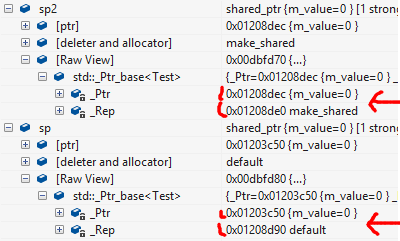 VS 2012 local's view
 How to use arrays with shared_ptr?
Arrays with shared_ptr are a bit trickier that when using unique_ptr, but we can use our own deleter and have full control over them as well: std::shared_ptr<Test> sp(new Test[2], [](Test *p) { delete [] p; }); We need to use custom deleter (here as a lambda expression). Additionally we cannot use make_shared construction. Unfortunately using shared pointers for arrays is not so nice. I suggest taking boost instead. For instance: http://www.boost.org/doc/libs/1520/libs/smartptr/sharedarray.htm How to pass smart pointers to functions?
We should use smart pointers as a first class objects in C++, so in general we should pass them by value to functions. That way reference counter will increase/decrease correctly. But we can use some other constructions which seems to be a bit misleading. Here is some code: void testSharedFunc(std::shared_ptr<Test> sp) { sp->m_value = 10; } void testSharedFuncRef(const std::shared_ptr<Test> &sp) { sp->m_value = 10; } void SharedPtrParamTest() { std::shared_ptr<Test> sp = std::make_shared<Test>(); testSharedFunc(sp); testSharedFuncRef(sp); } The above code will work as assumed, but in testSharedFuncRef we get no benefit of using shared pointers at all! Only testSharedFunc will increase reference counter. For some performance critical code we, additionally, need to notice that passing by value will need to copy the whole pointer block, so maybe it is better to use even raw pointer there. But perhaps the second option (with reference) is better? It depends. The main question is if you want to have full ownership of the object. If not (for instance you have some generic function that calls methods of the object) then we do not need ownership... simple passing by reference is a good and fast method. It is not only me who got confused. Even Herb Sutter paid some attention to this problem and here is his post on that matter: http://herbsutter.com/2012/06/05/gotw-105-smart-pointers-part-3-difficulty-710/ Some additional comments
Smart pointers are very useful, but we, as users, also need to be smart :) I am not as experienced with smart pointers as I would like to be. For instance sometimes I am tempted to use raw pointers: I know what will happen, and at a time I can guarantee that it will not mess with the memory. Unfortunately this can be a potential problem in the future. When code changes my assumptions can be not valid any more and new bugs may occur. With smart pointers it is not so easy to break things. All this topic is a bit complicated, but as usually in C++, we get something at a price. We need to know what we are doing to fully utilize the particular feature. Code for the article: https://github.com/fenbf/review/blob/master/smart_ptr.cppLinks
- "The C++ Standard Library" Second Edition was main reference for this post.
- http://stackoverflow.com/questions/8114276/how-do-i-pass-a-unique-ptr-argument-to-a-constructor-or-a-function
- http://stackoverflow.com/questions/14027079/stop-heap-allocation-via-make-shared
- http://stackoverflow.com/questions/9302296/is-make-shared-really-more-efficient-than-new
- http://ootips.org/yonat/4dev/smart-pointers.html
Related Tutorials
Balancing Game Development and Creative Direction in Indie Production
A practical look at how indie developers can balance creative direction with hands-on game development. This article co…
 huseyin_onur
My Unreal Engine Development Process: From Core Idea to Playable Build
A practical overview of my Unreal Engine development process, covering how I move from a core game idea to a playable b…
huseyin_onur

Introducing LaneGraph: The Ultimate Road Network Solution for Unity
Discover the power of LaneGraph, a lightweight and flexible lane-based navigation system for Unity. LaneGraph makes it…
Retargeting Mixamo Characters with Root Motion In Unreal Engine 5.4.
I have always found Retargeting Mixamo Characters To have Root Motion is a serious lengthy Tast, Recently I stumbled up…

How To Make A SIMPLE Main Menu In Unity
In this tutorial for unity, i go over how to make a simple main menu for unity, it's an unlisted video because i do not…
 FlipThaSwitzh

Guide to Gameplay Balance
A perspective on competitive gameplay balance, from a background of "shooter" sandbox design.
 Tucker933
Discussion
More from Bart?omiej Filipek
Custom Deleters for C++ Smart Pointers
We all know that smart pointers are really nice things and we should be using them instead of raw new and delete. But w…

Persistent Mapped Buffers in OpenGL
OpenGL (since version 4.4) gives us a new technique to efficiently move data from CPU to GPU. It's called persistent ma…
Introduction to Software Optimization
Takes you through the process and goes over the various techniques to optimizing your code
Discussion