
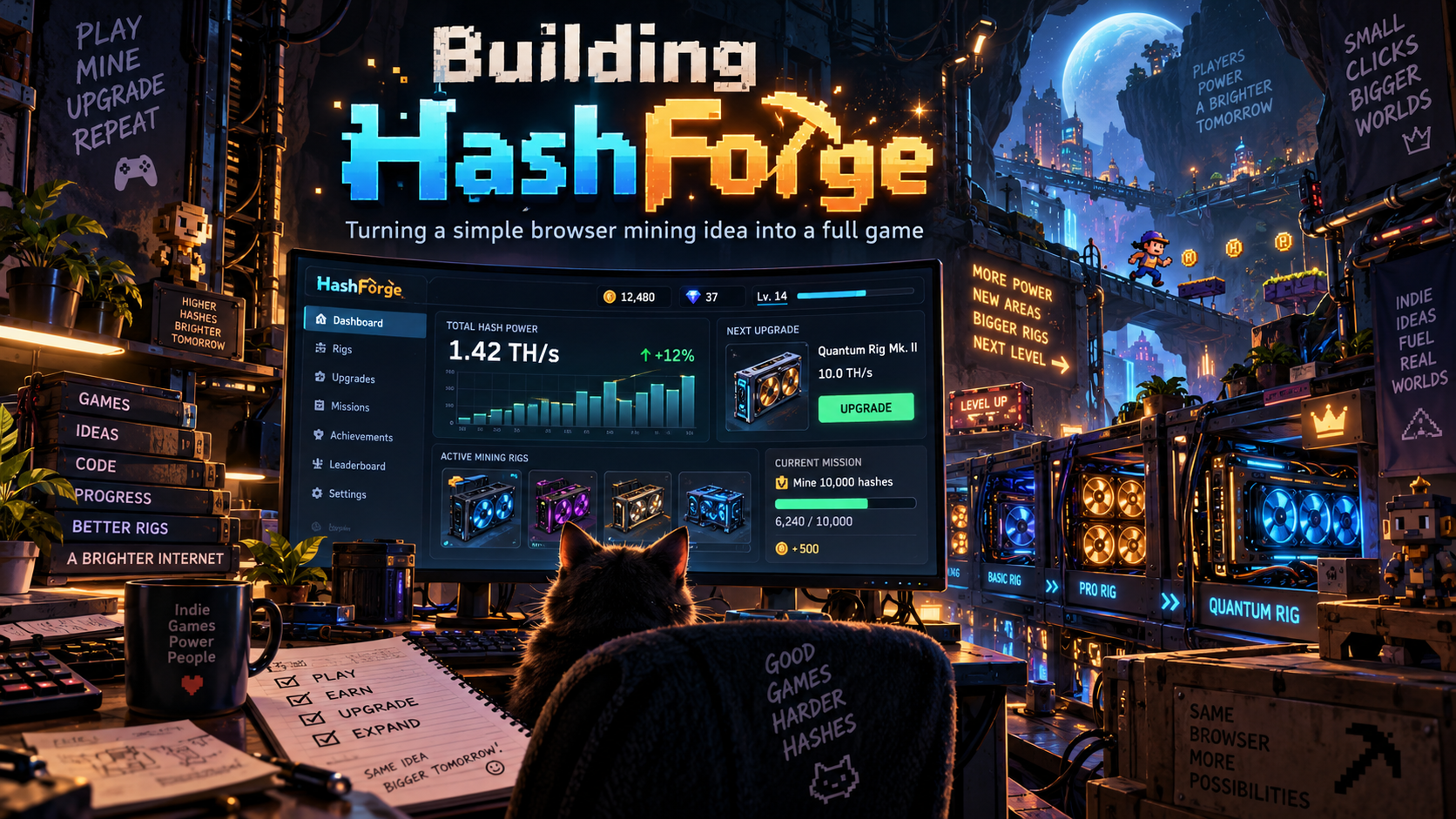
Building HashForge: Turning a Simple Browser Mining Idea Into a Full Game

When I first started working on HashForge, the idea was much smaller than what it has become.
The original concept was simple: create a browser game where players could build a virtual mining setup and gradually improve it over time.
But I quickly ran into a problem.
If the entire game revolves around watching numbers increase, how do you keep the player involved?
That question changed the direction of the project.
Making the Player Actually Play
Instead of turning HashForge into a pure idle game, I started adding small arcade games.
The idea was that progression shouldn't only come from waiting. Players should be able to actively improve their mining power by playing.
HashForge now has around 20 arcade games.
Winning games increases your mining power, while the mining side of the game gives that power a longer-term purpose.
That created the basic loop:
Play games → gain mining power → improve your setup → unlock better hardware → expand → play again.
It sounds straightforward, but balancing this loop has been one of the hardest parts of development.
The Progression Problem
One of the questions I'm still constantly working on is:
How quickly should a player progress?
If upgrades arrive too quickly, they don't feel important.
If progression is too slow, a new player may leave before discovering the deeper systems.
There is also a big difference between balancing a game for somebody playing for 10 minutes and somebody returning every day for several weeks.
I've experimented with cooldowns, hardware prices, mining power, daily activity systems and different reward structures.
Small changes can have surprisingly large consequences.
Increasing one reward may feel great initially, but several days later it can completely break the economy.
This has probably taught me more about game balancing than any individual technical feature I've built.
Building a Virtual Mining Room
Another major part of HashForge is the mining setup itself.
Players can collect and install virtual mining hardware, manage their mining power and expand their operation.
I wanted this part to feel like something the player is actually building rather than just another upgrade menu.
There are different rooms, hardware progression and several currencies between which mining power can be distributed.
Importantly, HashForge is a game and mining simulation. It isn't using the player's PC to perform real cryptocurrency mining.
The mining theme is the progression system around which the rest of the game is built.
Why Keep It in the Browser?
I've deliberately kept HashForge browser-based.
There is no launcher and no large installation.
Someone can open the game and start playing almost immediately.
That convenience is something I really like about browser games, although it brings its own development challenges.
A browser game has to deal with different screen sizes, mobile devices, browsers, sessions, loading behavior and server-side state while still feeling like a game rather than a website with some buttons attached.
I've had plenty of situations where fixing one small interface problem created another somewhere completely unexpected.
Anyone who has maintained a growing web game probably knows that feeling.
Adding More Systems Isn't Always the Answer
One lesson I've learned while developing HashForge is that adding features is easy compared with making existing features work well together.
At various points I've added missions, events, hardware systems, mining rooms, currencies, an exchange and additional arcade games.
Eventually you reach a point where another feature doesn't automatically make the game better.
Sometimes improving the first five minutes of gameplay is more valuable than adding the twenty-first game.
That is where a lot of my attention is going now.
What I'm Working on Next
The current focus is less about making the feature list longer and more about improving the experience.
I'm looking closely at:
early-game progression
balancing mining power
making hardware upgrades feel meaningful
improving the individual arcade games
clearer feedback when players make progress
better retention for players who return the next day
making the interface feel more like a game and less like a traditional web application
I also want to continue improving the visual identity of the individual games instead of allowing them to feel like generic mini-games placed inside a larger system.
I’d Like Developer Feedback
HashForge is playable now, but I'm still actively changing it.
I'd especially like feedback from other game developers about the core progression loop.
Does combining arcade gameplay with a persistent mining-management system make sense?
Would you prefer shorter sessions with faster progression, or a slower system where hardware upgrades take longer but feel considerably more valuable?
And perhaps the most important question:
What would make you come back the next day?
If you'd like to test the current version, it runs directly in the browser:
I'm interested in criticism as much as positive feedback. At this stage, finding the parts that don't work is much more useful than hearing that everything is fine.
Discussion