GameDev.net gamedev.net
🔒 Locked

Action points or not?

Started by Noddy92 May 15, 2018 at 12:06 PM 37 replies 19.4k views
Original Post
Noddy92
Noddy92

Hello,

I just have few questions. So, I'm currently designing a turn-based game, so my question relates to action point system. See I have a dilemma do I choose to implement old school action points (time units) which are calculated and distributed based on stats or do I use the one-two system like the new XCOM. I have been researching this topic, and some people say that action points are archaic, others that the new one-two system is overly simplified. What do you think, which is better in today's gaming scene?

Thanks


Thiago Monteiro
Thiago Monteiro

Well, my favorite turn-based game uses AP system (Jagged Alliance II), so I'm biased here perhaps. I don't think either system is inherently better than the other. That being said, I'd say having AP gives you a more straightforward mechanism to provide flexibility in comparison to a one-two system. To give an example, in Jagged Alliance you could use extra points to aim better, or maybe save it a bit to shoot twice in the next turn, or shoot and run. Adding abilities on top of that gives a lot of possibilities to explore. I find that the one-two system streamlines things a bit, which is not inherently bad and might remove unnecessary complexity, all things considered.


The bottom line, for me, is this: ask yourself the reason to add AP and how much complexity it will add (and you want in your game). If it is not providing nothing really different or if its use takes a lot to learn, the one-two system is familiar to players and works well. Otherwise, AP is a great option to mix up things a bit every now and then.

SRich867
SRich867

I'd say that it depends on how important you want the action selection part of your game to be, and whether you want action efficiency and economy.

If you want players to be able to choose actions quickly, then the 1 - 2 system promotes this - the player can decide quickly (potentially ahead of the character's turn) what he or she wants his or her character to do.

If you want players to deliberate more about what to do, then the action point system (with varied costs for actions) supports this - it takes the player longer to calculate options, and requires more thought.

I've been working on a pen and paper rpg for a while now and had a similar issue to decide. In the end, I went with a single action per character per turn - I wanted the players to decide what they were going to early to build anticipation for the outcome, and to speed play. With multiple players this also allowed more detailed plans to be put together. For a single player team-based game, APs will put the focus on individual action, 1-2 actions will put the focus on team action.

Noddy92
Noddy92

Great advice, but what I'm most concerned with is that the players will find action points too complicated (maybe the younger players, who didn't play Jagged Alliance 2, which is an awesome game, btw.).

People from the posts online that I read, are complaining that they have to pull out the calculator, which is funny because I never had that problem, and the older players like the older system. Somewhere I once read that the action points, are designed because they where emulating pen and paper games, but the problem is that I don't want to bother the player with too many numbers.

I just want a user friendly system, that doesn't burden the player, yet it is complex enough to perform a variety of actions. Basically what will most people understand including new players and the old players which already played this types of games.

Oh, and I'm designing a game in vain of Jagged Alliance, as far combat is concerned.


SRich867
SRich867

You could meet in the middle and give two unequally weighted actions. Like a big action and small action. That way different actions can be restricted to one or the other. A player can choose one big and one small action, or they could choose two small actions, or they could potentially have the option to save the smaller action to use in the following round.

This way it is quick and easy, there is some thought and usefulness is working out effective combinations, and there is a potential to carry actions over.

Alternatively, you could have three types. The small action (say for movement), the large action (say for shooting, etc) and a full action that takes the whole round (say for an aimed shot). I feel like this might be the middle ground.

Thiago Monteiro
Thiago Monteiro
13 hours ago, SomeoneRichards said:

You could meet in the middle and give two unequally weighted actions. Like a big action and small action. That way different actions can be restricted to one or the other. A player can choose one big and one small action, or they could choose two small actions, or they could potentially have the option to save the smaller action to use in the following round.

This could also work, but if you perform all your actions at once, it might not help. A variation on this could be: you have a fixed set of actions before the opposing faction can perform their actions, so you'd need to choose between many small actions or less actions with potentially higher impact. The difficult thing to adjust here is how many actions does each team get (due to number of squad members and so on), but it could be interesting anyhow.

Another positive point about this is that you can have an unified action bar and visually represent how much an action costs and how much this leaves you with. By only have 2 or 3 different costs, it becomes easy to identify how much you can do (which can be also marked in such a visual representation).

Noddy92
Noddy92

So what Richards is proposing is something similar to some sort of phase combat, if I'm understanding this correctly. The more research I do, the more I lean towards the classic action points (JA2, the original XCOM), but I'm really skeptical about this sort of hybrid system. This is one of the things I couldn't get used to RTwP (Real-time with pause).

I'm not saying his idea is bad, I'm just being cautious, because this is the core of my game or any turn-based game, and if approached carelessly it could turn out really bad.

Maybe if I put something like action point reserve (like in Xenonauts), that would tell the player what can be done with the remaining points. Anyway, back to my first question, which system will be more player friendly AP or one-two, are players getting lazy to calculate action points, can people enjoy my game besides the complex AP system?

SRich867
SRich867
11 minutes ago, Noddy92 said:

So what Richards is proposing is something similar to some sort of phase combat, if I'm understanding this correctly. The more research I do, the more I lean towards the classic action points (JA2, the original XCOM), but I'm really skeptical about this sort of hybrid system. This is one of the things I couldn't get used to RTwP (Real-time with pause).

I don't think that is what I am suggesting, but I might not be understanding by what you mean by phases combat...

What I am suggesting is this:

At the start of a turn each character has two actions... one little, one large. This is easily indicated with a bar (as Thiago suggests). Let's say there are two small actions, move or take cover, and one large action, shoot. There is also a massive action which takes the entire turn, like take an aimed shot, or get very deeply into cover. The character can use his entire turn to complete this longer action.

Each character has three choices, they can perform one little and one large action, in whatever order they want (they can move then shoot, or shoot then move, or take cover then shoot, or shoot then take cover), they can perform two little actions (run twice, or run then take cover, or take cover then run) or they can perform one massive action (take an aimed shot, or get into deep cover).

You can use different colours to show the available actions and the cost of each action.

Once each character has used his actions his turn is over. I'm not sure where the phasic bit is coming from...

This is just a suggestion. You should, of course, choose the mechanic that suits you best. I mostly wanted to highlight that each option has different effects regarding expedience and complication, and was suggesting something in the middle.

12 minutes ago, Noddy92 said:

Anyway, back to my first question, which system will be more player friendly AP or one-two, are players getting lazy to calculate action points, can people enjoy my game besides the complex AP system?

It's not about laziness, per se. It's about feel. If someone thinks the game is going to require calculation, or quick options, they'll approach it differently. You need to decide where you want the focus to be.

Eduardo Filippi
Eduardo Filippi
1 hour ago, Noddy92 said:

Maybe if I put something like action point reserve (like in Xenonauts), that would tell the player what can be done with the remaining points. Anyway, back to my first question, which system will be more player friendly AP or one-two, are players getting lazy to calculate action points, can people enjoy my game besides the complex AP system?

Hi, I think there is another reason why the one-two would feel "simpler", other than math: in a Big Action/Small action system there are only two different costs while on a AP system there can be a much wider range and this simplifies the UI/Makes it easier to remember.

There's nothing wrong with complexity as long as it adds meaningful decisions for the player, but depending on what kind of game you are aiming for you should budget it,

Thiago Monteiro
Thiago Monteiro
1 hour ago, Noddy92 said:

Anyway, back to my first question, which system will be more player friendly AP or one-two, are players getting lazy to calculate action points, can people enjoy my game besides the complex AP system?

I agree with SomeoneRichards here that it is not laziness really. In both in pen & paper and video games, I believe, there has been a shift away from certain forms of complexity. The problem with that was that, in the most egregious cases, you'd be kept away from the game in order to search something in a manual to understand what 1 out of dozens of small stats actually mean in terms of game. With more streamlined modern games, you can focus more on the gaming aspect of your game (say, which power is most efficient in a given situation instead of, If I use this item, this will give me 2 AP, which I can save, walk less and then use a powerful shot against enemy B). So, people got used to clutter-free games and need a reason to invest time on it.

One important distinction to make is between being complex and being opaque. Your game can be mechanically simple and still provide complex strategies to reach victory. Simply having complex mechanics does not prevent the existence of only one or two viable playing options (rendering the whole thing meaningless).


In short, if you want to be more appealing to more people, use the one-two system. If you have a good reason for using AP (which one-two system absolutely cannot do), go for it, but bear in mind that it has more potential caveats.


SRich867
SRich867
6 minutes ago, Thiago Monteiro said:

One important distinction to make is between being complex and being opaque. Your game can be mechanically simple and still provide complex strategies to reach victory. Simply having complex mechanics does not prevent the existence of only one or two viable playing options (rendering the whole thing meaningless).

I was just about to mention this, but from a different direction. Having a lot of options with action points will not only introduce complexity to the player, it will also give additional complexity for you. You'll need to balance the range of actions and possible costs up very carefully, to ensure that the opportunity costs involved in each will sum correctly.

On the other hand...

11 minutes ago, Thiago Monteiro said:

I agree with SomeoneRichards here that it is not laziness really. In both in pen & paper and video games, I believe, there has been a shift away from certain forms of complexity. The problem with that was that, in the most egregious cases, you'd be kept away from the game in order to search something in a manual to understand what 1 out of dozens of small stats actually mean in terms of game. With more streamlined modern games, you can focus more on the gaming aspect of your game

...and I feel dirty for saying this, but if your game is lacking somewhere else (aesthetics, depth, etc) forcing your players to focus on the intricacies of this system might be a handy distraction...

To be honest, I think your best bet at the moment would be to forget about the specific implication details, and think about the scope of applicable actions. Make a list of the kinds of actions that your player's characters will be able to perform, and try to identify the most likely combinations. You might find that look at the range of actions tells you everything that you need to know.

suliman
suliman

The AP system will feel more like a simulation/management game, the 2-action system feels more like a tactical game.

The AP system will let you add details like aim carefully, snap shot etc. It requires more planning for the player and slows down the rounds. The 2-action system is easier for designing distinct choices for the player: do I choose this or this; both cost 1 action. It's easier to overview the options you have.

I came from old xcom and fallout tactics. I first hated the "simplified" system in the new xcoms. But pretty soon I realised it was pretty clever, and actually made me think more about tactical decisions and less about obvious shores.

If you go for the old-school system, I strongly advice against details that the player need to do anyway, like standing up, sitting down, moving items in the inventory. These are shores and needed anyway so there is no added tactical decision for the player. If you remove all that, what do the old-school system actually add that you cannot have in the modern system?

I made a hybrid system but never completed that game. It used 3 points for each turn. Snap shot was 1P, aimed shot 2P. And you could also move some distance (based on soldier agility) per P. Quicker reloads (like pistols) were 1P and larger rifles took 2P. Also, you were not ending your round by shooting.

And noone wants to count AP to be able to know what the soldier can do later, or move a distance to find out you only have 11ap left but you needed 12 to shoot so you're screwed. You dont want the player to focus on that but (again) on the tactical decisions such as: where to go, what to risk, do I fall back or advance, do I shoot or use a grenade.

Noddy92
Noddy92

Richards what i meant when I sad phase combat, it seemed to me like this is the part were you move, or shoot, etc. But I see now that my poor choice of words caused confusion.

In my game I want the player to be able to perform a wide variety of actions, like shooting, aiming at specific part of the body, blind fire, lean and fire, roll, etc. Your idea looks amazing, but now I wonder how to implement it to work with stats. So, my stats are based on JA 2 and Fallout, so you get Strength, Agility, Wisdom, etc. One of my main concerns during the design was how to implement these traits.

If anybody remembers, in old games each stat did something, and agility gave action points (in most games, it contributed one way or the other), so maybe if I go with your idea, higher agility for instance would give more range or time to perform same action, right.

For instance in Jagged Alliance 1 and 2, each mercenary had different action points, based on their stats, with maximum I think was 25. The player was forced to choose the best available person for a specific job. So, how would stats (mainly agility stat) work into all of this? I can't remember did the new XCOM had stats like agility, or time units and how did it work with one-two system. If someone can remind me or explain, that would be great. So far in my project, I'm currently doing AI, and did a simple AP system, but I started having doubts about the system which brings us here.

SRich867
SRich867
17 minutes ago, Noddy92 said:

Richards what i meant when I sad phase combat, it seemed to me like this is the part were you move, or shoot, etc. But I see now that my poor choice of words caused confusion.

In my game I want the player to be able to perform a wide variety of actions, like shooting, aiming at specific part of the body, blind fire, lean and fire, roll, etc. Your idea looks amazing, but now I wonder how to implement it to work with stats. So, my stats are based on JA 2 and Fallout, so you get Strength, Agility, Wisdom, etc. One of my main concerns during the design was how to implement these traits.

If anybody remembers, in old games each stat did something, and agility gave action points (in most games, it contributed one way or the other), so maybe if I go with your idea, higher agility for instance would give more range or time to perform same action, right.

For instance in Jagged Alliance 1 and 2, each mercenary had different action points, based on their stats, with maximum I think was 25. The player was forced to choose the best available person for a specific job. So, how would stats (mainly agility stat) work into all of this? I can't remember did the new XCOM had stats like agility, or time units and how did it work with one-two system. If someone can remind me or explain, that would be great. So far in my project, I'm currently doing AI, and did a simple AP system, but I started having doubts about the system which brings us here.

You should be very careful when considering stats and their role. It can be very tempting to create a bunch of stats and try to find things for them to do, but it is much better to work out what you need to do first, and then decide if you require a new stat for that. Otherwise you end up with things like the luck stat in Fallout which was primary there to allow the developers to spell SPECIAL, and had to be fit into something.

Stats generally control one of three things, the chance of doing something (ie accuracy for your shots), the ability to do something (you need a minimum strength to carry a certain item), or the amount of something you can do (high speeds means you can travel further with a single move action).

Stats also tend to function in pairs, with common ones being accuracy (chance to hit) vs dodge (chance to not be hit), damage (chance to hurt) vs toughness (chance to avoid being hurt) and so on.

From a quick look at what your after you can easily identify a few areas that will need some kind of metric:

Whether an attack hits at range (so, an accuracy stat)

Whether an attack hits in melee (so, the same accuracy stat, or some kind of strength stat)

Whether a defender can avoid being hit / How effective cover use is (so, some dodge stat)

How far a character can move (so, some mobility/speed stat)

How much a character can carry (so, some encumbrance stat)

Where possible, you can group similar abilities together, so an agility stat could cover movement and dodginess, or they can be separate.

You should also strive to balance stats (which can be difficult), so each has one, two or three equal roles. You want to avoid any potential god-stat or dump-stat.

Another important consideration is whether stats can be changed, or if a character is stuck with them, and if you plan to have other items that can make up for or replace your stats. Is it worth me investing in a defence stat if I can get heavy armour later? On the other hand, because I know I can get heavy armour later on, I can focus on a different area for my character, like accuracy.

Again, the best approach is to list out possible actions, see where you can pair and streamline them, and then let that list guide your decisions around stats.

Noddy92
Noddy92

This is really great advice, Richards and good points too.

Yes I too was afraid of accidentally putting a god or a dump stat. I want the game to be grounded in reality as much as possible, and I want the player to train the stats (like in JA 2), I always liked this concept. The concept you propose seems possible if I can implement my design to get the most enjoyable experience and tactical depth.

As a side note what do you people think, would different weapons take more to fire, because I really want to have plenty of weapons, of the same type, caliber, etc.

Thanks

suliman
suliman

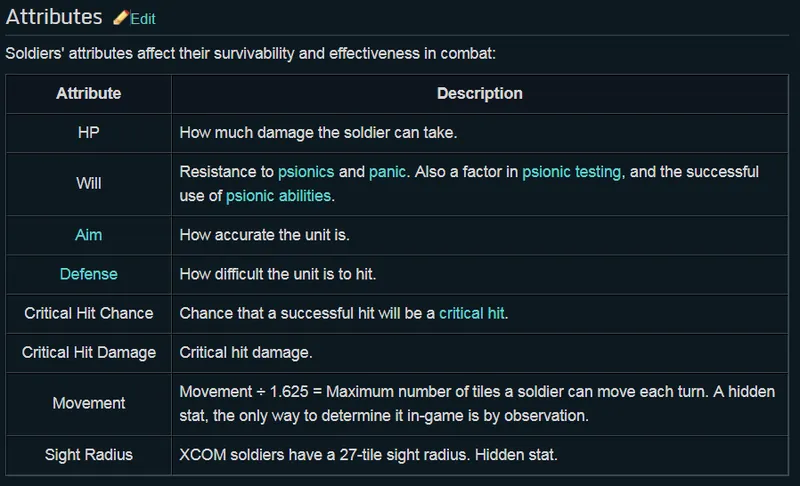
From the new xcom 1 (see pic below). All soldiers had 2 actions per turn. The differency between them was mainly what ability you chose when leveling up (you had 2 choices each level) which made them distinctly different (and YOU made them different, not arbitrary assigned random stats).

There was actually only 3 "real", individual stats: will, aim, defence.

Also the classes made them distincly different. In old xcom all soldiers were basically the same. And you optimized them to each have the one, best gun.

Having loads of numbers isn't doing anything by themselves. As pointed out by others: do NOT add stuff/stats unless they have a distinct purpose ingame.

p.png.04c4c2489239280c11a5d247bb735b90.png

Noddy92
Noddy92

I talked to my programmer and he says, the system can be changed because right now it's pretty bare bones.

I went and read a couple of first posts, and the more I think about it, the thing that Richards suggests while not a bad thing, seems like an expansion to the one-two system. He wrote one small action, one large and one full which takes the whole round. If I remember correctly in new XCOM if you use some actions it will end the turn for that soldier, right? It's been a while since I played it, so my memory is a bit fuzzy.

Also, I don't want classes in my game. What I had in mind, is here is a soldier with stats, you can improve some of them and make the most of their available skills. For instance, some have good aim, but also are good with explosives, so the player can choose which to upgrade during the game. I just think predetermined classes are a bit restrictive, and I just wanted for the player to choose which class or role they want for their soldier.

Thanks, suliman for the picture with stats, I've found this very useful.

Cryptopatik
Cryptopatik

Hey Noddy92.

As a new-school player (I'm 20), I would suggest the system that XCOM offers. It seems not hard to understand and yet pretty variable. But again, I am a newbie, so don't listen to me, it's just my opinion.

Guess I need to check out Jagged Alliance:D

Nikita
Noddy92
Noddy92

Oh you definitely should especially Jagged Alliance 2, old Xcom, Fallout Tactics, and such.

Noddy92
Noddy92

Before this thread comes to an end, I have one final question.

What is the best way to calculate action points or time units for one-two system? See, I was thinking something along the lines of Fallout 1, where one stat decided action points (Agility), but further questioning led me to the conclusion that it's best to combine it with something else to avoid it becoming a god stat. I thought of combining it with another stat, maybe dexterity, som my equation would look like:

Agility + Dexterity = Action points or (Time units)

What do you think is the best approach, for this problem, and if anyone was wondering how Fallout did it here is the link:

http://fallout.wikia.com/wiki/Action_Points

I'm looking at the original games and Tactics,

Thanks

Topic Locked

This topic has been locked by a moderator. New replies are not allowed.

Sign in to reply to this topic.