

This is a follow up to the thought of making the AI face some clear cut decisions, decisions that make a sea of difference on how things playout in the end. In a blog post I presented the idea of placing the AI in a handicaped position where his HQ has only two resource patches nearby (while the enemy has three resource patches nearby). Continuing on that trend and I have started working on the practical side of things: the gameplay. I am trying to emphasize the ability to start low on resources and still win the game. Therefore I came up with two races: One race is very dynamic, it has cheap buildings and can expand rapidly very much like Starcraft Zerg. The other one is static. It has expensive buildings and slow moving units. The plan is to place a Zerg like player on the map spot poor on resources and a static player near the rich site. The initial idea when I came up with these two races was to create an environment where the AI can make a clear cut decision, I didn't thought a high degree of gameplay fairness was posible (I`m talking about perfectly balanced races). I was thinking a zerg like player starting low on resources will not have enough resources to expand (build an expansion HQ and a combat units building at the same time to produce units that will put pressure on the static player in the early stages of the game). Therefore I was thinking to make use unfair units stats for the zerg like player. However eventually I realized you can have fairness too if you make the zerg like player buildings dirt cheap and very low on hp.
What I have settled for in the end was that in order to win the zerg like player will have to make the following choises: build the very cheap combat units building (the choise is made between a very cheap building producing the most cheap fast moving units with body to body combat style and a more expensive building producing units with more hp and a combat mode that I haven't settled on yet.) early in the game, train a group of most cheap units and send them to the enemy to force him build a building producing incredibly slow moving units out of a cheaper building producing incredibly slow moving units and a more expensive building producing units that move faster. My reasoning is that if the static player is forced to build very slow moving units once the threat is removed in the static player base, getting the slow moving units to the zerg like player base will take ages, providing the zerg like player with enough time to harvest the investment in the expansion.
Exploring some general gameplay ideas, looking for feedback.

Well, asymmetric map contact distance is certainly a scenario worth contemplating. One that I haven't run into in any real 4X game, because factions tend to have units that can do roughly equivalent things. If the faction with the slow expensive units really has no other unit types available, that really is a fundamental asymmetry that I personally don't have experience with.

Maybe this was done in games like Commandos, where a small squad of heroes wins over countless enemy soldiers?
Never played such a game, but i imagine it bridges RTS and FPS in some ways. Still strategic and top down, but centered about characters.
I would like this, expecting better entertainment compared to god perspective over soldiers and not caring about their fates at all.
Can't say much about impact on strategy mechanics, though.
Contact distance problems pretty much determine the openings of classic 4X games. One of the main ways I improved the apparent play strength of my SMACX AI Growth mod (of Sid Meier's Alpha Centauri) was to change the recommended default map from Standard to Huge. On the Standard map, you'd generally start too close to some AI faction and it would be trivial for you to overrun them, even with mere Scout units. On a Huge map you have to scout more before you can even find your nearest neighbor, and there's much more time for them to build up a viable defense to a pea shooter unit rush.
Unlike actual history, in classical 4X the strongest players are going to be those that start isolated and are left alone. Assuming they have enough of an environment to grow into, i.e. not an ice floe at one of the poles in Civ II. A faction that doesn't have to expend resources on defense and war, has a major advantage over those that must compete for space. Also the research models are very much ahistorical, with isolated civilizations perfectly capable of coming up with every single "needful thing" themselves. In the real world, humans colonized the Western Hemisphere about 10,000 years later than the old world, because they had to walk or boat along coasts to get there. The results are kinda predictable; Jared Diamond's Guns, Germs, and Steel is a good read in that regard.
Your strongest opponent is always going to be the one farthest away from you geographically. On a cylinder map with wraparounds at the east and west edges, that's gonna be halfway around the world east-west from you. On a toroidal topology map with N-S and E-W wraparound, that's gonna be at a long diagonal from you. This is because longest distance = least ability for you to interfere with their early logistics and growth.
You may try to deliberately run straight at them anyways, but if you do so, you'll sacrifice your opportunities against all civs that are closer to you. It's logistically expensive to take on those long haul campaigns when you're just getting started. I've occasionally done it against really dumb AIs anyways, just to see how much of a map I can control early, against the AI's inevitably spammy game of whack-a-mole. Sure you can extinguish the AIs somewhere, but as a collection of opponents, they're always gonna sprout and take seed somewhere. If the map is big enough, compared to your max possible early growth rate, then there will be plenty of parts of the map that you have no chance of controlling.
JoeJ wrote:
Can't say much about impact on strategy mechanics, though.
Is that a broad statement or something that concerns a particular problem? You built a mobile game featuring everything a mobile game needs to have. You know what tweaking designer numbers is.

I am trying to emphasize the ability to start low on resources and still win the game
This is a typical set of levers designers play with. Set them low. Set them high. Set them everywhere in between. Set up characters that do a one-shot kill, potentially with time delays. Set up characters that basically have a pea shooter or wooden sword.
Experiment around it, try it out.
Many odd things make great units. Demolition crews that are easily killed but destroy walls or buildings if they make contact. Attack dogs that insta-kill troops but can't damage vehicles. Invulnerable or indestructible armored units, likely with penalties of being slow and highly visible.
The playtest sessions experimenting with them can be comical. Lighting fast units that evade everything and quickly win a capture the flag. Juggernaut death bots that rule the map, or form up an impenetrable barrier. They can later be balanced, turned into short buffs, or unique / specialized units, but building and playing with them helps the designers understand the game better.
Calin wrote:
Is that a broad statement or something that concerns a particular problem? You built a mobile game featuring everything a mobile game needs to have. You know what tweaking designer numbers is.
I mean i have no experience with strategy games. The games i've made didn't have a lot of parameter tweaking either, just level design.
However, i do assume a reason of why RTS is pretty dead now is the lack of story and player empathy. You do not really care what happens to those tiny soldiers on screen - you only care about winning the match.
That's a downside compared to other genres, where i want to save the princess from Bowser torturing her, or where my heroic deeds will save the world.
But this can be added. E.g. if you zoom in to a small squad or even a single soldier, illustrating their personal fate and struggle, so the player can empathize with those units. He will care about individuals then, rather than just winning a war ignoring how many soldiers die to get there.
This can add more to a game, beside the strategic or AI differences from fighting many with only a few.
bvanevery wrote:
If the map is big enough, compared to your max possible early growth rate, then there will be plenty of parts of the map that you have no chance of controlling.
Instead a larger map you could also have a faster growth rate for one faction, i guess.
I wonder if a lack of level design is another flaw of strategy games which could be fixed.
A flat terrain is no map. You do talk about boundary conditions, e.g. wraparounds on 2, 4, or no sides of the map.
But you do not talk about actual level design within the map, likely because related games didn't have any.
There should be boundaries within the map too. Steep cliffs, rivers, maybe some ancient architecture which exists already before the units build their bases, etc.
In FPS games the walls of the corridors are the primary source of any tactical decisions the player makes.
But FPS becomes pretty boring on open outdoor environments, where shots come from any direction and tactics vanish.
For the given example, think of a small map fitting on a single screen. The distance between the enemy army and the small but fast player faction is too small. But we can make it larger by creating a long cliff dividing the two locations.
Then you can observe the enemy while building up, constantly affecting your decisions, responding to what you see instead scrolling around and following distant scouts.
I'm sure this has been done to some degree already, at least for those strategic action games about playing a small squad on a special mission in some enemy facility.
I'm interested in combining all this to merge genres. If we can zoom in from coarse factions at war towards individual characters having local interests and objectives, we can merge 1st / 3rd person action games with strategy games.
And i would expect much more from that than from the FPS+RPG merge we saw happening in recent years.
In 4X it is typical for the map to be randomly generated. There are typically some rules for how the generation is performed, either buried in a .ini file somewhere or made explicit with a pre-game UI. Pangaea style supercontinents, spread out continents, percentage of water on the planet, mountainousness, that sort of thing. Given the number of parameters a world generator will typically have, I think it's inaccurate to say there's no level design going on. But it is randomized level design. This is part of the staying power of the genre, to have random terrain challenges where the player must behave according to good war practices, and not simply memorize a map.
Some 4X games have tried to combine RPG elements. "Old World" is a recent one, adding some dynastic mechanics reminiscent of Crusader Kings. I haven't played it yet. I've owned it for almost a year, but the massively long play times of Emperor of the Fading Suns keep getting in my way lol. EotFS actually has a pen and paper RPG of the same name from the same company, but not that much RPG lore accuracy shows up in the 4X game. Would be good if they had the financial resources to make an integration effort, but they don't.
I mean i have no experience with strategy games. The games i've made didn't have a lot of parameter tweaking either, just level design.
However, i do assume a reason of why RTS is pretty dead now is the lack of story and player empathy. You do not really care what happens to those tiny soldiers on screen - you only care about winning the match.
You don't understand the market, then. Your assumption is faulty.
It is not the golden age when RTS was new and a small number of games from Blizzard and Westwood, that type of short term popularity shifts every few years where a few companies pour several hundred million dollars into the globally popular products. But it also isn't dead, it is, in fact, vibrant with a huge number of niche games exploring the possibilities of the genre.
People do like the characters, there are what we called "unexpected moments of delight" as players explore the game, but fundamentaly the game is always about winning the match. Even in Chess someone might appreciate a finely crafted chess set, but nobody is saying "that's such a beautiful knight piece, I am so emotionally attached that I can't lose it in a king/queen fork." In a match there is no story or emotional attachment, only the utility of the pieces on the board.
The stories make the framework of the game, and they are great for solo or cooperative campaigns, but it is meaningless for competition. Set it up in mythology, medieval times, modern military units, future units, or alien worlds, it doesn't matter. If you create heroes or specialty units, regardless of if that's bringing in Gandalf or Tanya, Hercules or Gul'dan, it is their utility for the match rather than the emotional connection that matters.
There is also no technical reason the stories can't be mixed, and apart from license issues it's even been done. Mix factions of Greek mythology and ancient heroes against futuristic storm troopers, only the unit balance is critical. The story might need to explain why the heavily armed laser-toting troops are falling to slings and arrows, maybe Zeus is empowering them or whatever, but make it balanced and the story is irrelevant, only the pieces on the board.
One thing I've found trying to design 4X, is that tactics and narrative compete with each other. They're not quite mutually exclusive, but they're working towards opposite ends, and the player's attention span is limited. All those squares you need to figure out where to push the next unit to, that works against contemplating characters or plot. If there's to be a story, it's often poorly paced because of the analytical tactical requirements.
Marcel Duchamp was quite a chess player. He talked about it being better to play an artistic (?) game of chess, than to just simply win it. However I've not been able to find an archive of exactly such a game he played, to know what he meant. There are probably some records of chess games he actually played in tournaments, and I suspect he probably didn't lean on the "artistic" idea so much then. He probably tried to win, as others typically do. And that constrains the aesthetics of the game. I look over various random players' shoulders, I see tactically reasoned and positionally acceptable games, but the patterns are very boring.
frob wrote:
But it also isn't dead, it is, in fact, vibrant with a huge number of niche games exploring the possibilities of the genre.
Sure, but i call FPS 'dead' too, although it's the only genre i currently play. Compared to the 90's both FPS and RTS is now a much smaller percentage of successful games, which is what i mean.
frob wrote:
but fundamentaly the game is always about winning the match.
But maybe, if we change some of the fundamentals, it gives us something new to play with.
bvanevery wrote:
One thing I've found trying to design 4X, is that tactics and narrative compete with each other.
Narrative competes with pretty much anything you might do in a video game, because stories are static content which can not really adapt to the dynamics we expect from interactive games. Personally i want to minimize any use of story for this reason.
But that's not what i meant with zooming in to individuals. A story isn't needed to empathize with characters. They only need to show emotions, ideally by responding to the events around them. Facial expressions and body language to express shock, pain, greed, etc. I see that's just a cosmetic addition to a classic strategy game, but maybe it could attract a wider audience to the genre due to better entertainment.
Besides, i think it would be nice to have some RTS where you start a mission to rescue some captured scientist from an enemy base. You begin with many units and large oversight, but as you get into the base you could zoom in to a small squad, and play more like XCom to get the scientist. Those squad members become heroes only for minutes, because later you'll zoom out again on the way home.
Shifting scales could be very interesting to explore, imo. But the character centrism would be only a consequence of that, not the primary design goal. In the ideal case, the 'story / narrative' happens in the players imagination from situational context. We just need to simulate some additional emotional states beside hp, ammo and armor. (to say it optimistically)
bvanevery wrote:
Given the number of parameters a world generator will typically have, I think it's inaccurate to say there's no level design going on. But it is randomized level design.
I call this procedural generation, but not level design. The parameters create smooth transition of geological features, but no sharp walls to give us a boundary defining actual 'levels'.
For my scientist example we would need detailed interiors of the enemy base. With underground labs, torture chambers, and ofc. toilets. Idk why toilets are in any FPS game. They sure are important.
So, if you design this base manually, or if you have algorithms to generate those interiors procedurally, i'd agree that's level design. And this certainly opens up new options on tactical game play you did not get from exterior RTS bases on smooth terrain. (I guess there is plenty of RTS where terrain adds a lot of constraints, which is a grey zone between those two extremes.)
Dynamic storytelling in a 4X TBS environment is possible but not easy to do. Sid Meier's Alpha Centauri demonstrated about half of what's needed to do. They certainly nailed the worldbuilding and the strong faction leader characters.
I would note that RTS is not synonymous with 4X. In fact 4X is more typically TBS by default, and of a much longer play time than typical RTS matches. Those short RTS matches have little dynamic narrative scope due to the time constraint. It's like comparing a half hour TV show that has to make room for broadcast commercials, with a modern 10 episode Netflix TV season.
The procedural generation issue is how high are the mountains, how deep is the ocean? These can be real barriers, especially for Earth history games where oceanic travel has to be invented. But it is typical for such games to do a bad job representing the Himalayas or even the Swiss Alps. Has to do with map scale and not being able to handle too much detail.
frob wrote:
This is a typical set of levers designers play with
Which , roughly, is a process present when developing any consumer product: tweak the formula, test the formula.
frob wrote:
Many odd things make great units
Getting there takes a mind oriented towards diversity. But diversity neighbors chaos. Set on finding that one odd thing that will give you the edge and you risk missing the target all together.
Calin wrote:
Which , roughly, is a process present when developing any consumer product: tweak the formula, test the formula.
Good. It's effective.
Returning back to the original goal, asymmetric gameplay can be very effective. It can work well with a large number of play types, in many ways two is more limiting than more. "Perfect imbalance" in a metagame is common, that is each has strengths and weaknesses that play against each other. In large games the metagame plays into it. This week A is popular so lots of people turn to character B to counter it. Then as B rises in popularity, players shift to play more of character C because they counter the strengths of B. After that, they shift to D. Then when D rises to popularity, people choose A because they are the foil to D.
Another variation, but not RTS, are the games like Team Fortress 2, on a similar imbalanced design. Someone chooses a scout because they're fast, double jump, and other benefits, but they're weak. Someone else chooses the heavy, they like the massive health and the damage they can pump out, but they're vulnerable to snipers and spies. Someone else picks the engineer, they love the sentry guns and the dispensers, despite the weaknesses of the time they take and the spie that can walk right past the sentry gun.
It's good with lots of playtesting, lots of experimenting with the absurd, lots of times cranking abilities far beyond where they make sense just to see what they do when you do it.

Calin wrote:
Getting there takes a mind oriented towards diversity. But diversity neighbors chaos. Set on finding that one odd thing that will give you the edge and you risk missing the target all together.
Game genres like a traditional RTS are fun because they are about dominating chaos and being right. "Odd things" are normal.
You don't see all the map, but exploration is in progress. You can be attacked at any time, but you have a defensive line. You aren't sure what the enemy will do, but you commit to a plan. You see unit X, and you know fielding unit Y against it will perform well.
bvanevery wrote:
Well, asymmetric map contact distance is certainly a scenario worth contemplating. One that I haven't run into in any real 4X game, because factions tend to have units that can do roughly equivalent things. If the faction with the slow expensive units really has no other unit types available, that really is a fundamental asymmetry that I personally don't have experience with.
Overspecialization of unit types is rarely seen because it normally represents an enormous strategic disadvantage: other factions can field units that are adequate or dominant against each of your units, but your faction cannot handle some of the units of other factions. It's a problem that should die young in any meaningful playtesting effort.
LorenzoGatti wrote:
Overspecialization of unit types is rarely seen because it normally represents an enormous strategic disadvantage
Endless Legends is supposedly a study in qualitatively asymmetric faction design, where each faction does not aspire to play the game the same way. However the AI is reputed to be totally brain dead, which has kept me from being interested in actually trying the game. I might even own a legit copy of it, given away on Epic Games some time ago. I cannot be bothered to go up the learning curve of yet another 4X with bad AI, life is too short lol.
AI failing doesn't surprise me at all. Most 4X games do poorly at it, and any game that chooses to vastly increase the surface area of the game rules, is likely to pay the price.
In contrast, Sid Meier's Alpha Centauri had fairly decent AI, if not brilliant, and some variety of faction play styles. But, all factions pretty much do aspire to do the same things over time, and the AI seemed to be parameterized for such expected eventualities. The parameterized game engine is what made it moddable, being able to plug in new stat values for units and actually have it work.
In order to come up with an AI response to enemy behavior I have been threading a lot in the direction of simulating a player's activity in all the details. But if you take a break and think at it, much more easier conventional algorithms can get you the same results. An enemy avoidance algorithm makes your units avoid the ground that's in the fire range of enemy units. With an algorithm like this you can implement harasing AI that can attack enemy workers when no enemy combat units are around and retreat on the path towards the AI base when enemy combat units show up. It's simple and error prof, by the means of the enemy avoiding routine the AI units will avoid the enemies in the way while retreating. While retreating AI units don't have to travel all the way down the home base, they can retreat just far enough to a safe distance from the enemy. If they are being chased they will retreat further. When the chase is over they can get back to attacking workers (if the enemy combat units have left) or move the attack to a building nearby. There is a catch though, the AI needs to have perfect vision of enemy at all time, there should be no fog of war constraints ( that doesn't refer to individual units AI which should keep reacting based on LOS).
Calin wrote:
With an algorithm like this you can implement harasing AI that can attack enemy workers when no enemy combat units are around and retreat on the path towards the AI base when enemy combat units show up. It's simple and error prof, by the means of the enemy avoiding routine the AI units will avoid the enemies in the way while retreating.
There's the possibility of an obstruction (enemies at all chokepoints) that requires waiting or attacking the enemy.
The other possibility of being pushed into some dead end by wandering enemies (e.g. not avoiding entering a house upon seeing enemies in the street) is also very suboptimal because it can lead to worse slaughter than running through enemy lines.
Calin wrote:
In order to come up with an AI response to enemy behavior I have been threading a lot in the direction of simulating a player's activity in all the details. But if you take a break and think at it, much more easier conventional algorithms can get you the same results. An enemy avoidance algorithm makes your units avoid the ground that's in the fire range of enemy units.
Exactly, i would say. That's how i think of it at least.
Personally i always avoid the 'intelligence' term, replacing it with 'behavior' instead.
This is because behavior is what we observe people doing. Dodging an obstacle, walking together in some formation, backing a teammate from some safer spot, etc., all this is behavior.
Contrary, learning a new game you didn't know, e.g. chess, and then playing your first match would expose your intelligence, but that's not what NPCs in a game do. So we do not need that much of intelligence beyond of what the programmer himself hard codes to get some logical behavior to fake it well enough.
Which is obvious ofc., but it leads to the good question of: 'What's easier - coding artificial intelligence to reproduce realistic behavior of a human player, or coding natural behavior to achieve an impression of NPCs being alive?'
Notice, the recent success of LLMs seems more a variant of the latter, afaict.
So eventually you are now willing to consider some alternatives over making dozens of copies of an ongoing RTS match to search for a good strategy.
But likely you lack experience with the tools to get there. That's mostly just math. But you don't need a PhD in math. Imo common sense is enough. You just need to study some examples of methods which are used everywhere, be it simulations, graphics, or whatever.
For example, here is a problem that feels super simple to humans, but getting the same decision from an algorithm isn't totally trivial.
Say there is a unit and it's goal is to collect gold coins from an environment looking like this:
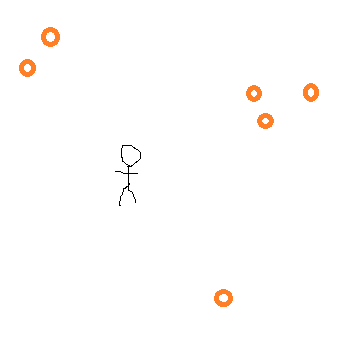
Where would you go to pick up coins? Probably to the top left, because there's more coins in one place than elsewhere.
But how would your AI make the same decision?
I would say an easy way is clustering and looking for local maxima. Which is easy. We can use a grid and add the value of gold to the cells which are near to them. I may distribute each coin to a 2x2 regiaon of cells, following the same basic weighting as used in a bilinear texture filter, which is simple math following common sense:
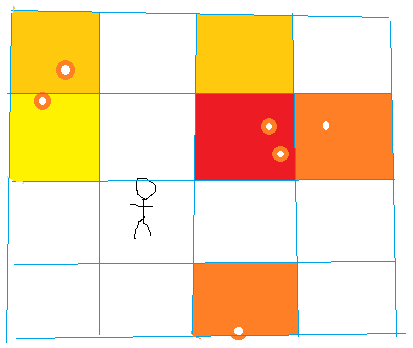
The solution eventually already shows up, but let's keep going to get our clusters.
For that we find all local maxima in the grid using this algorithm:
For each cell, compare it's value with its neighboring cells. If it is higher than all neighbors, we have a local maxima.
And for the example we get those 3 of them:
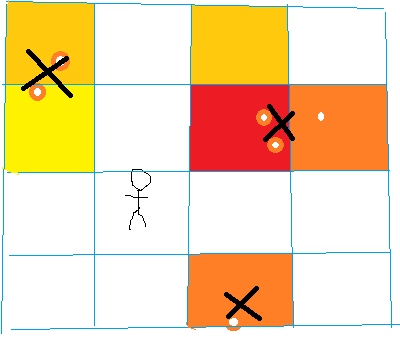
The crosses are not exactly int he middle of the cells, because i have used the gold value of cells as weights to calculate a more accurate position, which is optional but may be nice.
After that we look for the local maxima with the highest gold value and go there first.
Or, assuming the biggest cluster is far away, we may also use an heuristic to factor in distance.
So we might choose lesser gold but closer gold first, for more natural and meaningful behavior.
Notice all of this is simple and easy to implement, and no intelligence anywhere.