
Original Post

i'm trying to implement deferred rendering. i had been drawing diffuse, depth, normal at ‘_renderTargetList[0], _renderTargetList[1], _renderTargetList[2]’.
this is render code.
void Renderer::renderLight()
{
	ID3D11RenderTargetView *pRenderTargetView = nullptr;
	ID3D11DepthStencilView *pDepthStencilView = nullptr;

	g_pGraphicDevice->getContext()->OMGetRenderTargets(1, &pRenderTargetView, &pDepthStencilView);
	//-------------------------------------------------------------------------------------------------------------------------------------------------------------

	g_pGraphicDevice->getContext()->ClearRenderTargetView(_lightTarget->getRenderTargetView(), reinterpret_cast<const float *>(&Colors::Black));
	g_pGraphicDevice->getContext()->ClearDepthStencilView(pDepthStencilView, D3D11_CLEAR_DEPTH | D3D11_CLEAR_STENCIL, 1.f, 0u);
	ID3D11RenderTargetView *pLightRenderTargetView = _lightTarget->getRenderTargetView();
	g_pGraphicDevice->getContext()->OMSetRenderTargets(1u, &pLightRenderTargetView, nullptr);

	g_pGraphicDevice->getContext()->PSSetShader(g_pShaderManager->getPixelShader(TEXT("PointLightShader.cso")), nullptr, 0);

	ID3D11ShaderResourceView *pDepth = _renderTargetList[1]->getShaderResouceView();
	ID3D11ShaderResourceView *pNormal = _renderTargetList[2]->getShaderResouceView();


for (auto iter = _lightComponentList.begin(); iter != _lightComponentList.end(); ++iter)
		(*iter)->Render();

	g_pGraphicDevice->getContext()->OMSetRenderTargets(1, &pRenderTargetView, pDepthStencilView);
}
now i will draw Pointlight, so i made ‘_lightTarget’ and ’PointLightShader'.
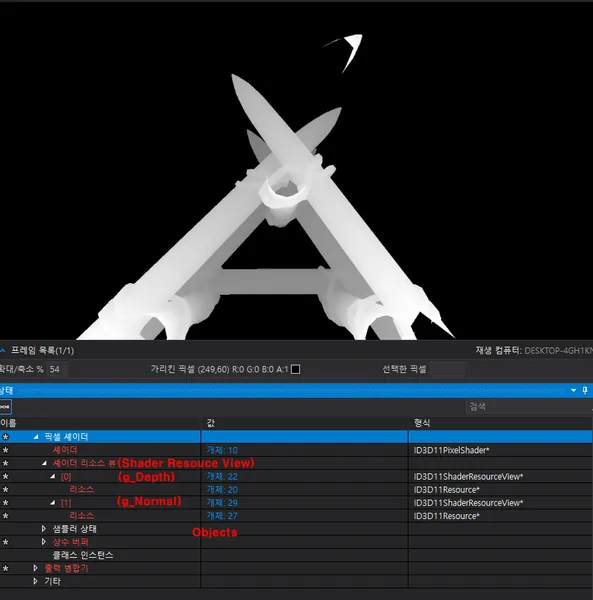
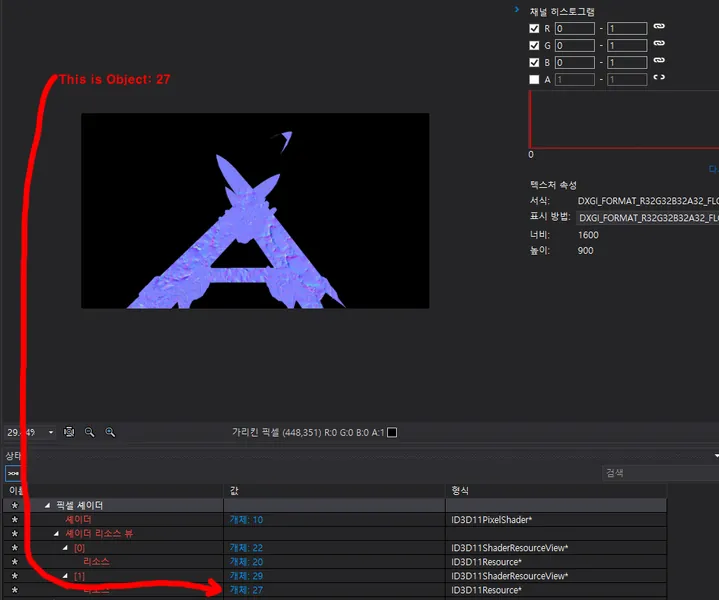
when i draw Pointlight it's not work well. so i had started debug it and founded that only g_Depth was sampled. although i set depth, normal texture and sampled these textures with uv.
this is PointShader.hlsl
Texture2D g_Depth;
Texture2D g_Normals;

SamplerState g_Sampler;

struct PixelIn
{
	float4 pos		: SV_POSITION;
	float2 uv		: TEXCOORD0;
	float3 normal	: NORMAL0;
	float3 tangent	: NORMAL1;
	float3 binormal : NORMAL2;
};


cbuffer CBuffer
{
	float4	g_lightPosition;
	float4	g_lightColor;

	row_major float4x4 g_inverseCameraViewMatrix;
	row_major float4x4 g_inverseProjectiveMatrix;
};

float4 main(PixelIn pIn) : SV_TARGET
{
	//PixelOut pOut;

	// uv (0 <= x, y <= 1) to proj (-1 <= x, y <= 1)
	//float4 projectPosition = float4(0.f, 0.f, 0.f, 0.f);
	//projectPosition.x = ((2.f * pIn.uv.x) - 1.f);
	//projectPosition.y = ((-2.f * pIn.uv.y) + 1.f);
	//projectPosition.z = (1.f - g_Depth.Sample(g_Sampler, pIn.uv).r);
	//projectPosition.w = 1.f;
	// not important!
	...

	float4 depth = g_Depth.Sample(g_Sampler, pIn.uv);

	float4 normal = g_Normal.Sample(g_Sampler, pIn.uv);


	return normal;	// sampled from g_Depth ???
}
this is result
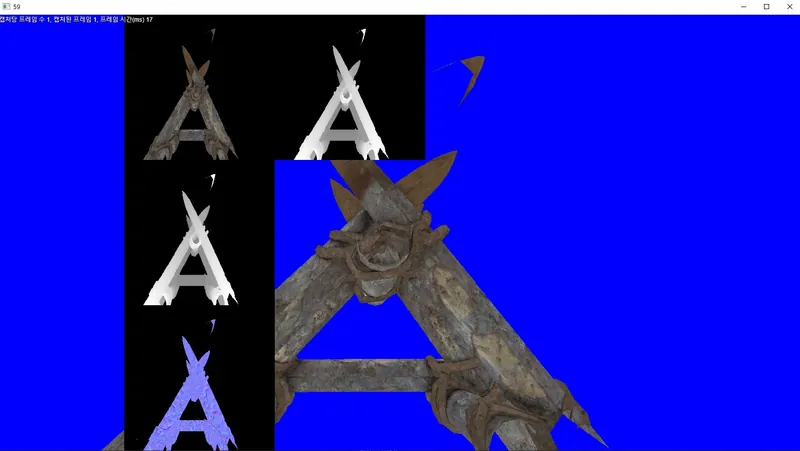
i used graphic debugging tools and i checked that resouces bounded well (object 27)
anybody who explain this situation? please?
