Original Post
I’m making a cat vs dog image classification using PyTorch. Should I have only one output variable, or should I have two (aka one hot)?
I’m making a cat vs dog image classification using PyTorch. Should I have only one output variable, or should I have two (aka one hot)?
The choice between a single output variable and two output variables using one-hot encoding ultimately depends on your specific requirements and the complexity of your task. If you're only interested in classifying between cats and dogs and do not plan to expand the classification task in the future, using a single output variable can be a simpler and more efficient option. However, if you anticipate the need to extend your model to handle more classes in the future or if you want more explicit probabilities for each class, using two output variables with one-hot encoding can be a better choice.
I don't think it makes a difference, but using the one-hot encoding makes it a bit simpler to write the loss function in a way that can be generalized to more possible outputs.
Agreed with Fleabay - in this situation, the single output should be more efficient here.
A one-hot output requires extra ‘effort’ because the network not only has to positively reinforce the ‘right’ output but also to negatively reinforce the ‘wrong’ outputs. With a single variable, these are exactly the same operation.
Both comments above are correct in that one-hot starts to get better once you move towards 3 or more outputs, not just because it's easier to understand as a human, but because now each bit of the output potentially represents 2 different outputs and it is dependent on the other bit. For example, if you had 00=cat, 01=dog, 10=duck, 11=fish, then your ‘dog’ training also needs to include ‘anti-fish’ training, as there's no longer just a single output you can increase to denote a more ‘dog-like’ input.
All that said, this is a trivial problem for modern systems and either would work.
I'm going to disagree with Kylotan (which I don't do often! ?). I have to go into details, so this might not be for everyone, but there is a nugget of knowledge in the fourth paragraph that you might not have thought of before.
If you use a single output and you want to interpret it as the probability of the image being a dog, you should probably have a final sigmoid layer, and the loss function you should use is log-likelihood, which for probability p and true label y is -y*log(p)-(1-y)*log(1-p).
If you have a one-hot encoding instead, you are probably going to have a final SoftMax layer, and the loss function you should use is cross-entropy, which amounts to -is_actually_a_dog*log(probability_of_dog)-is_actually_a_cat*log(probability_of_cat).
Notice how the function sigmoid(x) = 1/(1+exp(-x) can be written as sigmoid(x) = exp(x)/(exp(x)+exp(0)), which is the SoftMax with logits x and 0. Then 1-sigmoid(x) is the other value of the SoftMax, exp(0)/(exp(x)+exp(0)). So the one-output version is mathematically the same as the two-output version, but where you have hardcoded one of the classes to have logit 0.
These two options are identical for most purposes. Just before the final layer, you'll have some linear combinations. In the single-output case you'll have one linear combination. In the two-outputs case you'll have two linear combinations, where the loss function only cares about the difference. The gradients propagated to the layers before will be [I believe] identical.
In practice, you will not be able to measure the difference in performance between the two options (if anyone disagrees, I would like you to try to measure it). But the option with two outputs will be easier to get right (you will be less tempted to use an L2 loss, for instance), easier to think about and easier to extend beyond 2 classes. So that's the one I continue to recommend.
I thank you all for your time and expertise.
I get about 60% test data classified correctly, and I'm not sure if it's because I'm using a traditional neural network? I'd like to see results like 90% correct.
The code is at:
https://github.com/sjhalayka/pytorch_cats_vs_dogs/tree/4b55edb2c3038dcc75ca0ec0a8fa637145e8f704
taby said:
I get about 60% test data classified correctly
That's pretty good, for chihuahua or muffin…
60% is pretty bad when you consider that the baseline (pure guessing) is 50%. 60% is the score you would expect to get on a true-false quiz when you only know 20% of the answers.
32x32 is a pretty crappy resolution to get anything done. What does your data really look like?
A multi-layer perceptron with tanh non-linearities is not a great architecture for this task. If I were given this problem and enough pictures of dogs and cats to train a net, I would probably try a CNN (probably something like ResNet).
But these days you should be able to solve this classification problem with no training at all, using CLIP. In brief, OpenAI already trained two neural networks for you: one that maps images to a fixed-length vector representation, and another one that maps text to the same fixed-length vector representation, in such a way that images and their descriptions have similar vector representations. You can compute the representations of “cat” and “dog”, and when you want to classify an image you just compute its vector representation and see if it's closer to “cat” or “dog” in this space.
Yes, I need to know the difference between a traditional artificial neural network and a CNN and DNN. Obviously the traditional ANN does not work well.
The data can be downloaded from https://www.kaggle.com/datasets/tongpython/cat-and-dog?select=training_set
alvaro said:
If you use a single output and you want to interpret it as the probability of the image being a dog
I don't disagree with what you said in your very detailed post, especially when it comes to using modern pre-configured layers and functions, but I do want to pick up on this aspect. (And, before I do, to repeat to the OP that this really does not matter - it's just details.)
If - and only if - your network is performing a single classification task between 2 classes, there's no need to extract probability values. In fact, extracting a probability value would actually be a regression task that is being used for classification purposes. This means you're learning more information than you strictly need to solve the task, which must require a more complex network or more effort in training, as there's no free lunch. The activation functions and similar are all irrelevant to this - if you want more information out then you simply must put more in.
This may well not be that relevant in a modern system like PyTorch where you most likely don't get that degree of low level control over the outputs, but it is a theoretical factor.
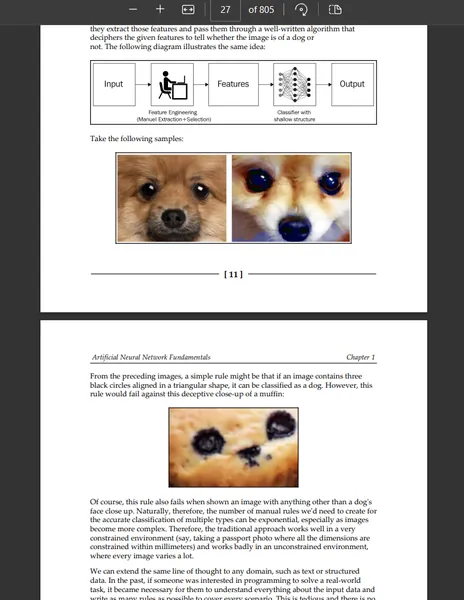
LOL Muffin Dog from Modern Computer Vision with PyTorch:
taby said:
LOL Muffin Dog from Modern Computer Vision with PyTorch:
Did you like my comment without knowing what I was talking about? XD
Haha so it’s an actual thing eh?! LOL
I have a mandatory upvote for all comments in my threads. Even if I don’t like it, I’ll still upvote it lol
That said, your post was surreal, and that’s my kind of sfyle
Your goal is to tell cats and dogs apart. There should be no muffins in your training data. When looking at a muffin, your only question is “is this muffin more dog-like or more cat-like?”, not “is this an animal at all?”.
If you want your neural network to be able to determine that something is neither a dog nor a cat, then you have a three-way classification problem, so a binary output will obviously not do at all.
Kylotan said:
If - and only if - your network is performing a single classification task between 2 classes, there's no need to extract probability values. In fact, extracting a probability value would actually be a regression task that is being used for classification purposes. This means you're learning more information than you strictly need to solve the task, which must require a more complex network or more effort in training, as there's no free lunch. The activation functions and similar are all irrelevant to this - if you want more information out then you simply must put more in.
If your network doesn't produce probably values, what does it produce? What loss function would you use?
In the end, the network is a function approximator.
I'm stuck. My code gives me an error that I am just not understanding, due to my (somewhat lack of) Python skills:
training_set\dogs\dog.108.jpg
training_set\dogs\dog.1080.jpg
training_set\dogs\dog.1081.jpg
training_set\dogs\dog.1082.jpg
training_set\dogs\dog.1083.jpg
training_set\dogs\dog.1084.jpg
training_set\dogs\dog.1085.jpg
training_set\dogs\dog.1086.jpg
training_set\dogs\dog.1087.jpg
Traceback (most recent call last):

RuntimeError: Given groups=1, weight of size [20, 3, 5, 5], expected input[198, 64, 64, 3] to have 3 channels, but got 64 channels instead
The code is:
import numpy as np
import math
import cv2
import random
import torch
from torch.autograd import Variable
import torch.nn as nn

import os.path
from os import path


img_width = 64
num_channels = 3

#num_input_components = img_width*img_width*num_channels
num_output_components = 1

num_epochs = 100
learning_rate = 0.00001


import torch.nn as nn
import torch.nn.functional as F


class Net(nn.Module):

	def __init__(self):
		# call the parent constructor
		super(Net, self).__init__()

		# initialize first set of CONV => RELU => POOL layers
		self.conv1 = nn.Conv2d(in_channels=num_channels, out_channels=20, kernel_size=(5, 5))
		self.relu1 = nn.ReLU()
		self.maxpool1 = nn.MaxPool2d(kernel_size=(2, 2), stride=(2, 2))
		# initialize second set of CONV => RELU => POOL layers
		self.conv2 = nn.Conv2d(in_channels=20, out_channels=50, kernel_size=(5, 5))
		self.relu2 = nn.ReLU()
		self.maxpool2 = nn.MaxPool2d(kernel_size=(2, 2), stride=(2, 2))
		# initialize first (and only) set of FC => RELU layers
		self.fc1 = nn.Linear(in_features=800, out_features=500)
		self.relu3 = nn.ReLU()
		# initialize our softmax classifier
		self.fc2 = nn.Linear(in_features=500, out_features=num_output_components)
		self.logSoftmax = nn.LogSoftmax(dim=1)

	def forward(self, x):
		# pass the input through our first set of CONV => RELU =>
		# POOL layers
		x = self.conv1(x)
		x = self.relu1(x)
		x = self.maxpool1(x)
		# pass the output from the previous layer through the second
		# set of CONV => RELU => POOL layers
		x = self.conv2(x)
		x = self.relu2(x)
		x = self.maxpool2(x)
		# flatten the output from the previous layer and pass it
		# through our only set of FC => RELU layers
		x = flatten(x, 1)
		x = self.fc1(x)
		x = self.relu3(x)
		# pass the output to our softmax classifier to get our output
		# predictions
		x = self.fc2(x)
		output = self.logSoftmax(x)
		# return the output predictions
		return outpu


class float_image:

	def __init__(self, img):
		self.img = img

class image_type:

	def __init__(self, img_type, float_img):
		self.img_type = img_type
		self.float_img = float_img


net = Net()


if False: #path.exists('weights_' + str(num_input_components) + '_' + str(num_epochs) + '.pth'):
	net.load_state_dict(torch.load('weights_' + str(num_input_components) + '_' + str(num_epochs) + '.pth'))
	print("loaded file successfully")
else:
	print("training...")


	all_train_files = []

	file_count = 0

	path = 'training_set\\cats\\'
	filenames = next(os.walk(path))[2]

	for f in filenames:

		file_count = file_count + 1
		if file_count >= 100:
			break;

		print(path + f)
		img = cv2.imread(path + f).astype(np.float32)
		#img = cv2.cvtColor(img, cv2.COLOR_BGR2GRAY)
		res = cv2.resize(img, dsize=(img_width, img_width), interpolation=cv2.INTER_LINEAR)
		flat_file = res / 255.0 #np.asarray(res).flatten() / 255.0
		all_train_files.append(image_type(0, flat_file))


	file_count = 0

	path = 'training_set\\dogs\\'
	filenames = next(os.walk(path))[2]

	for f in filenames:

		file_count = file_count + 1
		if file_count >= 100:
			break;

		print(path + f)
		img = cv2.imread(path + f).astype(np.float32)
		#img = cv2.cvtColor(img, cv2.COLOR_BGR2GRAY)
		res = cv2.resize(img, dsize=(img_width, img_width), interpolation=cv2.INTER_LINEAR)
		flat_file = res / 255.0 #np.asarray(res).flatten() / 255.0
		all_train_files.append(image_type(1, flat_file))


	optimizer = torch.optim.Adam(net.parameters(), lr = learning_rate)
	loss_func = torch.nn.MSELoss()


	batch = np.zeros((len(all_train_files), img_width, img_width, num_channels), dtype=np.float32)
	ground_truth = np.zeros((len(all_train_files), 1), dtype=np.float32)

	random.shuffle(all_train_files)

	count = 0

	for i in all_train_files:

		batch[count] = i.float_img
		ground_truth[count] = i.img_type
		count = count + 1

	for epoch in range(num_epochs):

		x = Variable(torch.from_numpy(batch))
		y = Variable(torch.from_numpy(ground_truth))

		prediction = net(x)
		loss = loss_func(prediction, y)

		print(epoch, loss)

		optimizer.zero_grad()	 # clear gradients for next train
		loss.backward()		 # backpropagation, compute gradients
		optimizer.step()		# apply gradients


	#torch.save(net.state_dict(), 'weights_' + str(num_input_components) + '_' + str(num_epochs) + '.pth')


path = 'test_set\\cats\\'
filenames = next(os.walk(path))[2]

cat_count = 0
total_count = 0

for f in filenames:

#	print(path + f)
	img = cv2.imread(path + f).astype(np.float32)
	img = cv2.cvtColor(img, cv2.COLOR_BGR2GRAY)
	res = cv2.resize(img, dsize=(img_width, img_width), interpolation=cv2.INTER_LINEAR)
	flat_file = res / 255.0# np.asarray(res).flatten() / 255.0


	batch = torch.from_numpy(flat_file)

	prediction = net(Variable(batch))

	if prediction < 0.5:
		cat_count = cat_count + 1

	total_count = total_count + 1
#	print(batch)
#	print(prediction)

print(cat_count / total_count)
print(total_count)


path = 'test_set\\dogs\\'
filenames = next(os.walk(path))[2]

dog_count = 0
total_count = 0

for f in filenames:

#	print(path + f)
	img = cv2.imread(path + f).astype(np.float32)
	img = cv2.cvtColor(img, cv2.COLOR_BGR2GRAY)
	res = cv2.resize(img, dsize=(img_width, img_width), interpolation=cv2.INTER_LINEAR)
	flat_file = res / 255.0 # np.asarray(res).flatten() / 255.0

	batch = torch.from_numpy(flat_file)

	prediction = net(Variable(batch))

	if prediction > 0.5:
		dog_count = dog_count + 1

	total_count = total_count + 1
#	print(batch)
#	print(prediction)

print(dog_count / total_count)
print(total_count)
staby said:
I'm stuck. My code gives me an error that I am just not understanding, due to my (somewhat lack of) Python skills:
OK Phil, whats your question?
Why 64 channels when I am specifying 3?
This topic has been locked by a moderator. New replies are not allowed.
With your permission, GameDev.net uses analytics cookies to understand how people use the platform. You can accept analytics or continue with necessary cookies only. Learn more