GameDev.net gamedev.net
🔒 Locked

Relationship between resolution and polygon count

Started by Newgamemodder Sep 20, 2024 at 8:27 PM 26 replies 10k views
Original Post
Newgamemodder
Newgamemodder

Hi Gamedev forums!

Hope all is well with you guys :D

I'm trying to research things regarded to graphics programming. So i get 8,294,400 is the pixel amount for 4K. I also understand that a rule of graphics is 1 triangle per pixel. Lets say i have X amount of triangles in my frustum. Will only 8,294,400 worth of triangles be in view?

Now if that is the truth how the expletive is this company manageing to render 1.8 billion triangles?

https://developer.nvidia.com/blog/realistic-lighting-in-justice-with-mesh-shading/

And how is it that this youtuber manages 800 million triangles at 12K? Shouldn't it be a maximum of 79,626,240?

Just wanna point out this is mesh shaders and not nanite im looking for info about.

Thanks and hope you guys can help me understand this thing that is making me pull my hair out!

JoeJ
JoeJ

Newgamemodder said:
I also understand that a rule of graphics is 1 triangle per pixel.

Not sure what you mean, but if we use teh GPU hardware to render one triangle per pixel, that's inefficient.
GPUs assume that the triangles are larger, and there are always 4 pixel shader threads combined to work on a quad of 2x2 pixels. Often some of those pixels are not inside the triangle, but the threads do the calculations anyway, which is a waste. So if we render one pixel sized triangles, only 25% of GPU threads contribute to the visible image.
That's the primary reason why Nanite uses a software rasterizer implemented in compute for small triangles, which is faster than hardware acceleration in this case.

Newgamemodder said:
Lets say i have X amount of triangles in my frustum. Will only 8,294,400 worth of triangles be in view?

We can exceed this limit in multiple ways:
Using MSAA multiple triangles can contribute to a single pixel, e.g. at most 4 with 2x2MSAA, or 16 with 4x4MSAA.

Using TAA it can be even more, which uses typically 64 samples. Even if in one render only one triangle can win the pixel, by combining multiple frames multiple triangles contribute to one visible pixel.

Same for other anti aliasing techniques. Any form of AA requires that multiple triangles can contribute to one pixel.

But ofc. this does not mean you could see subpixel details on your screen. The only reasonable goal here is smooth images. Ideally our tirangles are not smaller than a pixel. If we do this, we create a new potential source of aliasing. If the screen resolution is not high enough for our details, the pixel starts to flicker because just one triangle wins it, out of a selection of many tiny subpixel triangles with all different colors.
So it's not just a waste of resources, it also looks bad.

Newgamemodder said:
Now if that is the truth how the expletive is this company manageing to render 1.8 billion triangles?

Newgamemodder said:
And how is it that this youtuber manages 800 million triangles at 12K? Shouldn't it be a maximum of 79,626,240?

Having a scene of X triangles at the highest level of detal does not mean all of them are actually visible. Some may be off screen, some will be face backwards, others will be too small to intersect a pixel center, and most important: Many of them will be occluded by other triangles in front of them, and many are replaced by a lower level of detail for a current perspective.

So they talk about 3D datasets and how much of it they can manage and process.
Notice this is independent from the final presentation on a flat 2D screen.

If i want to impress, i'll make two related statements:

  1. My scene has 24 trillion triangles.
  2. But i only need to render 3 millions of them per frame, showing all the glorious details.

The first they tell to consumers, the second they tell to devs at GDC.

Newgamemodder
Newgamemodder

Thanks JoeJ!

Always appreciate your wise guidane and responses! :D

About the 800 mil thing iirc it actually was post culling and other stuff :D (you are completely correct by the “my scene has x amount of triangles”

At 0:45

I think the 1.8 billion was post culling aswell :D

So you can have any polygon count at any resolution but it'll need Anti aliasing?, but also the polygon count is influenced by lods, triangle intersections and backface culling and culling in general

For example my total polygon count in the frustum is about 5 billion but i know nowhere near that amount will be rendered, but with various culling, LODS and other optimization do you think it can be done with mesh shaders?

I always feel alot wiser after posting here :D

JoeJ
JoeJ

Newgamemodder said:
About the 800 mil thing iirc it actually was post culling and other stuff :D (you are completely correct by the “my scene has x amount of triangles” At 0:45

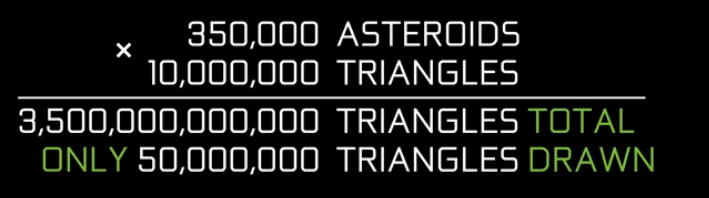
I see they claim 50M:

Haha, i see they covered both my marketing statements. And i did not even watch the video before. :D

Newgamemodder said:
So you can have any polygon count at any resolution but it'll need Anti aliasing?

Yes. Think of older games like Quake. Ther was no AA back then, but because the triangle resolution was so low, nobody had a problem with crawling edges. It was even nice and satisfying to watch how the edges crawl from pixel to pixel.

But as geometry became more detailed, there were more and more edges on the screen. The crawling eventually dominates the whole image and is very distracting. Anti aliasing is the solution.

So yes, if the frequency of geomtric detail is high compared to the resolution of the image, we need antialiasing for spatially and temporally smooth images.

But there are two ways to achieve antialiasing:

Multisampling: Examples are ray tracing or TAA. It works by taking many samples within the area of a pixel and calcualting their average. But it's expensive, and so we may reduce the cost by accepting samples from older frames.

Prefiltering: Examples are texture MipMaps or levels of detail for geometry. Here we precompute the average over a larger areas at multiple scales, and then taking just one sample from the scale matching our sampling resolution gives the desired result. So far we have solved this problem really well for textures, where it's trivial. But for geometry it's much harder.

Newgamemodder said:
For example my total polygon count in the frustum is about 5 billion but i know nowhere near that amount will be rendered, but with various culling, LODS and other optimization do you think it can be done with mesh shaders?

It can be done. Nanite is the example, which also uses mesh shaders for larger triangles.
But what's actually practical in a specific case depends on engine, target platform(s), storage limits.

JoeJ
JoeJ

Ha, i have to post this. The unforgotten mystery of ‘Unlimited Detail’. :D

Still unbelievable he did this on a laptop CPU. What a gfx programmer. :O

Newgamemodder
Newgamemodder

Heh i noticed i wrote 800 million then linked the wrong video lol tsktsktsk xD

If what i want becomes possible what type of Anti aliaiasing should i use and what resolution?

It probably won't use nantie but will use mesh shaders in their own engine, i assume this changes nothing? 🙂

Highly doubt it will ever be higher than 5 billion tris. I haven't counted shadow meshes and collision meshes (do i need to count shadow and collisions? neither projectiles and particle effects. Also my 5 billion is pre culling and lods.

You've been super helpful Joej! :D

JoeJ
JoeJ

Newgamemodder said:
If what i want becomes possible what type of Anti aliaiasing should i use and what resolution?

Haha, that's a very bad question. People pull out their pitchforks and pop each other an eye out when it comes to declaring the best AA method.

Imo the truth is: TAA is all we can afford. But some people really hate it, and thus AA remains an open problem.

For resolution, this really depends on content. (i guess you mean triangle counts not screen res.)
If i look at those asteroids from the video, that's pretty smooth geometry, and the blurry SSAO lighting makes it even more smooth. I can see no details at all. Only when they turn on wireframe mode i'm eventually impressed technically, but for that content it's just pointless.

A better case would be detailed spaceships, with lots of sharp features and small stuff on them.
To make the details visible, we would need accurate and sharp shadows for a gritty image.
In this case you need as much triangles as the content requires, but ofc. you can model only as much small features as the hard/software can handle.

Newgamemodder said:
It probably won't use nantie but will use mesh shaders in their own engine, i assume this changes nothing?

So your nickname isn't accurate anymore? It's not about mods, but about real development?

Does not change anything, since mesh shaders still raster triangles, causing the same aliasing problems.

Newgamemodder
Newgamemodder

Actually i meant resolution like 4K or does it not matter if i use 4K with TAA? was thinking higher screen res = less AA

Was thinking High poly LOD0 and LOD1 but low poly shadow mesh and collision. I did a recaluculation of my polycount and excluding particles and laser polygon count i'm at about 2.49 billion. Hance why i'm throwing around 5 bil because i don't know about the particles and projectiles….

Haha my nickname is still accurate, just checking what is possible to ask a company to do xD

JoeJ
JoeJ

Newgamemodder said:
Actually i meant resolution like 4K or does it not matter if i use 4K with TAA? was thinking higher screen res = less AA

Stop thinking, do the math : )

Let's say we want high quality AA. You may know from 2x2 MSAA that this has heavy stair stepping artifacts, so 2x2 is not enough. I would say we need 4x4 to get good quality. TAA often uses a subpixel sequence in a 8x8 grid, and that's really high quality then (if the image is static)

From that we can calculate the resolution a screen needs so we do no longer need any AA:
4K = 8M * 8x8 = 256M pixels. Or better, we calculate only horizontal resolution:
4K * 8 = 32K. So we need a 32K screen to get rid of AA.
I hope we'll never get this. Because if so, only Jensen himself can afford the necessary GPU at the size of his oven.

But you are right. I guess on a 4K screen 2x2 MSAA is much more acceptable than on a HD screen.
If they would have the same size, but they don't.
4K screens are usually larger than HD screens, and we still sit close to cover as much of our view with screen as possible.

Short answer: We'll always need AA, and we have already settled on upscaling and frame interplation on top of that.
The trend is clear:
Gamedevs keep rendering at ‘low’ resolution, ignoring the 4K craze and beyond from now on.
GPU vendors care about upscaling, stretching, halucinating, intelligencing, interpolating, inferencing, reconstructing, (TM)… and then they claim this already makes 90% of videogame graphics.

I'll let them get away with the bullshit, because if it ends the resolution and framerate craze, i'm fine with that.
And i'm pretty sure they will care about AA, and all the other postprocessing as well, pretty soon. Don't worry about AA. ; )

Newgamemodder said:
I did a recaluculation of my polycount

You like that, calculating polycounts, no?

2.5B for a whole universe, or 2.B for a single room you're actually in?

MagnusWootton
MagnusWootton

JoeJ said:

Newgamemodder said:
I also understand that a rule of graphics is 1 triangle per pixel.

Not sure what you mean, but if we use teh GPU hardware to render one triangle per pixel, that's inefficient.
GPUs assume that the triangles are larger, and there are always 4 pixel shader threads combined to work on a quad of 2x2 pixels. Often some of those pixels are not inside the triangle, but the threads do the calculations anyway, which is a waste. So if we render one pixel sized triangles, only 25% of GPU threads contribute to the visible image.
That's the primary reason why Nanite uses a software rasterizer implemented in compute for small triangles, which is faster than hardware acceleration in this case.

These days it is 1 triangle a pixel, output from open scad (its a procedural script cadder) puts out 1 triangle per pixel. Video cards can handle it these days.

But theres an issue with floating point, when the triangles are that close to each other, they tend to output lines instead of triangles in an STL file and the normals actually become non computable. so theres issues with it thats fer sure.

If u have it 1 triangle a pixel then u can do amazing self shadowing, it works good on parallax occlusion mapping as well. Then if u multisample ontop of that (If u make it say 100 triangles per pixel) it actually blends all the microshadows onto single pixels and u end up with something similar to a BRDF result with microfacets. 😉

JoeJ
JoeJ

MagnusWootton said:
These days it is 1 triangle a pixel, output from open scad (its a procedural script cadder) puts out 1 triangle per pixel. Video cards can handle it these days.

They can handle it eventually well enough for some application, but it is ineffcient. If you render one triangle a pixel, it's faster to use a software rasterizer in compute, than relying on (current) hardware acceleartion.

So there is a pending decision to make: Either GPU vendors implement efficient micro triangle rasterization in hardware, or they deprecate rasterization all together and remove those ROPs from future GPUs. I guess we'll see the former.

It's also pretty clear that one triangle per pixel does not really make sense anyway, since if we want that, it's much faster to render single points instead complex triangles.

MagnusWootton said:
But theres an issue with floating point, when the triangles are that close to each other, they tend to output lines instead of triangles in an STL file and the normals actually become non computable. so theres issues with it thats fer sure.

Precision limitations of some file format are irrelevant. That's probably caused from a too low setting of digits for text based data, but meshes are stored as binary data.
The binary data is usually also quantized for compression, and this can cause close vertices to merge and so triangle areas and normals become zero, but again that's a matter of choosing the right settings.

Precision limitations do not hinder us to achieve crazy levels of details. What hinders us is: 1. storage costs, 2. complex software, 3. HW performance.

MagnusWootton said:
If u have it 1 triangle a pixel then u can do amazing self shadowing, it works good on parallax occlusion mapping as well. Then if u multisample ontop of that (If u make it say 100 triangles per pixel) it actually blends all the microshadows onto single pixels and u end up with something similar to a BRDF result with microfacets.

Yes, but that's a good example of ‘multisampling is too slow, and we should prefilter instead.’
The works on physically based shading did just that: They handle microfacets with a single roughness value, and they fit an analytic function to measured real world results to approximate things like self shadowing of micro facets.
Knowing those simple functions, and having a texture with a roughness channel, we can model this effect very well with just one sample.

Newgamemodder
Newgamemodder

Oh i thought i'd need something like 64k resolution (4K with enough anti aliasing to have 2 bil pixels) haha

So you mean i don't need an extreme resolution to fix AA?

Yeah my polygon count is for everything on the “map”

Thanks Magnus! :D

shumtaka
shumtaka

@JoeJ Hi Joe, you delivered legit new info! Where can i read about all this stuff?

MagnusWootton
MagnusWootton

Newgamemodder said:

Oh i thought i'd need something like 64k resolution (4K with enough anti aliasing to have 2 bil pixels) haha

So you mean i don't need an extreme resolution to fix AA?

Yeah my polygon count is for everything on the “map”

Thanks Magnus! :D

I wouldn't call rendering on 64k resolution mandatory, but It could be a game feature if u wanted it to be.

Do u mean Anti-aliasing? But there's something else u can do, mega resolution ambient occlusion! (Thats what I was thinking of.)

Mega resolution Ambient occlusion would work good, it just being a screen compute means u can actually do huge maps with it real time if u've got a nice new video card, but it is going to cost you so much of the performance budget to get it. Would look really good on grass.

Anti-aliasing and multi-sampling does give the game a more realistic look, you get rid of all the hard boundaries, shadows come out alot nicer, and the edges of the shafts of light look alot better, but it costs u to do it a fair bit.

Going to all the trouble to convert all the high poly models to low poly with normal maps would be faster than rendering just the raw high poly models, but u dont actually have to, u can actually render the hipoly models these days, but u get a lot less of them. If you want a horde of hipoly looking monsters its still the best to do the low poly convert still if u could be bothered.

JoeJ
JoeJ

Newgamemodder said:
Oh i thought i'd need something like 64k resolution (4K with enough anti aliasing to have 2 bil pixels) haha

My impression is that you do the wrong counting and math.
You want high triangle numbers for high detail. Then you calculate how may triangles this will be, and then you conclude:
‘I have X triangles, and i want full detail so i want only one triangle per pixel, and thus i ideally have a display resolution of X pixels.
The italic part is wrong for any 3D game with perspective projection, becasue the size of triangles relates to distance. Distant stuff becomes smaller and this breaks your assumption.

The correct conlcusion is:
‘I have X triangles, and i want full detail. At a point where the triangles become very small and cover only a fow pixels on screen, i want to switch my model to a lower level of detail, so my triangles stay larger than Y pixels.’

Y is usually recommended to be about 10 pixels due to the 4 threads issues, but with something like Nanite it can become indeed as low as 1 pixel.
But more important: Screen resolution does not really matter much regarding the detail of content. It matters much more how close the player can come to the geometry. If he moves close enough, he can see individual triangles and texels even with a 320 x 200 resolution.
And this, and only this is the real reason why we want high resolution content. It's about distance first, screen resolution is secondary.

As a content creator you can almost ignore things like screen resolution and choice of AA method, since that's something the end users decide. They want a 4K screen or not, they tweak their DLSS settings as they see fit, or they prefer MSAA eventually. And ideally they can pick what they want.

We became almost independent from screen resolution already back then, when we switched from 2D games to 3D games. It matters for HUD elements, but not so much for the 3D scenery.

shumtaka said:

@JoeJ Hi Joe, you delivered legit new info! Where can i read about all this stuff?

Well, it's all generic graphics programmer topics.
With the rise of game engines this is no longer as much discussed on forums like this as it was before, but many gfx programmers still do blog posts to share experience.
This is a good source linking to recent posts, papers, videos etc.: https://www.jendrikillner.com/post/graphics-programming-weekly-issue-358/

JoeJ
JoeJ

Newgamemodder said:
Was thinking High poly LOD0 and LOD1 but low poly shadow mesh and collision

I forgot to comment on this one.
For physics collision we need a low poly representation, yes. (I've learned the hard way: Really very low!)

But for shadows we want the same geometry that we use to render the image. If we use a lower lod, shadows become inaccurate, and they miss to capture fine details. Up to the point where those details become unrecognizeable and just a waste.

Personally i can observe this very well in nature, looking at the mountain out of the window.
On a cloudy day with direct sunlight occluded, the surface of the mountain looks flat, low contrast, and not detailed at all.
But if the sun is visible, the hard shadows expose all those tiny details of the rocks or trees on it. Only then it looks detailed at all.

That's why Epic introduced a virtual shadow maps system together with Nanite. This did not receive as much attention, but is maybe equally important. It tries to divide the SM into many smaller parts, so they come closer to an ideal one SM texel for each screen pixel ratio. If we have many small SMs at different resolutions, hardware rasterization again becomes inefficient because it's meant to render just one view at high resolution, not many views at varying resolution. So the compute rasterizer is very benefitial to generate SMs.

That's often overlooked form people criticizing Nanite for it's performance overhead.

Still, on the long run we would love to ditch shadow maps, replacing it with accurate raytracing.
But currently that's not possible, since RT APIs are not flexible to handle any fine grained LOD solution.
It would work however with discrete LODs. Those can be traced without issue.

Newgamemodder
Newgamemodder

Joe do you think i can increase my polygon count?, it would then be 3 billion not counting projectiles or particles? so maybe 5-6 billion not counting LODs and culling and what's in the frustum. Does this change anything? Hopefully my LOD0 is what my artist says haha. Before you ask why i'm planning on 3D scanning physical models hence why it's such a high polygon count.

Honestly i have no idea how many of the triangles will be in the frustum. I thought that if it handles my worst case scenario it can handle everything…

You know me and my polygon count calculations ;D

Sorry I'm slow so i don't need massive pixel resolution?, i just want to know how much without having jaggies :P

Regarding low poly shadows i was thinking the space ships have “trenches” and i were to copy the hull only instead of all small details in the trenches

JoeJ
JoeJ

Newgamemodder said:
Joe do you think i can increase my polygon count?, it would then be 3 billion not counting projectiles or particles? so maybe 5-6 billion not counting LODs and culling and what's in the frustum.

Well, for some real world data you can look here: https://github.com/Activision/caldera

They say 2 billion points. Not sure what they mean, but seems 3 billion is practical.

Newgamemodder said:
Before you ask why i'm planning on 3D scanning physical models hence why it's such a high polygon count.

Yeah, scanning means more polygons than manually modelled stuff, even with automated reduction.
However, scanning what? Real world miniaturemodels of spaceships? Spaceships are hard surface models, and scanning may create too many articats. Modeling them from scratch with the computer might be less work than tedious manual cleanup. (No experience - just a guess)

Newgamemodder said:
Sorry I'm slow so i don't need massive pixel resolution?, i just want to know how much without having jaggies :P

To avoid jaggies, you always need the same amount of AA samples per pixel, no matter what's the resolution. Assuming the 4K display is larger than the HD display, the pixels are equally large on both.

To see all the glorious detail, you need to walk closer to the wall with a HD display than with a 4K display.
So it does not matter. The player can observe all the detail no matter what.

But ofc. if you marketise 4K support, people assume the maximum detail of content is higher because of that. Although technically that's not necessary. Even with ‘only HD content’ the 4K player still has the advantage of seeing more details in the distance.

And you can't decide about screen resolution anyway. You can only make sure your game works with any resolution.

Regarding low poly shadows i was thinking the space ships have “trenches” and i were to copy the hull only instead of all small details in the trenches

If the trenches are in shadow they have high contrast to the lit surface. And this contrast gives the gritty details.
If the trenches are not shadowed but equally lit than the surface, the trenches will be barely visible.

I expect spaceships as seen in Star Wars profit at least as much as my mountain example.
If we take something like a car, that's a smooth surface causing no detailed self shadows, so here the low poly shadow caster would be good enough. Enterprise from Star Trek is also smooth and would benefit less from having accurate shadows.

It depends on content ofc., but you should try it out.

Newgamemodder
Newgamemodder

Are 2 billion points with or without mesh shaders?

About the 3 billion triangles that's without projectiles or particles nor without LODs and other types of culling :D so i guess that it's possible then. Should i still have a massive detailed shadow and should i count it in my calculations? and i assume the total count can be higher on a lets say 6090 or a new titan.

The problem is i don't know how many will be in view and how far away/close they are nor how many triangles LOD0 and shadow will have… Right now with 5 million per ship WITHOUT shadows it's 3.6 billion not counting projectiles or particles, also it still doesn't count lods or culling…

With HP shadows it will probably be 7.2 billion…

Sounds really stupid but the high shadow count is giving me anxiety :/

Regarding shadows what if it's a star destroyer?

Aha so you mean the samples of AA like 4K = 8M * 8x8 is for all resolutions, i understand that now! :D

It doesn't matter f it's HD that would be 1K = 2,073,600 * 8x8

So i should use 8 taa?

JoeJ
JoeJ

Newgamemodder said:
So i should use 8 taa?

I used the 8x8 samples only to compare it with standard multi sampling.

But TAA is not a spatial average, it is technically a temporal, exponantial moving average.
Works like this:

alpha = 0.05 // usually a low value
newPixelColor = previousPixelColor * (1-alpha) + currentSample * alpha // preserving the former sampels with a high weight

So it's actually infinite samples, accumulated over time to get some average.

The problem is, since camera and objects move, it is difficult to find the previousPixelColor, which may come from another pixel.

So the quality of TAA mostly depends on how well we can calculate this (using motion vectors), and how well we can decide to reject previous samples in case they are no good fit (e.g. because of disocclusion).

So there is no number that could describe TAA quality. It's all about implementation details.

Newgamemodder said:
i assume the total count can be higher on a lets say 6090 or a new titan.

Sure, but it seems the average player compute power goes down, not up.
People buy more Switches, handhelds, or maybe soon slick mini PCs than overpriced and overspecced dGPUs.

Moores Law is dead, and HW performance stagnates. I don't expect big speedups anymore, at least not affordeable ones.
What we do get instead is increasing variance: A 4090 is 60 times faster than a StemDeck, according to teraflops.

So we need to make our engiens more scalable, and the enthusiast niche is no indicator anymore to predict future HW power.

Topic Locked

This topic has been locked by a moderator. New replies are not allowed.

Sign in to reply to this topic.