GameDev.net gamedev.net
🔒 Locked

[Demo][PC] Astralis: Dawnblades - heroic fantasy tactical RPG, looking for feedback

Started by Gravenoire Studio May 18 at 12:02 PM 5 replies 900+ views
Original Post
Gravenoire Studio
Gravenoire Studio

Hi everyone,

I'm Benoit from Studio Gravenoire, a small self-funded French indie studio of three people. We are currently working on Astralis: Dawnblades, a heroic fantasy tactical RPG for PC, built with Godot.

The game has a public Steam demo, and I am posting here mainly to get developer/player feedback on the first impression of the demo rather than to drop a link and disappear.

Steam demo:
https://store.steampowered.com/app/4233920/Astralis__Dawnblades/

What is Astralis: Dawnblades?

Astralis: Dawnblades is a single-player tactical RPG where you lead the Dawnblades, an independent mercenary company.
The core loop is:

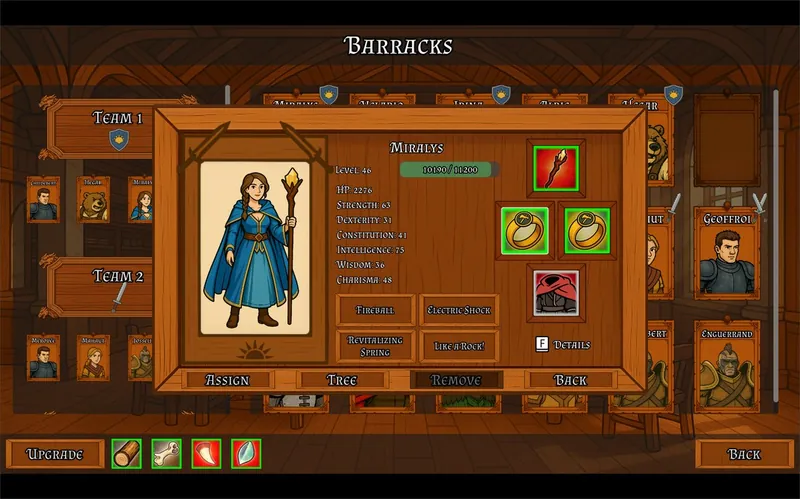
  • prepare your squads at the stronghold;

  • assign recruits, equipment and roles;

  • choose expeditions on node-based maps;

  • survive turn-based tactical battles;

  • bring back loot and resources;

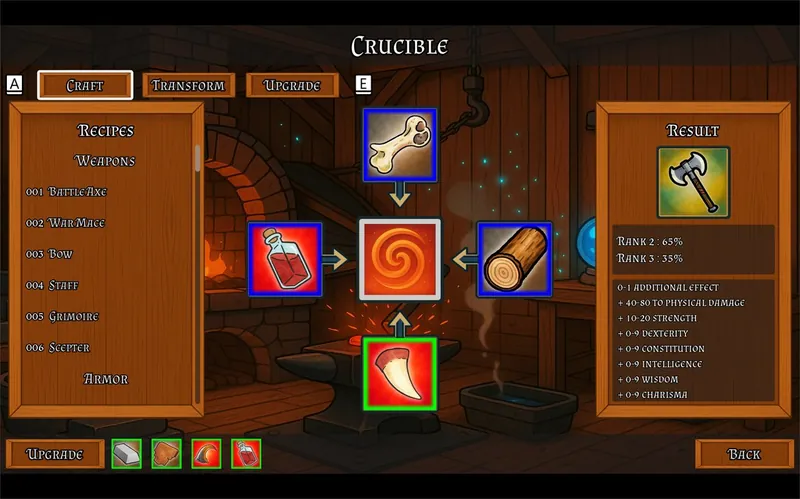
  • craft, improve and reorganize your company before the next run.

The game is not designed as a pure roguelike. The idea is closer to a long-term RPG progression loop built around squad management, risk/reward expeditions, crafting and tactical combat.
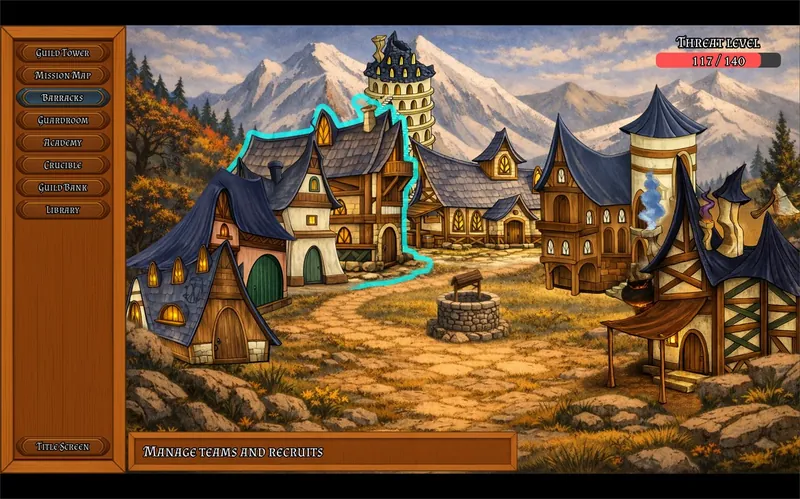
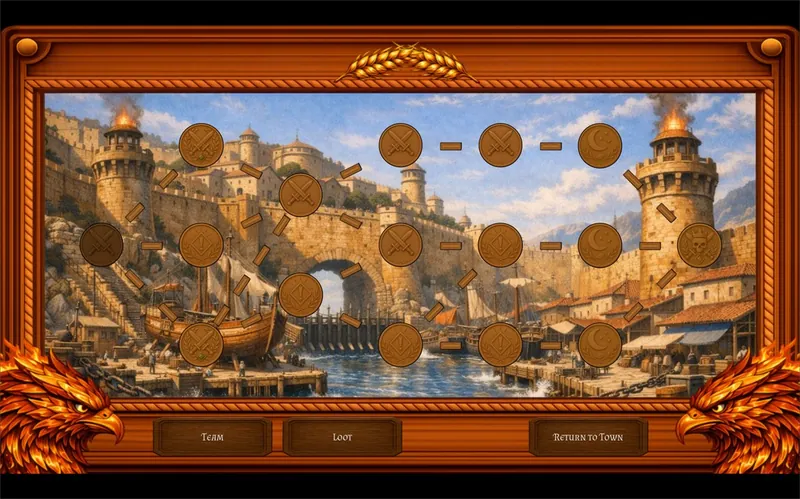
Combat and MATB

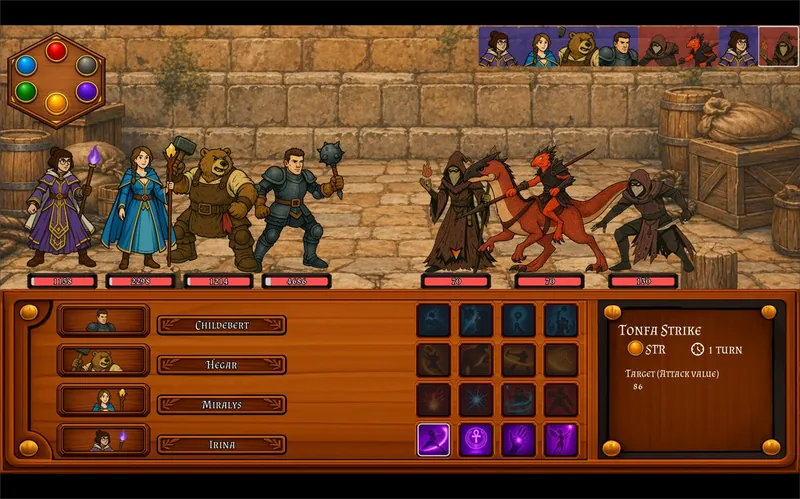
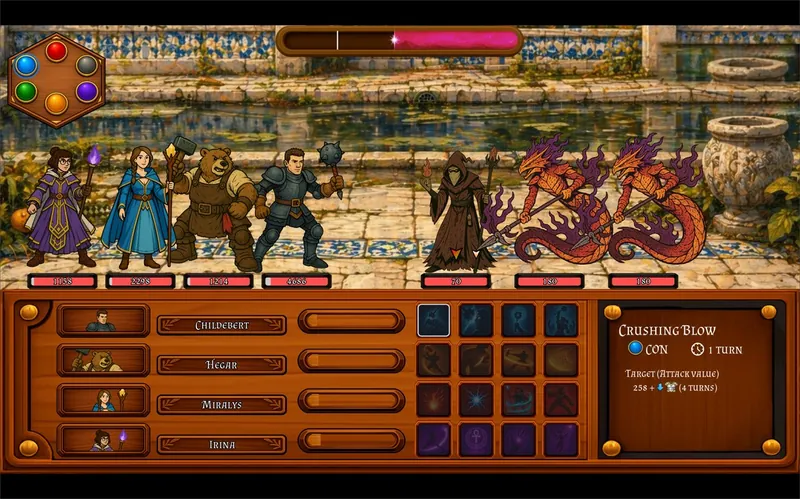
Combat is turn-based and built around party roles, skills, cooldowns, resistances, buffs/debuffs and team synergies.

There is also an optional system called MATB. When enabled, characters act when their charge bar fills, and musical tension creates timing windows that can boost physical or magical attacks. It is meant to add pressure and rhythm for players who want it, while keeping a more classic turn-based pace available when disabled.

What kind of feedback would help us most?

If anyone has time to try the demo, we are especially interested in feedback on:

  1. Is the opening of the demo clear enough?

  2. Does the stronghold -> expedition -> combat -> loot/craft loop make sense quickly?

  3. Are the tactical battles readable?

  4. Does the UI give enough information without becoming too heavy?

  5. Does the MATB layer feel interesting, confusing, or unnecessary?

  6. Is the risk/reward of pushing deeper into an expedition understandable?

  7. At what point did you feel engaged, or at what point did you start to lose interest?
A bit of context

We are a very small team, and Astralis is built with Godot. The game is currently in development, with a public demo available on Steam. We know that first impressions matter a lot, so feedback on clarity, pacing and onboarding is especially valuable to us right now.

Quick info:

  • Title: Astralis: Dawnblades

  • Studio: Studio Gravenoire

  • Engine: Godot

  • Genre: tactical RPG / heroic fantasy / squad management

  • Platform: PC / Steam

  • State: in development

  • Demo: available on Steam

  • Languages currently supported on Steam: French, English, Spanish, Italian

  • Target release: 2026

Thanks for reading, and thanks in advance to anyone who takes the time to try the demo or comment on the presentation.

RmbRT
RmbRT

I think having an optional mode that plays entirely differently (the rhythm kind of thing) is bad design. It waters down your game's personality. Do what you intend to do, and deliver everything at a uniform level of polish across the whole game. If you half-ass a feature that you aren't confident in, you send mixed messages and try to appeal to incompatible audiences. IMO, indie games should choose a specific audience that they serve really well, instead of multiple audiences that they only serve a bit. And even if the mode enabled perfectly matches one audience, and with it disabled, perfectly matches another audience, the existence of that option at all has a psychological impact on the players' perception of your game.

Regarding the demo: if you had a web build, I would try it out maybe. But I certainly won't run some random guy's program on my computer.

Walk with God.
Gravenoire Studio
Gravenoire Studio

Thanks, that is a very useful point.

I agree that an optional system should not feel like a second game bolted on top of the first one. MATB is intended as an optional layer over the same turn-based combat, not as a completely separate combat mode. The idea was to bring more dynamism to the game, in a spirit close to older Final Fantasy games such as Final Fantasy VI, while still letting players choose the pace they prefer: a more chill, classic turn-based experience, or a more dynamic one with extra timing pressure.

That said, I understand the risk you are pointing out: if the feature is not clear, strong and well integrated enough, its mere existence can make the game feel less focused. That is actually one of the reasons we are asking for feedback on the demo. We need to decide whether MATB should be improved and better integrated, kept as an advanced option, or reworked more deeply. We do not want to keep a feature just because it already exists if it hurts the overall identity of the game.

To give a bit of context, Astralis is our third commercial game after Ataraxie, a metroidvania released in 2024, and Labyban, a puzzle game released in 2025. Both were released on PC and Nintendo Switch. With those previous projects, we learned how to finish and ship games while committing to specific design choices, but Astralis is much more ambitious in terms of systems and readability. That is why feedback like this is genuinely useful to us: it helps us check whether our intentions are coming across clearly, or whether some systems are blurring the message.

Regarding the demo, this is precisely why we provide it through Steam instead of asking players to download a random file from an unknown link. Of course, it is not an absolute guarantee for everyone, but it is the cleanest and most reassuring way we currently have to distribute a public demo.

Thanks again for taking the time to comment. This is exactly the kind of design feedback we are looking for.

Gravenoire Studio
Gravenoire Studio

Thanks, that is a very useful point.

I agree that an optional system should not feel like a second game bolted on top of the first one. MATB is intended as an optional layer over the same turn-based combat, not as a completely separate combat mode. The idea was to bring more dynamism to the game, in a spirit close to older Final Fantasy games such as Final Fantasy VI, while still letting players choose the pace they prefer: a more chill, classic turn-based experience, or a more dynamic one with extra timing pressure.

That said, I understand the risk you are pointing out: if the feature is not clear, strong and well integrated enough, its mere existence can make the game feel less focused. That is actually one of the reasons we are asking for feedback on the demo. We need to decide whether MATB should be improved and better integrated, kept as an advanced option, or reworked more deeply. We do not want to keep a feature just because it already exists if it hurts the overall identity of the game.

To give a bit of context, Astralis is our third commercial game after Ataraxie, a metroidvania released in 2024, and Labyban, a puzzle game released in 2025. Both were released on PC and Nintendo Switch. With those previous projects, we learned how to finish and ship games while committing to specific design choices, but Astralis is much more ambitious in terms of systems and readability. That is why feedback like this is genuinely useful to us: it helps us check whether our intentions are coming across clearly, or whether some systems are blurring the message.

Regarding the demo, this is precisely why we provide it through Steam instead of asking players to download a random file from an unknown link. Of course, it is not an absolute guarantee for everyone, but it is the cleanest and most reassuring way we currently have to distribute a public demo.

Thanks again for taking the time to comment. This is exactly the kind of design feedback we are looking for.

RmbRT
RmbRT

I just watched the trailers. The part where MATB is demonstrated doesn't feel action-packed enough, honestly. You can't just take animations that are clearly intended for a turn-based experience and use them for a rhythm game. A crucial part about rhythm action is that the visuals need to be like a dance, with constant flow to it. I don't think a 2-pose attack animation can ever mesh well with that kind of thing. However what you can do is to add sprite movement to make an attack feel more dynamic. So when you do the lightning spell, make the character take a step back and then forward, kind of like the tackle animation on old GBA pokemon games. Actually, the GBA pokemon games are a great example of making attacks feel impactful despite using static sprites. Use sprite movement, flashing/tinting of sprites, and particles that are aligned to the beat, to make an attack feel more dynamic. Without that, all you have is a timer tied to the music, forcing you to act quickly, but none of the haptic reward that makes doing so feel great (except maybe “damage number goes up” or something). A rhythm game should feel and look like you're dancing: you want to feel like you're interacting with the rhythm, and you want the reaction on screen to also look like it fits into a dance. Even if that dance consists of throwing fire balls. And you definitely also want to show indicators of how well-timed the attack was, either as a variation of the attack sprite (maybe with a shader, such as adding a glow?), or as particle effects on the character, etc.. The “deflection” animation is also way too long for a rhythm combat game, as it breaks the flow for like 5 seconds or something.

P.S.: I just noticed that some attacks like the knight's do use sprite motion. All attacks should have at least this level of dynamicity to it.

The character art is inconsistent. The trailer showing the woman at 32 seconds uses flat colours everywhere, while the the man at 20 seconds has lots of texture to his clothes, and the giant has a very grainy look to it. Stick to one art style, unless you want to explicitly leverage differences in art style / visual language for expressing mechanics. Also, the art style with the strong #000000 outlines makes the woman look very flat. Especially if you look at her braid. Flat = dead/shallow, which is okay if you deliberately aim for that effect. However, I think that also clashes with the MATB vision. I know you're just a small team, so animations are hard to make. Which is why I would not recommend including lots of animated characters in a 2D game to an indie studio. I recommend having a look at the Nonsensical 2D youtube channel. He dominantly uses an art style that is roughly similar to what you use, and he has great insights about how art design ties into gameplay experience.

The game's visual language is generally clashing, now that I look at it. You mix completely flat-coloured sprites having strong black outlines, with grainy sprites, and then HUD elements that feel blurry (especially the wood texture), making a stark contrast to the strong and sharp outlines on the characters, and then you also add the red bar at the top, which is also very grainy but with flat-shaded regions instead of gradients, and then you have the 6 gems or whatever at the top left corner which use smooth gradients and even suggest self-shadowing, making them feel out of place with the flat characters. And your outline/border thickness on things is also highly inconsistent. The red bars below the characters have way too thick outlines, nothing else on screen has outlines that thick. And the grainy art suggests the “drawn on paper” look, while the flat look suggests “digitally created image”.

The AI-generated character sprites (yes, I know you adapt them by hand) also have this weird mix of strong facial expressions but rigid-looking body poses.

At 39 seconds in the trailer, you sometimes use semi-transparent nodes on the skill graph or whatever that is. Don't do that. I don't want the connecting lines that are behind the icon to shine through the icon. Instead, grey the icon out or something, but keep it at 100% opacity.

If I were making this type of game myself, I would try to massively cut down on the number of assets needed, wherever possible, even if I had a dedicated artist. I would focus on having few, but well-animated characters that feel fluid and dynamic in their motions, which I feel is a prerequisite for adding the rhythm mode. For that, I would probably choose pixel art, but that's just my personal affinity that works out well for me when I do sprites. The linked youtube channel does great HD game art just as well. Or, if you really do need lots of characters, I would animate none of them, and instead focus all that time and effort on visual effects instead (GBA pokemon style attack effects). The main reason why I would use pixel art is that it enforces uniform outline sizes, and the canvas is small enough to allow me to still hand-paint every single pixel deliberately within reasonable time frames, allowing me to create highly polished sprites. The same can be done with HD painting, too, but requires more discipline. I would not recommend using generative AI to speed up the art process, no matter how tempting it is. Instead, I recommend going for an art style that you can actually pull off by hand even without AI. Removing constraints is not helpful. Designing with hard constraints actually helps you deliver a more focused final product, as it forces you to think hard and make deliberate choices and trade-offs, and forces you to leverage everything you do to its maximum possible impact, whereas unconstrained designs make you approach the process with a completely different mindset.

I think you should check out the indie game clinic channel on youtube, he talks a lot about the mindset and thought process required when designing games, and also points out many mistakes that are commonly being made in indie games. And look into art channels that teach you about visual language. I personally like Lighting Mentor, Stephen Travers Art, and the Nonsensical 2D channel linked above. Also I recommend having a look at, and actually reading, a few webtoons and mangas, to see what the pros do for the comic style that you're going for. I'm talking about colour grading, line-work, shading/hatching, etc..

P.S.: Looking at your previous games, it's obvious that you have lots of content in those games, but at low quality. I recommend making a game that is as high quality as you can deliver, even if you have to massively cut down on content. Because realistically, nobody wants to play or buy a game with low quality. But even something like a reskinned slot machine sells and has players, if it is polished well enough (see Slots & Daggers). And doing so also forces you to improve on your skills, because you'll have to achieve a level of quality that you haven't produced so far.

Walk with God.
Gravenoire Studio
Gravenoire Studio

Thank you for taking the time to write such a detailed breakdown.

This is a lot to process, but it is useful. I think the main points I take from your feedback are:

  • If MATB is meant to add rhythm and dynamism, the visual feedback has to support that much more strongly.

  • The attacks need more motion, timing feedback, impact and flow, otherwise the system risks feeling like a timer on top of turn-based combat rather than something that actually interacts with the music.

  • Some animations, like the deflection, may be too long and break the pacing.

  • The visual language is not consistent enough between character art, outlines, grain, UI textures, icons and skill graph elements.

  • We may need to focus more on fewer, higher-impact visual improvements rather than trying to produce too much content at once.

That is hard feedback to receive, but it is also very concrete, so thank you for that.

I especially agree with the point that MATB cannot just be a mechanical option. If we keep pushing it, it needs stronger audiovisual feedback: clearer timing indicators, better attack impact, movement or sprite motion where possible, and effects that feel tied to the beat. Otherwise it risks weakening the identity of the combat instead of strengthening it.

On the art direction side, I understand the issue you are pointing out. As a small team, we tried to cover a large amount of content, but consistency is clearly something we need to improve: outline thickness, texture treatment, UI readability, opacity states, and how characters sit together on screen. We probably need to identify the highest-impact areas first rather than trying to fix everything at once.

I will also check the channels and references you mentioned. Even if we do not make the exact same production choices, the point about constraints is valuable. A smaller but more coherent visual target is often stronger than a broader one that feels uneven.

Thanks again. This is exactly the kind of feedback that helps us decide what to prioritize before release.

Topic Locked

This topic has been locked by a moderator. New replies are not allowed.

Sign in to reply to this topic.