

Inscribed Spheres
Box2D has outlined an inscribed-sphere technique for speeding up separating axis tests in convex-polytope collision detection. The core idea is to use the centers and radii of inscribed spheres as a cheap upper bound on how much separation any face or edge can possibly achieve, letting the solver skip work before it reaches the expensive edge-pair stage.
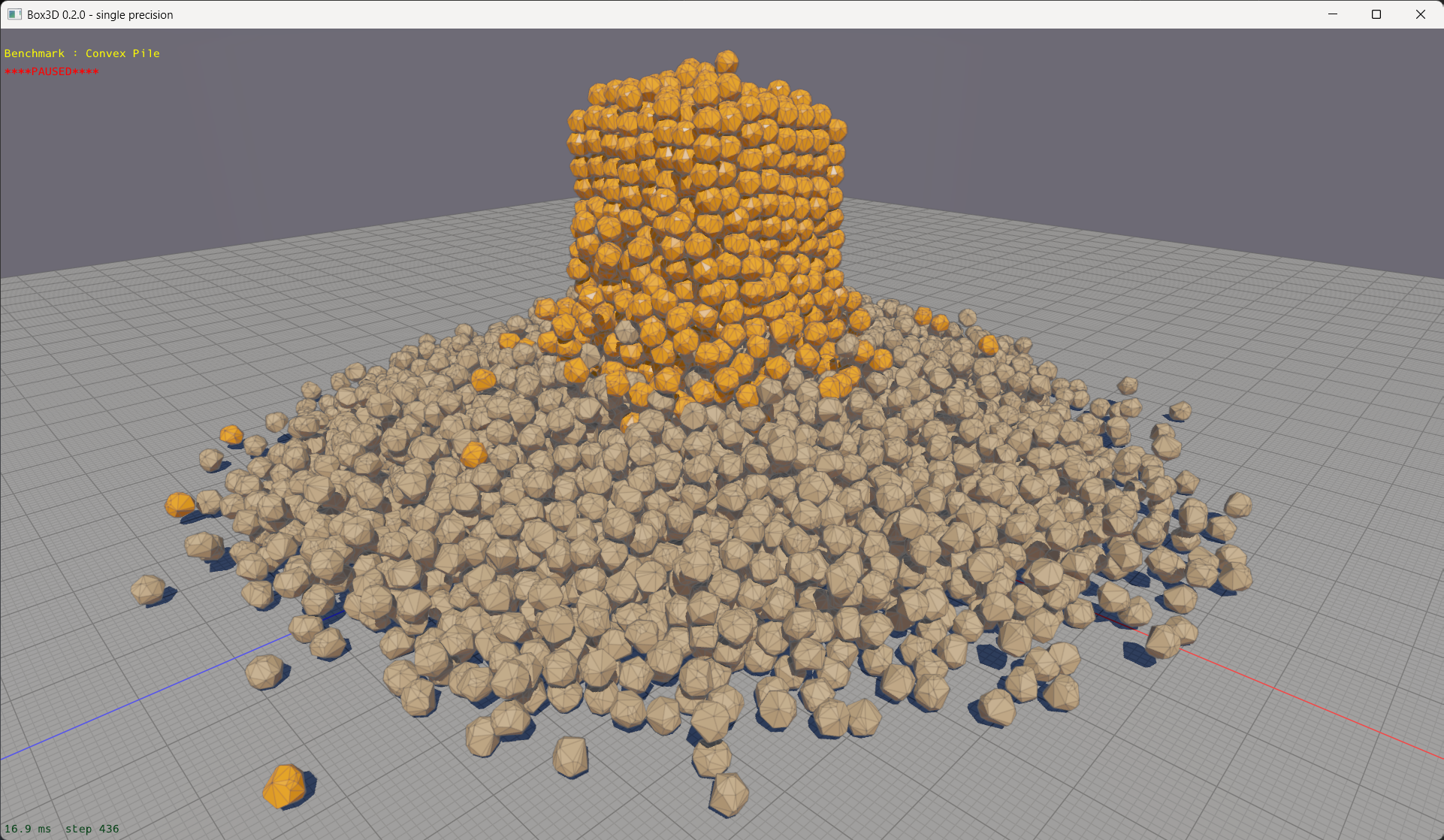
That matters because SAT is already doing a lot of heavy lifting in Box3D, especially for contact manifolds between overlapping convex hulls. The post notes that even with Gauss-map rejection, SIMD edge testing, feature caches, and contact recycling, large piles of complex shapes can still spend most of their time in the edge-pair hot loop. The new bound can replace many per-face dot products with a single dot product, and in 3D it can cull edges before pair testing at all.
The broader trick is to use the Gauss map arc for an edge to bound the best possible separating axis along that arc. If the projected center vector cannot beat the current maximum separation, the edge is discarded early. The write-up also shows how the same idea applies in 2D with inscribed circles, and notes that the radius term needs a small tolerance adjustment to stay robust against round-off.
For engine developers, the practical takeaway is straightforward: this is another way to keep SAT viable for complex convex scenes without falling back to slower overlap handling or shrinking shapes to stay in a cheaper regime. It is especially relevant for physics programmers working on broad piles, stacking stability, and contact generation performance.
“I have developed a scheme to use the Gauss map edge arc to cull edges before they even reach the edge pair test.”
- what
- Box2D describes an inscribed-sphere method to accelerate SAT contact generation for convex polytopes.
- who
- Box2D / Box3D, with the technique building on a 2011 idea from Pierre Terdiman.
- when
- The write-up references Terdiman's 2011 suggestion and presents the newer scheme now.
- impact
- Can cull faces and edges earlier, reducing expensive edge-pair tests in dense convex piles.
Promising perf win for robust convex collision
Follow box2d updates
See relevant stories in your personalized news feed.
Discussion