
Creating an orchestral score from a guitar riff
How to begin writing for a large number of instruments from a single initial idea.
.png)
I haven’t been classically trained when it comes to composing music, but thankfully you don’t have to be nowadays, if you want to throw in some violins or brass sections into your scores…
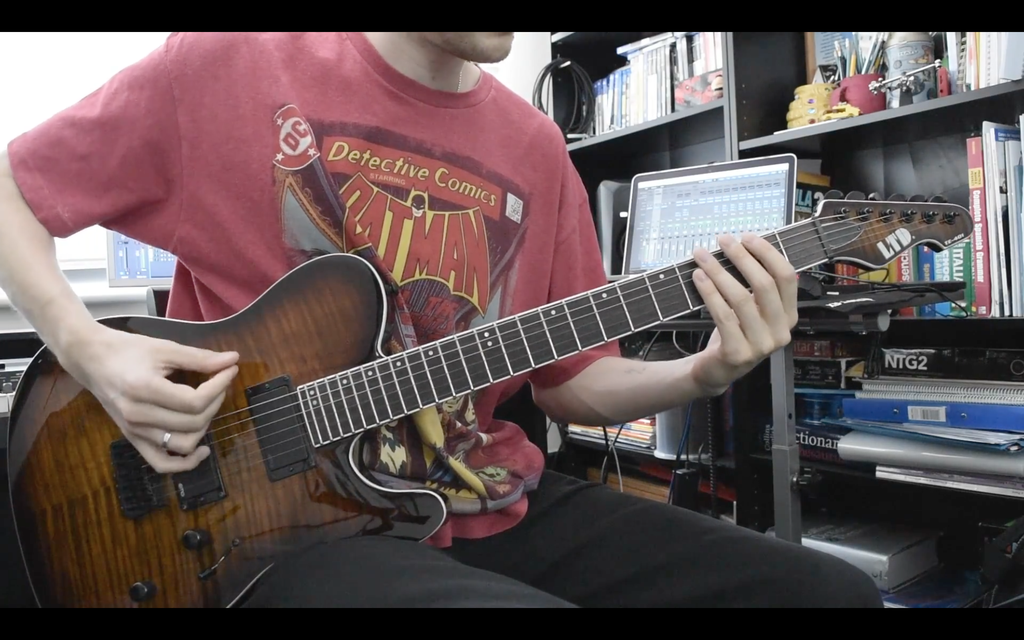
This music was for the 2nd stage of a boss fight in the video game I’m currently working on (see here for a trailer) and I wanted some heavy music to pick up the pace and intensity of the battle sequence. The boss is a massive, ancient armoured knight in comparison to our much smaller warrior, so the mood of the track had to be intimidating and looming. Picking the right instruments and sound for a scene is half the battle in my opinion. Being a “souls-like” game, orchestral music is a go-to, but I’ve had no experience in doing so beforehand, so I started with something that’s familiar to me: a guitar. I slapped on some distortion and wrote a couple of ideas that I personally would want to hear when fighting this boss. I then layered it with some percussive mutes where I felt a beat, and a “lead” melody that could work over the top as a progression idea.
I then opened my Native Instrument sample packs and started orchestrating (choosing the combination of instruments to play the notes of the riff) by writing my notes into Logic Pro X’s midi editor. A great place to start is with the low strings, ie the cellos and double basses, to build up from the lower frequency instruments. Then I added some trumpets and brass for accents and colour and finally shoved some nice heavy percussion loops to bring out the drive and power behind the musical idea.
Some extra parts here and there, some reverb, compression and some mixing lead me to what you hear in the video above.
Of course, i'm not trying to say that mixing experience isn't important in getting the overall sound right, as well as proficiency in your DAW (digital audio workstation) and knowing which instruments work best for certain passages. However this method (for me anyway) is a great way to build up confidence when utilising instruments and styles that are otherwise totally alien.
Having a clear vision of what you want to create and a simple guitar riff can take you a long way.
Thanks for reading.
Related Tutorials
Beginner Graphics Programming Study Guide
This is a roadmap for learning the basics of graphics programming on one's own, from free online resources.
 raynmetal

Manual, mipmapped atlas texture wrapping on lower-end mobiles (WebGL1/GLES 2)
Manual texture wrapping within atlas textures / tilemaps with mipmapping on mobiles without EXT_shader_texture_lod.
 RmbRT
RmbRT

Capsule Collision Detection Tutorial
Collision detection between a Capsule and a Line Segment and a Capsule and a Capsule. Prerequisite: Linear Algebra (Ve…

Lesson 1 — What C# Actually Is
Why is C# the language driving the production of thousands of indie games using Unity and custom engines all around the…

Sphere with Plane and Polygon Collision Detection
In this video, I demonstrate how to detect collisions between a static sphere, planes, and polygons — a core concept in…

Steps to Make a Simple Game in Unity
if you’re diving into game development, Flappy Bird is basically the ‘hello world‘ of the gaming universe. It is the ul…
Discussion
More from Sergio Ronchetti

FMOD for game developers!
FREE Fmod template to setup any game project. And a quick video on what Fmod Studio's main windows look like.
Sergio Ronchetti
.gif.c4dc3917e38414db3623a81af2e49473.webp)
Sound Design with an iPhone SE
How using an iPhone SE for sound design can still yield high quality results
Sergio Ronchetti
Making sound effects for video games: Using Fmod with Unity
My blog as a beginner in sound design for video games. In this article i talk briefly about how Fmod has helped make so…
Sergio Ronchetti
Discussion