
Taptitude: two years of success on Windows Phone
It
- Windows Phone continues to be a great market for indie developers.
- The mini-game collection model continues to resonate with our users.
- There is significant headroom for future growth.
Downloads
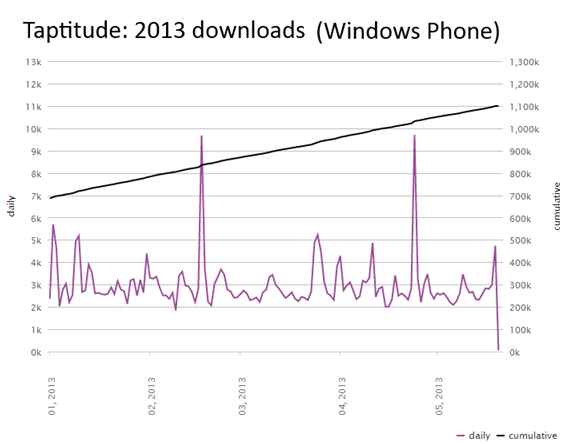
We recently announced that Taptitude has broken the 1 million download mark on Windows Phone. Let's take a look at how these were distributed.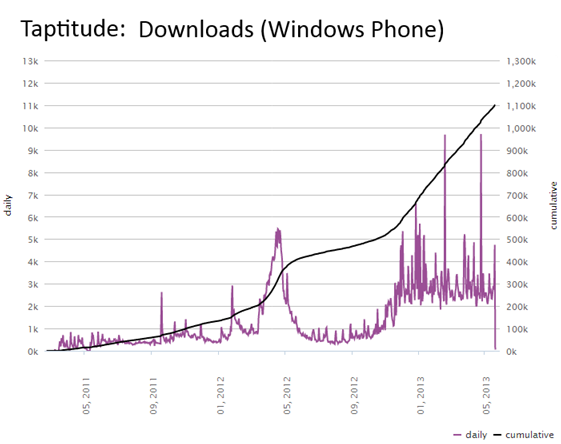
Crashes
Microsoft provides crash reports in their Dev Center portal. We find it helpful to monitor these reports weekly and fix any obvious bugs before we ship the next update. Generally our crashes per day are reasonably low compared to our user base, but from time to time a bug will slip through and we'll see a spike.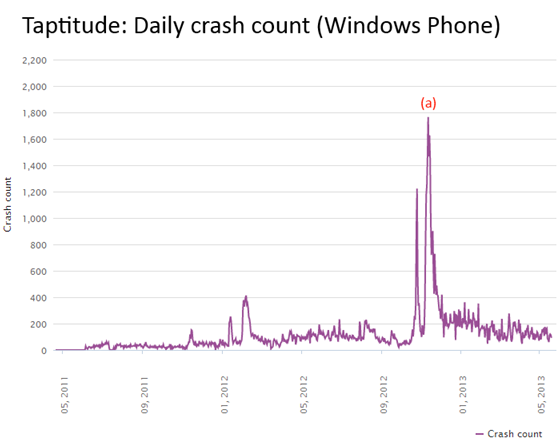
Advertising
Taptitude is still primarily an ad-supported game, and we've enjoyed considerable success pursuing this business model. We keep things simple; showing a single ad on the screen at all times, and cycling once every 30 seconds. Users can remove the ad by purchasing Taptitude Gold from the in-game store. Over the last two years we've grown steadily up to ~40 million impressions per month.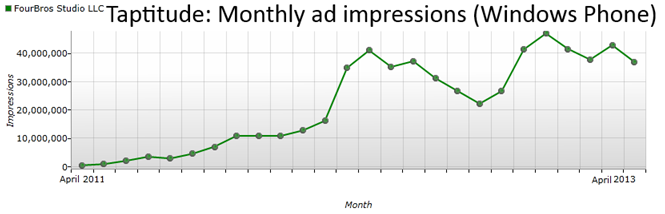
In App Purchase
We added IAP to Taptitude at the beginning of 2013 and have seen pretty steady uptake.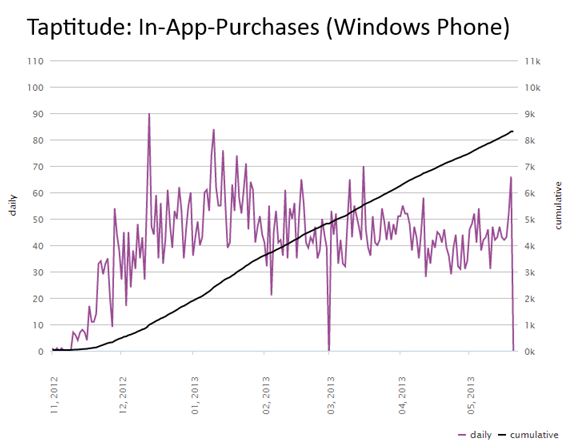
Summary
Now that we've seen the numbers, let's look back at my original observations:1. Windows Phone continues to be a great market for indie developers.
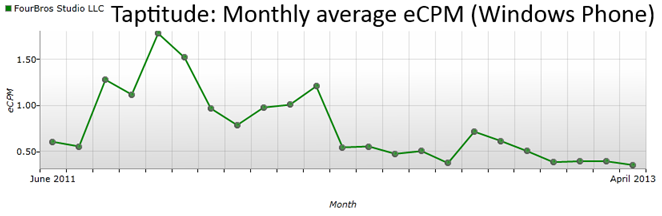
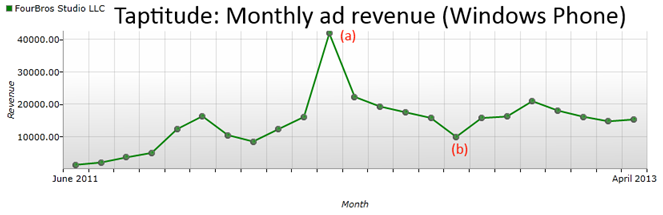
Taptitude has been more successful than we had ever dreamed, and even after two years we're still bringing in significant revenue off of Windows Phone advertising. While eCPM has dropped, the market has grown, and we're happy with the results. IAP was added in WP8, which opens up new revenue streams, but we've yet to fully realize this potential.2. The mini-game collection model continues to resonate with our users.
Taptitude has grown from a small collection of only 5 mini-games to over 80 mini-games with increasing quality and complexity. We can see from in-game stats that our users are very sticky, some of which have put many days of in-game time into Taptitude. We have optimized for bite sized fun, getting users to come back every day, and continuously expanding the game so users stay engaged for months. This has yielded consistently high impressions per user.3. There is significant headroom for future growth.
While Taptitude is doing well on Windows Phone, we've only just begun. We've recently ported Taptitude to iOS, Android, and Windows 8 and we look forward to having enough data to compare. By some reports, Windows Phone only has ~5% of the market share, so with the addition of Android and iOS we could be looking at substantial gains in the next 6 months to a year. We've nailed the ad-supported model, but we have a lot of work ahead to monetize IAP without impacting the game negatively.Conclusion
We hope sharing this data will help other indies understand the market and make better decisions about how to roll out fantastic mobile games. It's too tempting for most developer to see huge numbers on iOS/Android and think that these are the only platforms worth targeting. We're living proof that Windows Phone, even with its smaller market share, is a great platform to kick start your game project while you get it ready for the big (and more competitive) markets. If your game isn't developed with a million dollar budget, you might consider a similar strategy.Related Tutorials

Interview: How indie devs from a small Russian city make games for Google Play and social networks
Duck Rockets, an indie studio from Russia, shared their insights on the following: * why small local markets are more …
 Alconost

RoKabium Games on Building a Game from the Ground Up
Interview with RoKabium Games on their success as a two-person indie developer studio.
 Steven Large

Interview: Game Design Careers with Byron Atkinson-Jones
In this interview, Byron discusses the best ways for young video game designers to get into the games industry.
 Iain Twizzworks

Interview: Cliff Harris on What it Takes to Become a Successful Game Developer
Game designer, programmer, and running a one-man games business, Cliff Harris of Positech Games is behind strategy and …
Tony Chan

Challenges of a VR Indie Developer: Interview with Eric Nevala of Wobbly Duck Studios
Wobbly Duck Studios founder Eric Nevala (@slayemin is his profile here on GameDev.net) has been documenting the develop…


How to Become a Game Designer - Interview with Game Design Professor, Al Doyle
Iain Fenton interviews Al Doyle, professor of game design at New York's Tuoro college, and discusses in length the best…
Iain Fenton
Discussion
More from FourBros Studio
Reverse-Normal 3d Outline Tutorial
A simple trick for getting a crisp outline on a 3d mesh.

Color Palettes
Creating a custom color palette can be a very satisfying and powerful way to establish your own unique look. I'll guide…
Composition 101: Balance
What are the principles of Balance in Composition? Otto Ostera discusses the 3 elements of balance: shape, direction, a…
Discussion