
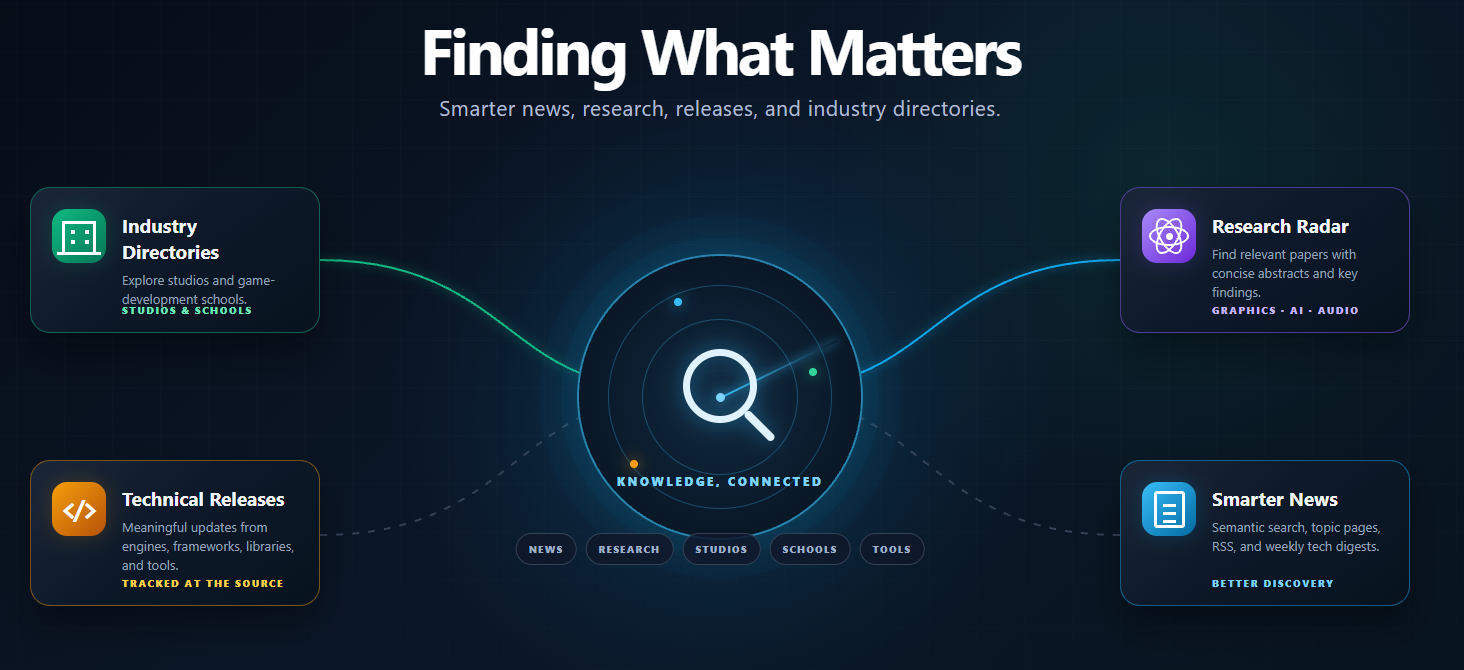
Finding What Matters: Smarter News, Research, and Industry Directories

In my last update, I wrote about the more personal side of what we've been building: avatars, badges, profile customization, and new ways to recognize the people who contribute to GameDev.net.
This time, I want to cover the other half of the work: making GameDev.net better at helping you find useful information.
That includes a new research hub, smarter news search, better technical release coverage, weekly digests, and public directories for game studios and schools.
A new directory of game studios
We've launched a public game studio directory covering studios, publishers, tool makers, middleware companies, and service providers from across the industry.
You can search the directory and filter listings by location, organization type, and claim status. Individual pages include the information we have about each organization, such as its location, focus, notable work, and official website.
Importantly, these are reference listings—not fake community accounts. If an organization hasn't been claimed, we say so clearly.
If you represent a listed studio or organization, you can submit a claim. Once approved, a studio listing can connect to GameDev.net's existing team system, giving the organization a real presence that its members can manage.
If your organization is missing, you can suggest it for inclusion.
This is still an early foundation. Over time, I'd like the directory to connect studios with their games, tools, technologies, teams, job opportunities, related news, and GameDev.net members. For now, the goal is simpler: create an honest, useful reference for understanding who is working in the industry.
A directory for game development schools
We've also launched a game development school directory.
Prospective students can browse and search programs across game development, game design, art, animation, audio, production, and related disciplines. Listings can be filtered by location, program type, degree focus, and claim status.
Schools and educators can claim their listings through the same general process as studios. Approved claims can connect to GameDev.net's school and team features, giving educators a place to build a community around their program.
Choosing a school is a major decision, and no directory can make that decision for you. My goal is to make it easier to discover programs, compare the basic facts, and find the right questions to ask.
As with the studio directory, missing schools can be suggested for review.
Research Radar
Game-development research tends to be scattered across conference proceedings, university pages, personal sites, and general academic feeds. Even when you find a relevant paper, it can take a while to determine whether it's useful to the problem you're actually trying to solve.
The new Research Radar brings that work together in one place.
You can browse recent research across:
Graphics
AI and machine learning
Audio
Networking
Design
Physics
Each item includes a concise abstract and key findings so you can quickly decide whether to read the full paper. Research is also grouped by recency, making it easier to see what appeared this week, this month, or earlier.
Our goal is to help you find the papers worth giving your time.
News search
News search now combines traditional keyword matching with semantic ranking.
Normal keyword search is good when you know the exact words used in a headline. It's less useful when you're searching for an idea expressed with different terminology.
The new search can understand more of the meaning behind a query, which helps it find relevant stories even when the exact phrase you typed doesn't appear in the title.
That should be especially useful for technical subjects where the same concept can be described in several ways.
Better coverage of engines and tools
We're now tracking selected game-development repositories and their releases more directly in the GameDev News.
That gives us a better chance of catching meaningful updates to engines, frameworks, libraries, and tools from the original source, rather than waiting for a secondary article or social post to appear.
This isn't meant to become a feed of every commit or version tag. Drafts, pre-releases, old updates, and low-signal releases are filtered before anything becomes a news item.
The goal is to surface releases that a working game developer might actually care about. If there's an important engine, framework, or open-source tool you think we should follow, let me know.
The Weekly Tech Digest
Not every useful technical update is a major story.
A small library release, engine plugin update, new developer tool, or niche technical article might be valuable to exactly the right person while never generating enough attention to reach the front of a conventional news feed.
The Weekly Tech Digest gives those items somewhere to go.
Each digest collects useful technical stories from the week into a single roundup with a short summary. It appears as an expandable card in the news feed, and every edition has a permanent page you can share or return to later.
If you prefer not to see the digest in your feed, you can turn it off in your preferences.
Topic pages, better URLs, and RSS
News stories now have cleaner, readable URLs, and recurring subjects have dedicated topic pages.
That means an engine, studio, company, or technology can have a permanent landing page instead of existing only as a temporary feed filter. Topic pages bring related coverage together and make it easier to follow the subjects you care about.
We've also added a proper news RSS feed at /news/rss/ for those of you who still prefer an actual feed reader. I do not consider RSS obsolete, and apparently quite a few of you agree.
Your followed tags and favorite studios, engines, and other entities now have more influence over the For You feed too.
Reminder: GameDev.net MCP server
We announced this separately, but it fits the larger theme of making GameDev.net's knowledge easier to find.
AI assistants and coding agents can connect to GameDev.net through our MCP server at /mcp/. They can search the site's forums, tutorials, articles, answer pages, and news while citing the original source.
That last part matters.
GameDev.net contains more than 25 years of answers written by real developers. If that knowledge is going to inform AI-assisted work, I want the people and discussions behind it to remain visible and not be flattened into an anonymous answer with no source.
The MCP server is published in the MCP registry, and higher usage tiers are included with GameDev Pro.
Building a more useful map of game development
The common thread through all of this is discovery.
Game-development knowledge is spread across forums, GitHub repositories, research papers, conference archives, studio sites, school programs, personal blogs, Discord servers, and dozens of other places. Useful information appears briefly and then disappears into a timeline.
I think GameDev.net can help organize some of that. It doesn't mean we copy the entire internet, but by finding useful things, adding context, and connecting them to the people and organizations behind them.
The studio and school directories are a beginning. Research Radar is a beginning. Better release tracking and topic pages are beginnings too.
There's a lot left to do, but the pieces are starting to connect, and GameDev.net is becoming a more useful platform with a strong community.
Discussion