
GameDev.net gamedev.net
🔒 Locked

Solo Dev Seeking Feedback: A New Blockchain Gaming Model Focused on Adversarial Mechanics

Started by pem May 5 at 9:13 PM 8 replies 1.5k views
Original Post
pem
pem

Hello gamedev.net Community,

I've been heads-down in a project for more than a year or so, and I finally reached a point where I feel comfortable enough to share the high-level concept — and I need the collective wisdom of this community. I'm genuinely worried about whether this idea is fundamentally sound, or if I’m hopelessly overthinking it.

I'm a solo developer, and this is an ambitious attempt to blend decentralized finance (DeFi), applied game theory, and game design into a platform I call "Wrong Crowd".

I want to introduce it to you all and see if it resonates with anyone out there.
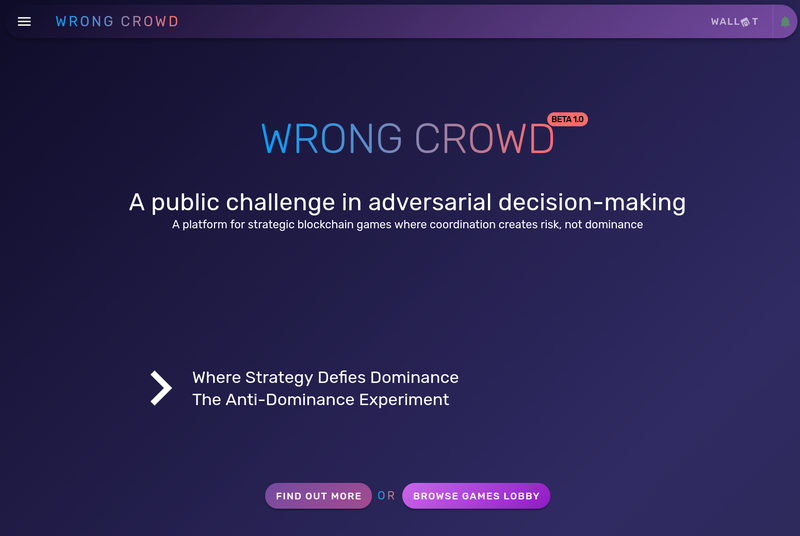
Wrong Crowd Hero

What’s Wrong Crowd?

Wrong Crowd is a blockchain-based gaming platform designed for adversarial decision-making games.
The core idea revolves around players competing in a public, block-chain based game and try to win the whole or part of the pot.

Each game includes:

  • A Pot: collected as entry fees by on-chain game contract.

  • A Set of rules: implemented by on-chain contract.

  • A Set of choices: implemented as transactions for players to execute on-chain.

Each game is designed with these requirements:

  • All game rules are transparent.

  • All game rules and outcomes are deterministic with no random values in calculations.

  • All votes are secret and get revealed only when game rules dictate.

  • Influence or alignment increases risk.

What’s Marble Master?

Marble Master is my first game for this platform.
It’s a strategic game played in rounds, each round some of the players are eliminated until someone wins the game.
Players can go greedy and try to win fast or be cautious and play it slow, there are no best strategies, everything depends on how everyone else is playing and interpreting the game.
Votes are hidden until each round is concluded and then all the votes are published with round outcomes meaning which players are eliminated or is the game ended and winners are found.
The mastery comes not from a skill, but from understanding the group's collective psychological tendencies and betting against the perceived wisdom of the crowd.

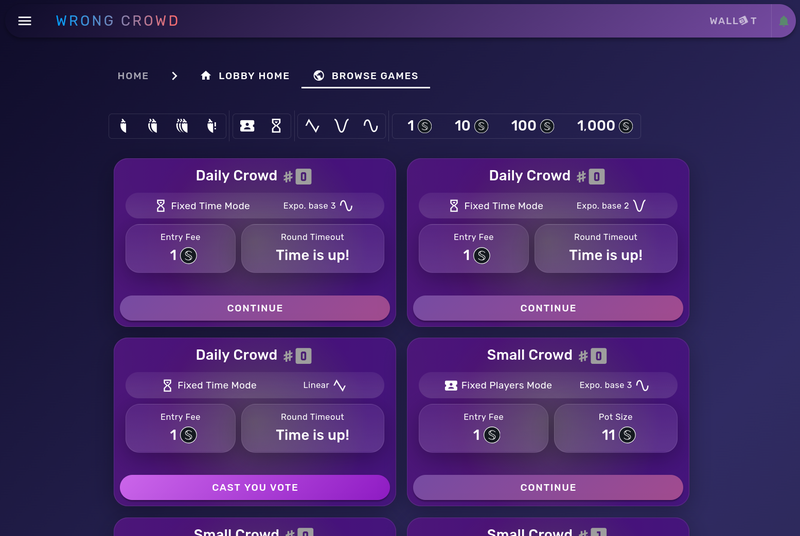
The game operates in two main modes:

  • Fixed Time: with a fixed time frame (a day for ex.) to collect first round votes. Number of players of this game mode is undetermined and is revealed after first round.

  • Fixed Players: Number of players is known and as soon as those number of players submit their vote, game progresses to the next round.

Considering games with different entry fees, and sub settings, there are many games to play.
The game is turned base and time has almost no meaning, except that you forgot to submit your vote in available time window.
Whats the stage of development:

I’m currently in the final stages of testing and refining Marble Master on Secret Network.
The platform is built using:

  • Secret Network for blockchain integration.

  • Nodejs for server-side caching and game administration, notifications and so on.

  • Vuejs for client app (Webapp as main target).

Where I Need Help / Your Feedback

I’m running this solo and I need feedback:

  • Legal/IP Professionals: I'm operating in a regulatory gray area (literally and geographically). My platform is inherently adversarial and involves stakes (entry fees), which puts it near the line of regulated gaming, but the math is designed to prevent any guaranteed outcome. I am seeking resources or general guidance on legal frameworks/consultants specializing in non-guaranteed, decentralized predictive betting/gaming models. Could the community point me toward expert networks or general best practices for posting online about such platforms.

  • Blockchain Devs, Founders/Entrepreneurs: For those who have successfully launched technical projects (especially in Web3), what is the most efficient path to move from solo dev to a funded, multi-person team? Specifically, what initial seed funding milestones should I focus on to attract VC/angel interest, or what kind of early collaboration (non-dilutive support, mentorship, etc.) would be most valuable right now?

  • General Feedback: I'm excited about this, but I'd love to hear your criticisms and design notes

Looking Ahead:

This is my first public mention of "Wrong Crowd" and "Marble Master" and I’m eager to gather feedback from the community.

Also, AI was used to formulate and generate parts of this post, but I have read it multiple times 🙂.
Thank you for taking the time and reading this post.

Alan Voren (PlayServ)

Two honest notes:

  1. The legal exposure is heavier than "gray area" suggests — entry fee + payout = gambling in most regulators' eyes regardless of skill component, so a specialized iGaming-crypto lawyer is non-negotiable before public launch.

  2. For funding, traction trumps pitch decks right now in Web3 — get 50 people playing repeatedly before approaching VCs.

None
pem
pem

thank you for the response @Alan Voren (PlayServ).

I wonder, why i did not more get responses

does it look like a crypto hype or advertisement?
am I providing little information or the game is not relatable?
How should I distance my idea from crypto hype and make it look like legit game?
How should I create a community for the game without revealing too much?, I have a fear of crypto casinos stealing the idea

RmbRT
RmbRT

So basically a reverse-prediction market, skinned as a game?

Walk with God.
pem
pem

kind of yes, @RmbRT
but prediction markets are about external events, these mechanics are about the crowd that are playing them (meaning how does the herd choose, what does each player perceives as a common sense).

The first mechanic that I’m introducing in “Marble Master” has a handful of simple rules, yet each player can interpret them through their own common sense. The rules are written in plain, straightforward language—no wordplay—yet each person will have their own opinion about how others interpret those rules and how they themselves should act to win.

I can “skin” many stories to the same rules and mechanics, right now, “marbles” are something that I just picked, I thought that using a hyped story can make the idea look like a crypto scam, if not, I can “skin” the same rules and mechanics like “Red-Light, Green-Light” game.

In my ultimate vision, after maturing in enough mechanics, I want to design game rules and mechanics that are like an escape room, a digital escape room with transparent rules and anti dominance mechanics that each player has a reasonable chance of winning (or in other words, everyone has equal chance of winning at start of each game, even if some players try to buy more influence)

frob
frob

pem wrote:

I wonder, why i did not more get responses

Because it didn't need them, and the post looks VERY spammy.

The first reply covers the two big ones: It is likely to be regulated as gambling and money laundering laws in most of the world, and blockchain adds almost nothing.

pem wrote:

does it look like a crypto hype or advertisement?

Yes. I very nearly moderated it to oblivion as spam.

pem wrote:

How should I distance my idea from crypto hype and make it look like legit game?

It isn't a "legit game". What you described is a textbook platform for money laundering.

You admit there is no skill, and there is no luck. It is entirely about predicting how the majority can vote, which is trivially biased with players in collusion, which is a textbook method for money laundering.

There is no traditional game mechanic. Even in games like poker, the randomness of shuffled cards is essential for the game to be fair. Non-collusion is also essential for the game to be fair. Neither of those are part of your platform.

If you're taking a rake, or a percent of the wager, that's strictly regulated, again because it's so easy to engage in money laundering.

pem
pem

frob said:
blockchain adds almost nothing

A vanilla blockchain merely records transactions in an immutable ledger, as you said it adds almost nothing.
By adding a zero‑knowledge layer, the system can keep all sensitive data hidden from every participant, including the validators. The validators still receive cryptographic proofs that the rules were followed, but they cannot read or alter the underlying information. Thus, a zero‑knowledge blockchain guarantees that no external actor can manipulate or even see the data, which is what truly protects the integrity of the game.

frob said:
It is entirely about predicting how the majority can vote, which is trivially biased with players in collusion, which is a textbook method for money laundering.

It is about predicting how the majority will vote, but the mechanic is designed so that the majority cannot control the outcome— a single vote can change the result in its favor.

I don’t think I can prove or demonstrate this without revealing the actual rules, but the main point behind all of these mechanics is: coordination increases risk. The cost of coordinating grows with both the size of the group and the stake each member brings in. Whales can’t dominate because the risk they carry is larger than the benefit they could gain.

in Marble Master you cannot guarantee a win even if you control 9 out of 10 votes. There is a path for that single vote to win while all the other votes are coordinated against it!

Another way to frame the issue is through chaotic systems and hash functions:

  • In a chaotic system, a minuscule change in the starting state can lead to a totally different outcome.

  • A hash function maps two almost‑identical inputs to drastically different outputs.

I want to emphasize that these analogies are used solely to counter the money‑laundering claim;
the actual rules of Marble Master implicitly embed greed and fear in players’ choices and are not merely a mathematical hash function!

frob said:
It isn't a "legit game". What you described is a textbook platform for money laundering.

If I can address your money‑laundering concerns, allow me to beg to differ. I contend that even the simple mechanics of Marble Master meet the definition of a game. Think of it more like a Rock‑Paper‑Scissors interaction than a poker‑style protocol.

In the small group of close friends to whom I have shared the rules, each had a strong opinion about how a crowd would decide, yet each of them was picking a different move for themselves.

frob said:
If you're taking a rake, or a percent of the wager, that's strictly regulated

I have a vague idea about how to include governance into this, as each game session requires blockchain transactions other than players moves for each rounds calculations and move the game state forward, but it makes everything much more complicated and for now I want to focus on mechanics themselves and how the entire idea should be presented.

frob said:
I very nearly moderated it to oblivion as spam.

I promise it’s not spam :,D
I’d love to keep this conversation going and make sure the post stays useful to everyone. Thanks for the heads‑up, and looking forward to your insights.

I guess my main objective is to present these mechanics to the right crowd🙂 in the right way, and that is one of the reasons I’m sharing this here.
I wonder whether it’s better to ditch the “Game” phrasing and to discard “Gamers” as the initial audience group, but I really don’t know which audience this would appeal to more

RmbRT
RmbRT

I don't think there can be any sensible rules that actually allow for what you are aiming for. If all parties collude, then they can 100% direct the outcome. And collusion doesn't necessitate that all colluding parties have to vote for the same outcome. It just mean that they follow a shared plan. Which means collusion can be indistinguishable from honest or even random behaviour. After all, they can collude and agree to behave randomly. Just from teh way you talk about it, I don't think you really understand how far collusion can go.

pem said:
I wonder whether it’s better to ditch the “Game” phrasing and to discard “Gamers” as the initial audience group, but I really don’t know which audience this would appeal to more

If you really want to do this seriously, take out the money, and make it into a game about earning rankings in a leaderboard. You can still do zero-knowledge cryptography even without using cryptocurrencies or blockchain. There are people who love playing mindgames against each other. Stuff like Among Us are an indicator for that, as well as the strong loyalty people have to grand strategy games. However, Among Us is a social game relying on acting & performing subterfuge over voice chat, while also having an actual 2D game provide the stage where all this takes place. And the grand strategy games are extremely complex, and allow for players to make elaborate plays over long periods, reacting to the moment-to-moment circumstances and clashing many times.

From what I understand, your game basically consists of a single voting round per match and that's it? Unless there's a highly interactive phase that leads up to that, during which players can perform subterfuge, it won't appeal to players who would enjoy Among Us. And unless the game also allows for strategic interaction with the game itself, it probably also won't appeal to grand strategy fans.

In a game, people want to get good at it and be rewarded. They want to practice it. If all the game offers is social navigation / manipulation among a randomly assembled party of strangers over the internet, meaning you don't even see these people in real life, so you cannot even gather clues like body language, etc., from them, then you basically take away the things that are actually required for that to work properly and for building that skill. That game could work much better if it were in a real-world setting where people meet face to face.

Maybe it's actually better to make a board/card game out of it? You lose the social aspect when you go online, so you need to add something else that compensates for that loss of depth.

Walk with God.
pem
pem

RmbRT said:
I don't think there can be any sensible rules that actually allow for what you are aiming for.

If we’re talking about a majority that wants to control the outcome while we, as designers, do not want to allow that, chaotic systems and hash functions illustrate this point. No matter how much you control a chaotic system, you can’t guarantee the outcome unless you control exactly 100 % of the inputs, not 99.99 % but a full 100 %.

RmbRT said:
If all parties collude, then they can 100% direct the outcome.

Yes, if you control 100 % of the votes you can dictate the outcome, but that means you are only playing against yourself (or a closed group).

Regarding money‑laundering concerns, I don’t see how this platform would be useful; a dedicated Cryptocurrency tumbler would be a simpler choice. Even if someone tried to use it as a tumbler, an outsider could cast a single vote to negate your 100 % control, creating a risk for that intent.

RmbRT said:
After all, they can collude and agree to behave randomly

They could collude and agree to act randomly but what would they gain from that? It could be a strategy (like tossing a coin to decide whether to go short or long in a market), but it doesn’t give them any control over the outcome of the game and I will argue that when other players are acting randomly but you are playing with understanding of the rules, you will have much higher chance of success.

RmbRT said:
I don't think you really understand how far collusion can go

I have “whale resistance” as one of my main requirements, and Marble Master is not my first attempt to create such a mechanic. I’ve worked on other mechanics, found potential vulnerabilities in them, and set them aside. In the current iteration of the rules presented in Marble Master, I believe I have satisfied this requirement. As I mentioned before

pem said:
in Marble Master you cannot guarantee a win even if you control 9 out of 10 votes. There is a path for that single vote to win while all the other votes are coordinated against it!

RmbRT said:
If you really want to do this seriously, take out the money, and make it into a game about earning rankings in a leaderboard.

That would be like playing poker without money, or paper trading. I will implement virtual money on a private chain as an introductory phase for new players to learn the concept, but real stakes are what create true greed or fear in players. If you’re into poker or have traded on a demo account versus a real account, you know what I mean.

RmbRT said:
From what I understand, your game basically consists of a single voting round per match and that's it?

In the case of Marble Master, it actually consists of multiple rounds. A typical game lasts at least 3–4 rounds, or more depending on how the crowd plays. There are also other variants of Marble Master that can affect the number of rounds—for example, the number of marbles each player starts with in the first round.

RmbRT said:
Unless there's a highly interactive phase that leads up to that, during which players can perform subterfuge

I am working on other game mechanics that include a starting phase in which players create the map they will play on, but those are much more complicated to implement and to introduce to players.
After consulting with friends who are familiar with my current game rules (in Marble Master), I decided to continue with simpler rules and not treat this as the final form but rather as a starting point. I plan to introduce such mechanics and implement more complex games later, so that players who are already familiar with the concept and have tested these games can move on to them.

RmbRT said:
so you cannot even gather clues like body language, etc., from them, then you basically take away the things that are actually required for that to work properly and for building that skill

This is one of the downside of these mechanics, but still there are information available to consider as a player when voting, like what happened in previous sessions of the game or how did the current players voted in the first round of the game and how does that affect next rounds and what is your strategy to overcome that.

RmbRT said:
That game could work much better if it were in a real-world setting where people meet face to face.

You’re absolutely right, and my only mitigation so far is to pay close attention to how I phrase the rules. For a very naive comparison, in Rock‑Paper‑Scissors it’s common for players to choose Scissors as their first move simply because it’s the last word they hear before making a decision.

RmbRT said:
You lose the social aspect when you go online, so you need to add something else that compensates for that loss of depth.

Again, that’s a valid point. I don’t have any mitigations in place for it at the moment.

Another aspect that sets these mechanics apart from typical games is that no single player can control the flow of the game. Players must wait for a round to conclude before the game can continue, and only then can they vote for the next round. Consequently, the pacing is not what you would expect from a conventional game.

RmbRT said:
Maybe it's actually better to make a board/card game out of it?

This platform sits somewhere between a prediction market, a trading market, and gambling. In all of those, you are dependent on many external actors to keep everything fair. I want to design a system that is inherently and provably fair and anti‑dominance at the same time.

This brings us to the debate about the first target audience.
Although the platform is described as something between gambling and markets, I think that people who are involved in those arenas are too hardcore for my mechanics (meaning they find my mechanics too simple or lacking the depth they are used to). My platform could be more appealing to gamers if presented with the right narrative.
On the other hand, I am biased against those platforms and their users, because my feature plans and goals are to reach more complicated mechanics that resemble escape rooms or, as @RmbRT mentioned, strategy games.
One of my friends mentioned game theorists and mathematicians, but I think those groups are small and not influential enough to be target audiences.

Again, and never enough, thank you to all who take the time and read these and I am looking forward to your insightful comments.

Topic Locked

This topic has been locked by a moderator. New replies are not allowed.

Sign in to reply to this topic.