
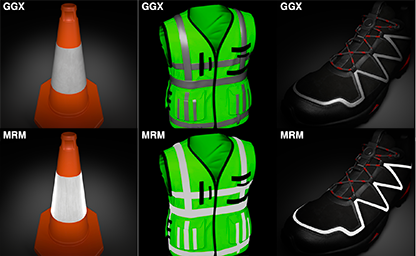

The Minimal Retroreflective Microfacet Model
The new Minimal Retroreflective Microfacet (MRM) model is basically a one-line conceptual change to standard microfacet shading: reflect the view direction about the surface normal before evaluating the BSDF. It builds on the earlier back-vector formulation, so the implementation cost is low compared with designing a separate retroreflection model from scratch.
Why it matters is that the authors prove reciprocity and energy conservation as long as the NDF is reflection-symmetric, which covers the common distributions most engines already use. They also validate the model against measured retroreflective material data, and note that it has already been adopted into OpenPBR and MaterialX, which makes it more than just a paper result for pipeline teams.
“turns any existing microfacet BSDF into a physically plausible retroreflective one by a single substitution”
- what
- The MRM model makes any existing microfacet BSDF retroreflective by replacing the view direction with its reflection about the surface normal.
- who
- Jamie Portsmouth, Matthias Raab, Laurent Belcour, and Francis Liu authored the paper.
- when
- Published in JCGT vol. 16, no. 1, pages 60-75, in 2026.
- impact
- Graphics teams can add physically plausible retroreflection with minimal code changes and reuse existing microfacet infrastructure.
Useful, low-risk improvement with real pipeline adoption
Follow graphics updates
See relevant stories in your personalized news feed.


Discussion