
Flexible particle system - The Container
One of the most crucial part of a particle system is the container for all particles. It has to hold all the data that describe particles, it should be easy to extend and fast enough. In this post I will write about choices, problems and possible solutions for such a container.
The Series
- Introduction
- Particle Container 1 - problems (this post)
- Particle Container 2 - implementation
- Generators & Emitters
- Updaters
- Renderer
- Tools Optimizations
- SIMD Optimizations
- Renderer Optimizations
Introduction
What is wrong with this code? class Particle { public: bool m_alive; Vec4d m_pos; Vec4d m_col; float time; // ... other fields public: // ctors... void update(float deltaTime); void render(); }; and then usage of this class: std::vector<particle> particles; // update function: for (auto &p : particles) p.update(dt); // rendering code: for (auto &p : particles) p.render(); Actually one could say that it is OK. And for some simple cases indeed it is. But let us ask several questions: - Are we OK with SRP principle here?
- What if we would like to add one field to the particle? Or have one particle system with pos/col and other with pos/col/rotations/size? Is our structure capable of such configuration?
- What if we would like to implement a new update method? Should we implement it in some derived class?
- Is the code efficient?
My answers:
- It looks like SRP is violated here. The Particle class is responsible not only for holding the data but also performs updates, generations and rendering. Maybe it would be better to have one configurable class for storing the data, some other systems/modules for its update and another for rendering? I think that this option is much better designed.
- Having the Particle class built that way we are blocked from the possibility to add new properties dynamically. The problem is that we use here an AoS (Array of Structs) pattern rather than SoA (Structure of Arrays). In SoA when you want to have one more particle property you simply create/add a new array.
- As I mentioned in the first point: we are violating SRP so it is better to have a separate system for updates and rendering. For simple particle systems our original solution will work, but when you want some modularity/flexibility/usability then it will not be good.
- There are at least three performance issues with the design:
- AoS pattern might hurt performance.
- In the update code for each particle we have not only the computation code, but also a (virtual) function call. We will not see almost any difference for 100 particles, but when we aim for 100k or more it will be visible for sure.
- The same problem goes for rendering. We cannot render each particle on its own, we need to batch them in a vertex buffer and make as few draw calls as possible.
Add/Remove Particles
It was not visible in the above code, but another important topic for a particle system is an algorithm for adding and killing particles:void kill(particleID) { ?? } void wake(particleID) { ?? } How to do it efficiently? First thing: Particle Pool
It looks like particles need a dynamic data structure - we would like to dynamically add and delete particles. Of course we could use list or std::vector and change it every time, but would that be efficient? Is it good to reallocate memory often (each time we create a particle)? One thing that we can initially assume is that we can allocate one huge buffer that will contain the maximum number of particles. That way we do not need to have memory reallocations all the time.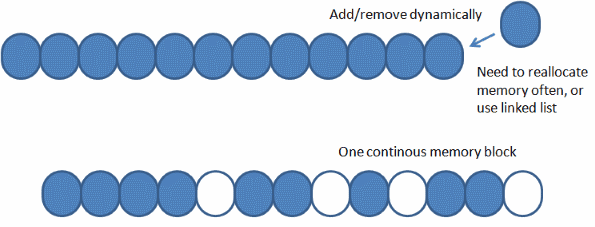
Second thing: Management
We can manage the buffer it at least two ways:- Use an alive flag and in the for loop update/render only active particles.
- this unfortunately causes another problem with rendering because there we need to have a continuous buffer of things to render. We cannot easily check if a particle is alive or not. To solve this we could, for instance, create another buffer and copy alive particles to it every time before rendering.
- Dynamically move killed particles to the end so that the front of the buffer contains only alive particles.
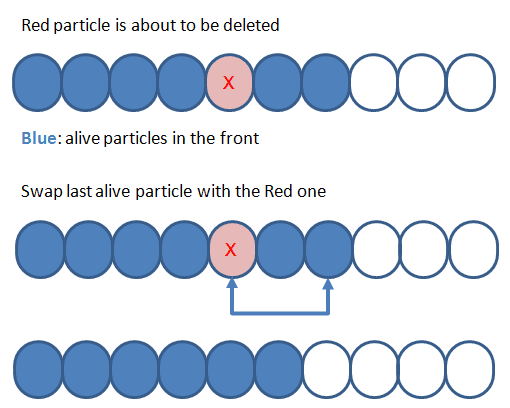
- When we update particles there is no need to check if it is alive. We update only the front of the buffer.
- No need to copy only alive particles to some other buffer
What's Next
In the article I've introduced several problems we can face when designing a particle container. Next time I will show my implementation of the system and how I solved described problems. BTW: do you see any more problems with the design? Please share your opinions in the comments.Links
14 Jun 2014: Initial version, reposted from Code and Graphics blogRelated Tutorials

Procedural Generation of 2D Tile Maps in Games
The article explains how to build a procedural 2D cave map generator using cellular automata. It covers map representat…

Localizing A Game Into French — Which Variant Should You Choose?
So, you’re making an awesome indie game, and now you’re thinking about localizing it into French? Great idea! There ar…
 Level Up Translation

How Long Does It Take To Localize An Indie Game?
So you’re planning on localizing your indie game, but you’re not sure how much time to schedule in. While the timing o…
Level Up Translation

Creating game videos: best practices and pitfalls to avoid
Game video production: practical tips on how to create a game trailer or teaser that you can be proud of. Give your aud…
 Alconost

Adopting CI/CD: How Midwinter Entertainment iterates at speed with the help of IMS
Game development was once like one long sprint: a huge effort until you reached the finish line — at which point you co…
 GameDev.net

5 Things to Consider When Making a Video to Promote Your App or Game
How can you show an app or game in your video in a way that attracts new users? Let’s take a look at what to go by when…
Alconost
Discussion
More from Bartlomiej Filipek
Custom Deleters for C++ Smart Pointers
We all know that smart pointers are really nice things and we should be using them instead of raw new and delete. But w…
Persistent Mapped Buffers in OpenGL
OpenGL (since version 4.4) gives us a new technique to efficiently move data from CPU to GPU. It's called persistent ma…
Introduction to Software Optimization
Takes you through the process and goes over the various techniques to optimizing your code
Discussion