Original Post

Hi, I'm drawing glowing particles with additive blending. Suppose you blend many red particles with R = 1, G = 0, B = 0 over each other: 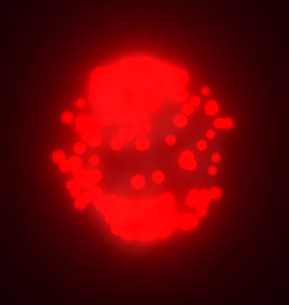 Note that the particles are _only_ red, no matter how bright the particles are. But when the particles are yellow (R = 1, G = 0.5, B = 0.1) the color becomes white. Of course it does, because we're doing additive blending.
 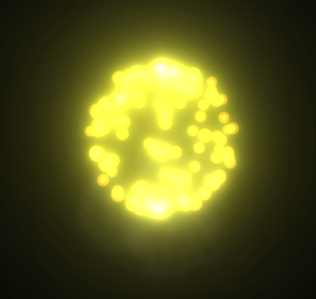 As I understand it, Red/Green/Blue is just an arbitrary construct that allows us to recreate most colors. With additive blending, some light colors (yellow) add up to white, but other colors (red) do not. That sounds wrong. Is that how light works in reality?
Note that the particles are _only_ red, no matter how bright the particles are. But when the particles are yellow (R = 1, G = 0.5, B = 0.1) the color becomes white. Of course it does, because we're doing additive blending. As I understand it, Red/Green/Blue is just an arbitrary construct that allows us to recreate most colors. With additive blending, some light colors (yellow) add up to white, but other colors (red) do not. That sounds wrong. Is that how light works in reality?