GameDev.net gamedev.net
Research Paper

This is an academic paper or technical research. Key findings may require technical background to fully understand.

Explore Research Radar

PRO Tired of ads? Read GameDev.net ad-free and help keep the community independent with GameDev Pro — $3/month.

Journal of Computer Graphics Techniques
Journal of Computer Graphics Techniques Research
· 1 month, 3 weeks ago

Equal-Area and Quasi-Conformal Mappings between Squares, Discs and Fernández-Guasti Squircles

Briefing

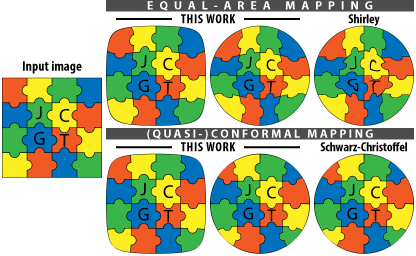
A new family of 2D mappings tackles one of graphics’ old shape-conversion problems: moving cleanly between squares, discs, and Fernández-Guasti squircles. The key change is that these mappings drop the usual radial constraint and instead use carefully chosen polar-angle behavior, letting them prioritize either exact area preservation or near-angle preservation.

For developers, the practical appeal is in the tradeoff space. The equal-area versions are mathematically expensive, relying on transcendental equations and incomplete elliptic functions, but they preserve shape much better along diagonals and reduce central angle distortion by roughly 1000x compared with Shirley mapping. On a modern laptop, a 1000 x 1000 image still finishes in under 2 seconds, though the method is 11–17x slower than Shirley’s.

The quasi-conformal versions are more immediately usable in production-style code. They use only elementary real-valued functions, and one tuned variant averages under 0.8 degrees of angle distortion while looking nearly identical to a true Schwarz-Christoffel transform. That version also runs up to 12% faster, which makes it interesting for real-time or batch warping pipelines where quality matters but full conformal math is too costly.

There’s also a broader animation angle here: by chaining square-to-disc and disc-to-square transforms, the same approach can morph between any two squareness values, or even create tunable warps by intentionally mismatching parameters on the forward and reverse passes. C++ and Octave implementations are available, so teams experimenting...

“average angle distortion below 0.8 degrees”

— Bjorn Vermeersch · Describing the tuned quasi-conformal mapping
At a glance
what
New equal-area and quasi-conformal mappings convert between squares, discs, and Fernández-Guasti squircles.
who
Bjorn Vermeersch; C++ and Octave implementations are provided as supplementary material.
when
Published in JCGT vol. 16, no. 2, 2026.
impact
Offers better control over area and angle distortion for image warping, morphs, and projection-style effects.
Signal Positive

Useful new warp options with strong quality/perf tradeoffs

Discuss

Follow graphics updates

See relevant stories in your personalized news feed.

Sign in to follow

Continue on GameDev.net

Useful next steps related to this story.

Game development news without the noise

One useful weekly briefing. No daily flood.

Sending your confirmation email…

Discussion

Loading comments...

Recommended resources

Graphics Programming Resources

See full guide
Real-Time Rendering, Fourth Edition cover
Editor pick Community pick

Real-Time Rendering, Fourth Edition

Amazon · Book

Real-Time Rendering combines fundamental principles with guidance on the latest techniques to provide a complete reference on three-dimensional interactive computer graphics. It will help you increase speed and improve image quality and learn the features and limitations of acceleration algorithms and graphics APIs. This latest fourth edition has been updated to include a chapter on virtual reality and augmented reality and covers new topics such as visual appearance, global illumination, and curves and curved surfaces. It is for anyone serious about computer graphics who wants to learn about algorithms that create synthetic images fast enough that the viewer can interact with a virtual environment.

GameDev.net may earn a commission if you purchase through these links. This helps fund the site at no extra cost to you.

Programming with wgpu in Rust cover
Editor pick

Programming with wgpu in Rust

Amazon · Book

Unlock the full power of modern graphics programming with wgpu and Rust. This comprehensive guide takes you from foundational GPU concepts to advanced real-time rendering and compute techniques—equipping you to build fast, safe, and cross-platform graphics applications. Written for intermediate to advanced Rust developers, this book provides clear explanations, hands-on examples, and detailed insights into how GPUs process and render data. You’ll explore everything from the fundamentals of buffers, shaders, and pipelines to advanced topics like deferred rendering, shadow mapping, and GPU compute workloads.

GameDev.net may earn a commission if you purchase through these links. This helps fund the site at no extra cost to you.

GameDev.net may earn a commission if you purchase through these links. This helps fund the site at no extra cost to you.