
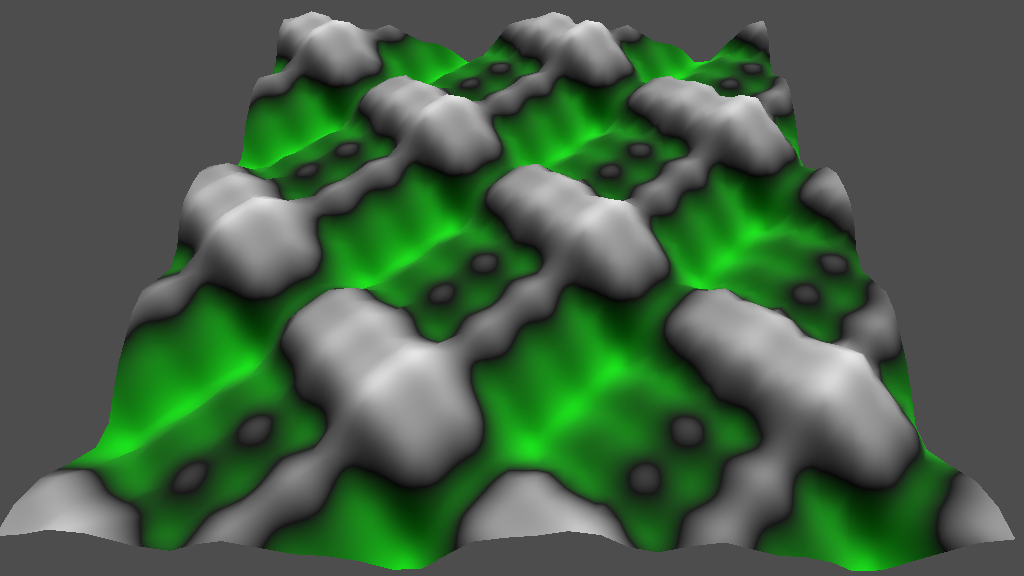
Animating Octaves - Procedural GPU Patterns
Procedural noise often gets tuned for spatial detail and then falls apart once it starts animating. Here, time is incorporated uniformly into the hash, effectively treating it like a third spatial axis and sliding a 2D slice through the pattern. That makes all hashes in an octave update together instead of drifting independently.
The catch is temporal lacunarity. With the second octave changing twice as fast as the first, the animation develops a clear pulse: a large change when both octaves update, then a smaller change when only the faster octave moves, then another large change. The result is not subtle motion but an obvious rhythmic beat.
For developers building GPU-driven materials or VFX, this is a useful reminder that animated noise needs to be evaluated in motion, not just in a still frame. A pattern that looks nicely layered at rest can reveal repeating temporal structure once it is used for flicker, erosion, cloud motion, or surface breakup.
The practical takeaway is that octave timing and hash design are as important as spatial frequency. If the goal is organic motion, the animation scheme needs to avoid synchronized updates that telegraph the underlying octave structure.
- what
- Time is folded into the hash as a third dimension, making all hashes in an octave change together.
- what
- Temporal lacunarity is set to 2, so the second octave animates twice as fast as the first.
- impact
- The combined motion produces an obvious pulsing pattern instead of smooth organic animation.
- context
- This is relevant to procedural GPU noise used in materials, VFX, and other animated surface effects.
Technical note on a visible artifact, not a product launch
Follow ai updates
See relevant stories in your personalized news feed.
Discussion