
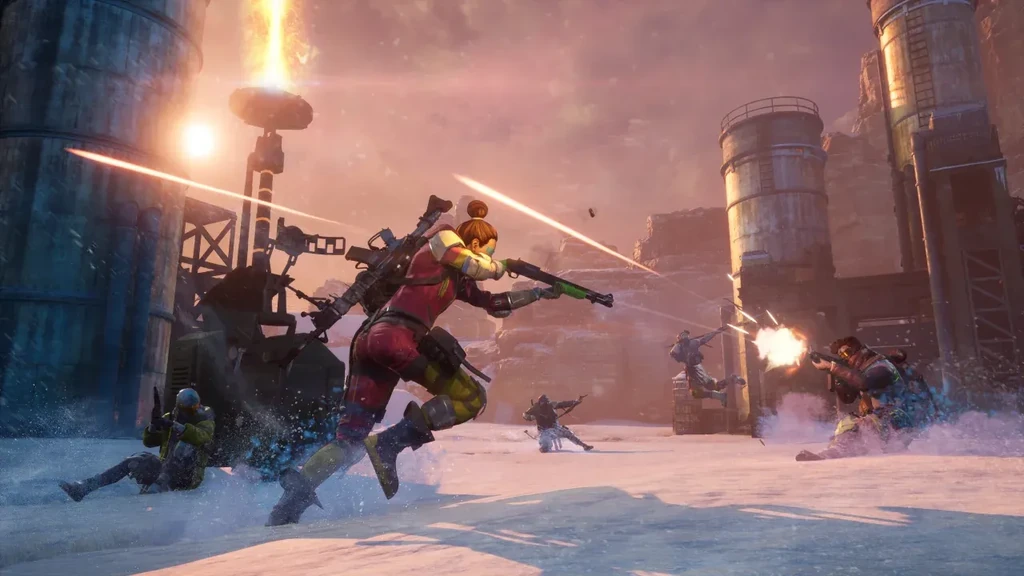
How Experimenting with Scale and Simulation Helped Midwinter Entertainment Find Fun with Scavengers
For game designers, ‘finding the fun’ is a serious undertaking. In a competitive market, more fun equals more players, equals a thriving and happy community. The question is: how do you create a retentive, rewarding experience that gamers connect with and come back to, over and over again?

Technical constraints can inhibit design, or force innovation
Of course, ambitious game designs require corresponding support from the backend tech, which can pose an added challenge for small studios with limited resources. Co-founder of Midwinter Entertainment Josh Holmes admits, when it comes to multiplayer games, simulating complex worlds “can put a lot of strain on the server that you’re utilising.” But building in-house solutions to push or exceed server limits is technically difficult, making it risky as well as expensive.
What makes a game fun is up to the players
There are a whole host of theories on how to make a fun game. “The development approach that I favour,” says Josh, “is one where you get ideas stood up as early as possible in a playable form, put them in front of players and learn through observation, through data, and through feedback how to improve that experience – and so having that ability to iterate is really, really key.”
The vision for Scavengers, he explains, is “a sandbox survival shooter that allows players to go on endless competitive adventures.” Midwinter Entertainment set out to create an alternative to the standard shooter that indexes towards mechanical skill as the key definer of how likely you are to win.
“We wanted to offer different skills that would play a really important role – so preparation, strategy, adaptation, collaboration.” Bringing these other skills to the fore meant creating “this very dynamic world that is causing players to constantly adapt on the fly,” says Josh. To do that, they introduced richly layered threats and dynamic elements that challenge players throughout their sessions.
Scavengers development was influenced by experiences with Halo’s Warzone
Several of the Midwinter Entertainment team – Josh included – had attempted something comparable in 2015 with Halo 5’s 24-player multiplayer mode, Warzone. “What we learned through that experience is just how complex it can be to try to balance the level of simulation that’s possible within a single game server,” Josh recounts. Back then, it meant making some compromises.
If they were to avoid doing the same this time, they faced two huge challenges with Scavengers. The first was creating a complex, AI-heavy world combining player-versus-environment with player-versus-player, where 60 players working in teams of three are joined by a total of 300 active non-player characters (NPCs). The second was getting the game playable as early as possible in order to gather feedback and iterate.
So, how did a small studio like Midwinter Entertainment achieve such technical prowess?
Increasing scale helped Midwinter Entertainment find the right balance
In the first instance, leveraging SpatialOS from Improbable Multiplayer Services (IMS) allowed the team to exceed the limits inherent to single-server architecture by offloading AI onto a second server. Because the various elements aren’t competing for resources, they can have hundreds of active AI at any given time, alongside a large-scale, dynamic world and a high player count. According to Josh, being able to experiment with scale led them “to discover some of the things that are most fun in the game today.”
In the second instance, using SpatialOS in combination with the IMS playtest hub meant Midwinter Entertainment could put a large-scale representation of the Scavengers experience in front of gamers from an early stage, in order to observe player behaviour, gather data, and collect feedback that would inform the game’s development.
“Any time you’re doing something that isn’t just taking an established pattern that already exists in the market, you’re on a search – you’re trying to discover what is fun,” says Josh. “Finding the fun is half the job of any game developer. And so getting the game stood up, iterating with players as part of that development process, I believe, is the key to discovering fun.”
IMS helps unlock your design ambitions
As a networking engine that gives you easier access to more compute – and comes with the added benefit of specialist tech support from game developers who understand the challenges of building large-scale game worlds – SpatialOS “solves a lot of the complexity of the networking problem, but it also gives you that scalability so you’re not committed to a particular set of constraints that may be true at the beginning of your conceptualisation and prototyping of an experience,” says Josh.
Stay in touch
Want insider insights on multiplayer development, straight to your inbox? Subscribe for updates
Related Tutorials

Procedural Generation of 2D Tile Maps in Games
The article explains how to build a procedural 2D cave map generator using cellular automata. It covers map representat…

Localizing A Game Into French — Which Variant Should You Choose?
So, you’re making an awesome indie game, and now you’re thinking about localizing it into French? Great idea! There ar…
 Level Up Translation

How Long Does It Take To Localize An Indie Game?
So you’re planning on localizing your indie game, but you’re not sure how much time to schedule in. While the timing o…
Level Up Translation

Creating game videos: best practices and pitfalls to avoid
Game video production: practical tips on how to create a game trailer or teaser that you can be proud of. Give your aud…
 Alconost

Adopting CI/CD: How Midwinter Entertainment iterates at speed with the help of IMS
Game development was once like one long sprint: a huge effort until you reached the finish line — at which point you co…
GameDev.net

5 Things to Consider When Making a Video to Promote Your App or Game
How can you show an app or game in your video in a way that attracts new users? Let’s take a look at what to go by when…
Alconost
Discussion
More from GameDev.net
New World Interactive: How IMS Game Server Operations Help Enable Greater Cost Management
Discover how New World Interactive migrated to Improbable Multiplayer Services and cut their monthly recurring server o…
GameDev.net
How to update your game without impacting player experience (or revenue)
How much is a minute worth? What about thirty? When it comes to free-to-play titles that rely on micro-transactions and…
GameDev.net
Adopting CI/CD: How Midwinter Entertainment iterates at speed with the help of IMS
Game development was once like one long sprint: a huge effort until you reached the finish line — at which point you co…
GameDev.net
Discussion